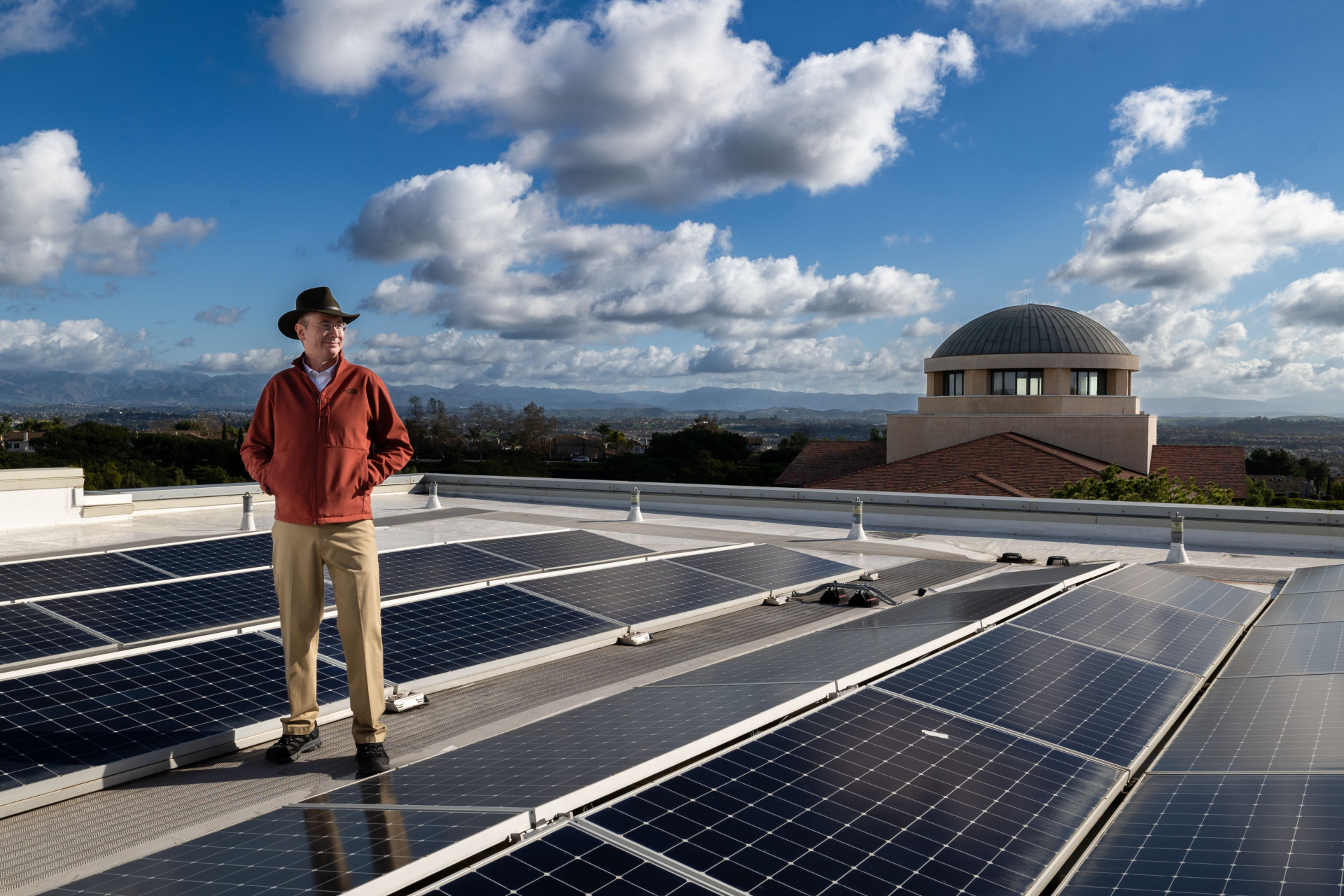
George Busenberg, associate professor of environmental management and policy, observes the solar panels on the roof of Marie and Pierre Curie Hall.
February 13, 2026
3 Min Read
Powering the Renewable Energy Transition: George Busenberg Examines Global Solar Policy
“Renewable energy gives us the opportunity for a new global industrial revolution,” said George Busenberg, associate professor of environmental management and policy in the Environmental Studies Concentration at SUA. But in order for these energy technologies to be deployed at scale, he explained, government policies must be in place to support them.
Busenberg’s new paper, “The Policy Evolution of Solar Energy,” offers important insights on how policy can drive long-term investments in solar power. Published in the inaugural issue of Occasional Papers, a joint initiative of the Soka Institute for Global Solutions and the Office of Academic Affairs, the paper is the first in a planned series on the policy history of alternative energy. In future installments of this series, Busenberg will examine wind power and hydropower.
“The overall purpose of the series is to ensure that the essential lessons of energy history are widely available to inform future energy policy decisions,” he said.
Occasional Papers is the ideal publication venue for this scholarship — and not only because the research topic closely aligns with the mission of the Soka Institute for Global Solutions and its focus on sustainability. This open-access digital publication makes new research widely available to global audiences and facilitates impact far beyond the academic community.
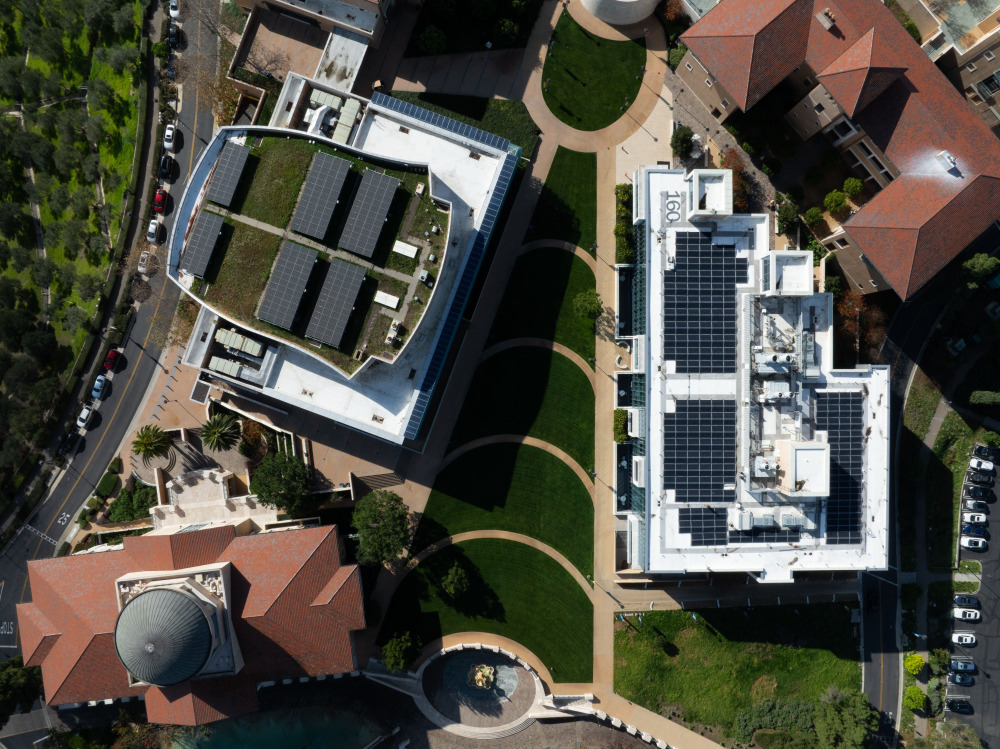
In an aerial view of SUA’s campus, solar panels are visible on the roofs of the Soka Performing Arts Center (left) and Marie and Pierre Curie Hall (right).
In clear and concise language that makes the paper accessible to laypeople and experts alike, Busenberg traces the policy history of solar power, from the first practical application of solar technology on a U.S. satellite in 1958 to the low-cost and modular solar photovoltaic systems currently in use around the world. The paper elucidates the major motivations behind pro-solar policy — including energy security as well as the mitigation of climate change and air pollution — and analyzes key energy policies in China, Germany, Japan, and the United States.
“Solar energy is now a competitor in the energy space and has momentum on a global scale,” Busenberg said.
Technological advancements in solar power and battery storage have drastically reduced the cost of solar energy systems, making them a practical and economically viable choice for many countries. And while the extensive use of land that solar energy requires can raise site conflicts, innovations like elevated solar canopies can help address some of these challenges.
“Solar is particularly helpful in low-income and remote communities that may be far from the grid,” Busenberg said. Agrivoltaic systems, for example, enable animal grazing and the cultivation of shade crops under solar canopies.
Busenberg’s thorough study of solar policy history, together with the forthcoming papers in his renewable energy series, represents a critical effort to “share energy information for global progress, and to do so in a clear manner that is accessible to people who don’t have energy expertise,” he said. “The energy endeavor is so vast that it requires the involvement of people who are not technical experts. Because these projects are expensive and involve siting considerations, public and political support matter.”
The Campus Green was buzzing on Sept. 23 as students, faculty, and staff gathered for SUA’s annual Welcome Back Community Event, an afternoon of food, games, and friendly competition to kick off the n...
Soka University of America has named this year’s top scholars — recipients of the Ikeda Scholarship, the John D. Montgomery Scholarship, the Soka Merit Award, and the Academic Excellence awards. Presi...
“If you believe in global citizenship education,” said eminent education scholar Carlos Alberto Torres during his lecture after receiving the 2026 Soka Global Citizen Award, “find a social movement an...
Team practices may have paused over the summer, but for SUA student-athletes, the season offered a different kind of training ground. High jumper Mili Fukada ’28 interned at U.S. Bank and taught balle...
When local residents Steve and Carol Theiss signed up for a community gardening program on SUA’s campus this summer, they expected to learn about growing organic produce and pick up a few tips for eco...
Nearly five decades apart, two institutions of higher learning were founded on a shared conviction — that education can help move the world toward peace and intercultural understanding.The Monterey In...
Dear Soka Community,I'm writing today to share a significant expansion of the Soka Opportunity Plan, made possible in part by the strength of our donor community.Beginning with the 2027–2028 academic ...
Dear Soka Community,After completing our negotiations with Middlebury College, I am pleased to announce that Soka University of America will establish a second campus in Monterey, California, continui...
Soka University of America (SUA) has named Carlos Alberto Torres the recipient of the 2026 Soka Global Citizen Award in recognition of his lifelong contributions to the intellectual foundations of glo...
“There is a beautiful lesson from nature that we can draw from,” said Mirian Vilela, executive director of Earth Charter International and recipient of the 2024 Soka Global Citizen Award, addressing 1...
"The world is not healed by cynicism,” said SUA Board of Trustees member Andrea Bartoli, addressing a packed house in Milbank Chapel at Teachers College, Columbia University, on June 13. “The world is...
In a region shaped by war, colonialism, and contested memory, what does genuine reconciliation require?The Soka Institute for Global Solutions (SIGS) continued exploring this question at the third and...
The Campus Green was buzzing on Sept. 23 as students, faculty, and staff gathered for SUA’s annual Welcome Back Community Event, an afternoon of food, games, and friendly competition to kick off the n...
Soka University of America has named this year’s top scholars — recipients of the Ikeda Scholarship, the John D. Montgomery Scholarship, the Soka Merit Award, and the Academic Excellence awards. Presi...
“If you believe in global citizenship education,” said eminent education scholar Carlos Alberto Torres during his lecture after receiving the 2026 Soka Global Citizen Award, “find a social movement an...
Team practices may have paused over the summer, but for SUA student-athletes, the season offered a different kind of training ground. High jumper Mili Fukada ’28 interned at U.S. Bank and taught balle...
When local residents Steve and Carol Theiss signed up for a community gardening program on SUA’s campus this summer, they expected to learn about growing organic produce and pick up a few tips for eco...
Nearly five decades apart, two institutions of higher learning were founded on a shared conviction — that education can help move the world toward peace and intercultural understanding.The Monterey In...
Dear Soka Community,I'm writing today to share a significant expansion of the Soka Opportunity Plan, made possible in part by the strength of our donor community.Beginning with the 2027–2028 academic ...
Dear Soka Community,After completing our negotiations with Middlebury College, I am pleased to announce that Soka University of America will establish a second campus in Monterey, California, continui...
Soka University of America (SUA) has named Carlos Alberto Torres the recipient of the 2026 Soka Global Citizen Award in recognition of his lifelong contributions to the intellectual foundations of glo...
“There is a beautiful lesson from nature that we can draw from,” said Mirian Vilela, executive director of Earth Charter International and recipient of the 2024 Soka Global Citizen Award, addressing 1...
"The world is not healed by cynicism,” said SUA Board of Trustees member Andrea Bartoli, addressing a packed house in Milbank Chapel at Teachers College, Columbia University, on June 13. “The world is...
In a region shaped by war, colonialism, and contested memory, what does genuine reconciliation require?The Soka Institute for Global Solutions (SIGS) continued exploring this question at the third and...