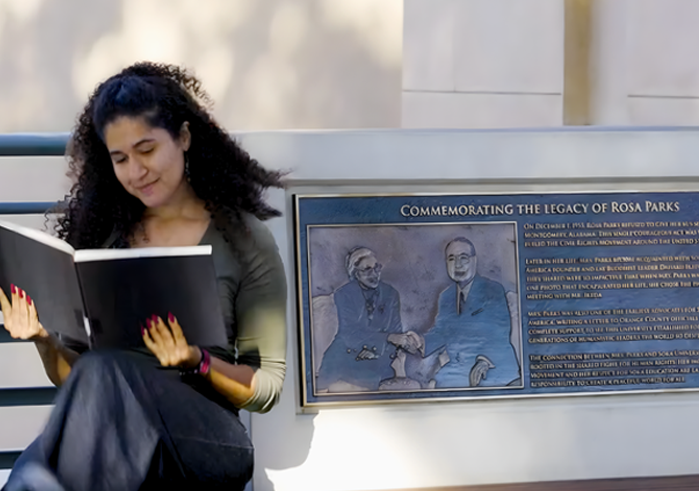
If you take a moment to rest in the shade near the Student Center, you may notice a bench with a cast bronze plaque commemorating something extraordinary: civil rights leader Rosa Parks shaking hands with SUA founder Daisaku Ikeda on January 30, 1993, at SUA’s graduate school campus, then located in Calabasas, California.
On that occasion, Parks and Ikeda had a conversation about racial justice and the challenges facing young people in the United States and Japan. Parks selected a photo of this meeting for her entry in “Talking Pictures,” a 1994 book compiling photos that notable American figures considered important to their lives and work. In her commentary on the photo, Parks said it “reminds us how people of very varied opinions and unique personalities from two different cultures have an opportunity to work together on a mission of world peace.”
Recently, Soka students working in the Office of Strategic Marketing and Communications, the Office of Diversity, Equity, and Inclusion, and the Office of Student Leadership and Service Engagement collaborated on a video highlighting the history of Parks’s connection to SUA and her belief in its mission to foster global citizens. In addition to Parks’s 1993 meeting with Ikeda, the video details her May 1994 visit to Soka Women’s College in Tokyo, where she was moved to tears by the students’ English-language performance of “We Shall Overcome.”
“I hope that learning about Rosa Parks’s connection to Soka University of America helps students realize that they’re part of a much bigger legacy of courage and social responsibility,” said Ruby Nagashima ’06, director of student leadership and service engagement. Together with Maya Gunaseharan, director for diversity initiatives and community building, Nagashima developed the idea for a video that would bring this history to life for the SUA community.
Jun Sawada ’26 of São Paulo, Brazil, took up the project with enthusiasm, writing the script as well as shooting and editing the video. He says learning about Parks’s long career of activism and service, as well as her support for SUA’s vision of fostering leaders of world peace, has led him to reflect on how he will apply his education to continue her legacy after graduation.
“To me, it is about producing films and telling stories that fight against racial inequalities,” Sawada said. “Filmmaking for impact is my way of living a contributive life.”
For Gracyn Ervin ’26, one of the presenters in the video, learning about Parks and her esteem for the Soka community is a call to action to make campus a welcoming space for everybody.
“Her message reminds me,” Ervin said, “that students must work together to make SUA a place where everyone feels accepted and valued, regardless of their identity.”
Ervin, who is from Santa Fe, New Mexico, put these ideas into practice last academic year. In her role at the DEI Office, she organized several events and produced a zine that gave students, faculty, and staff the opportunity to discuss what their mixed race, multicultural identities mean to them.
Sia Tholath ’26 of Mumbai, India, who also narrated the video, sees Parks’s work as a reminder of the ways she and her peers can lead by example, whether that’s through volunteering at the OC Food Bank, participating in beach cleanups, or pitching in at a donation drive to support refugee and immigrant families.
“Rosa Parks’s resilience is a pivotal example for us to learn to use our voices as the youth of this world, especially in trying times like right now,” Tholath said. “I hope people can truly understand the depth of her courage.”
Though Parks is best known for her role in the Montgomery bus boycott in 1955, her activism spanned decades – from investigating sexual violence cases and leading NAACP youth programs in the 1930s to fighting for fair housing in Detroit after death threats forced her from Alabama. In 1987, she co-founded the Rosa and Raymond Parks Institute for Self Development. A firm believer in the power of young people to create lasting change, she brought that conviction to her meetings with Ikeda and Soka students.
Another presenter, Jenna Beaupre ’28 of Los Gatos, California, hopes the video will inspire members of the SUA community to learn about Parks’s contributions across her entire life. “Something I wish more people understood about Rosa Parks is that she wasn’t just a part of the Montgomery bus boycott,” Beaupre said. “She was a lifelong activist who had been organizing and fighting racial injustice long before that moment. Recognizing her full story helps us better understand the sustained and continuous effort behind social change, challenging us to think about what sustained commitment to fighting injustice looks like in our own lives.”