At Teachers College, SUA Marks 30 Years of Ikeda's Vision for Global Citizenship
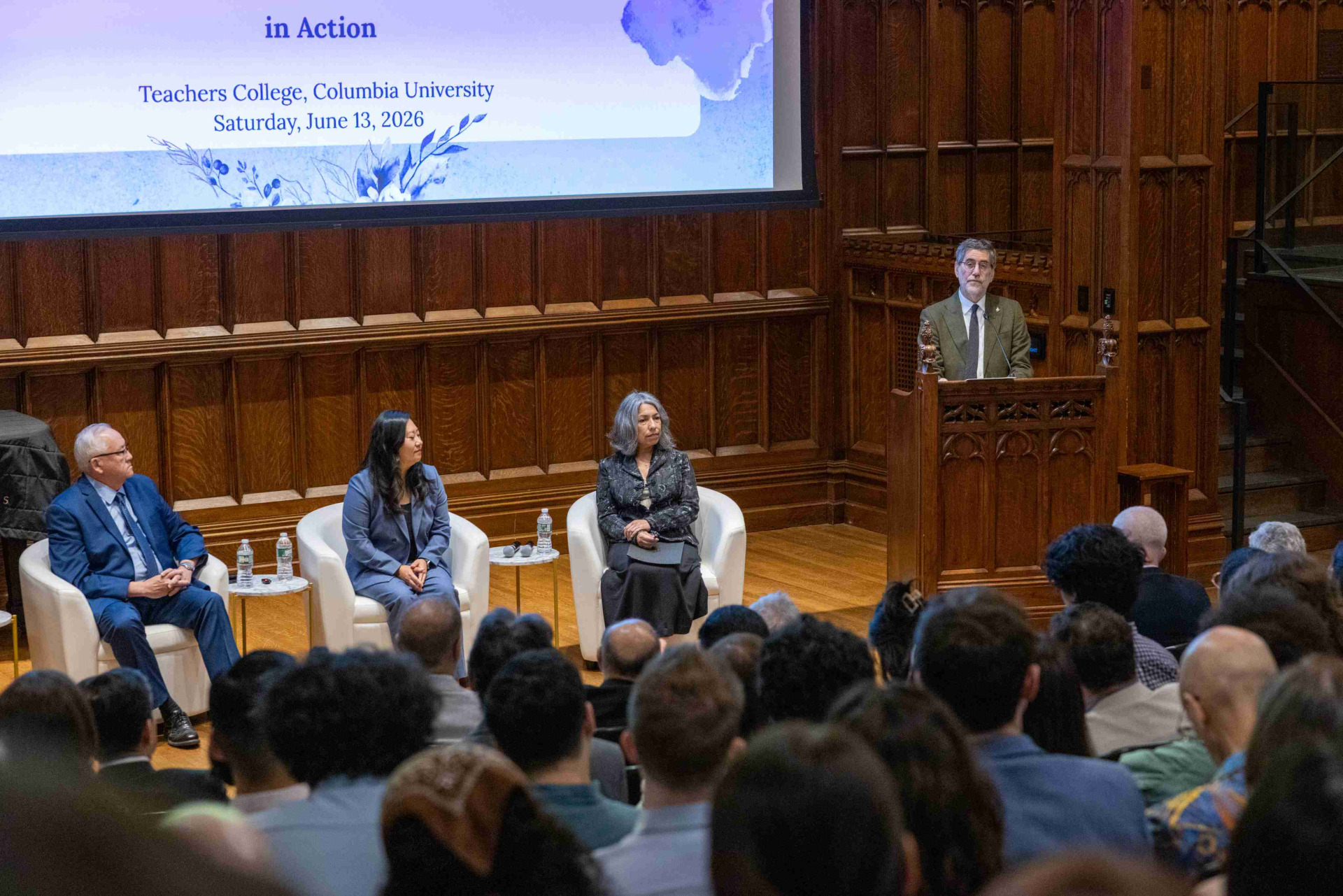
“The world is not healed by cynicism,” said SUA Board of Trustees member Andrea Bartoli, addressing a packed house in Milbank Chapel at Teachers College, Columbia University, on June 13. “The world is not transformed by resignation. The world changes because people are willing to imagine something better, and they dedicate themselves to making it real.”
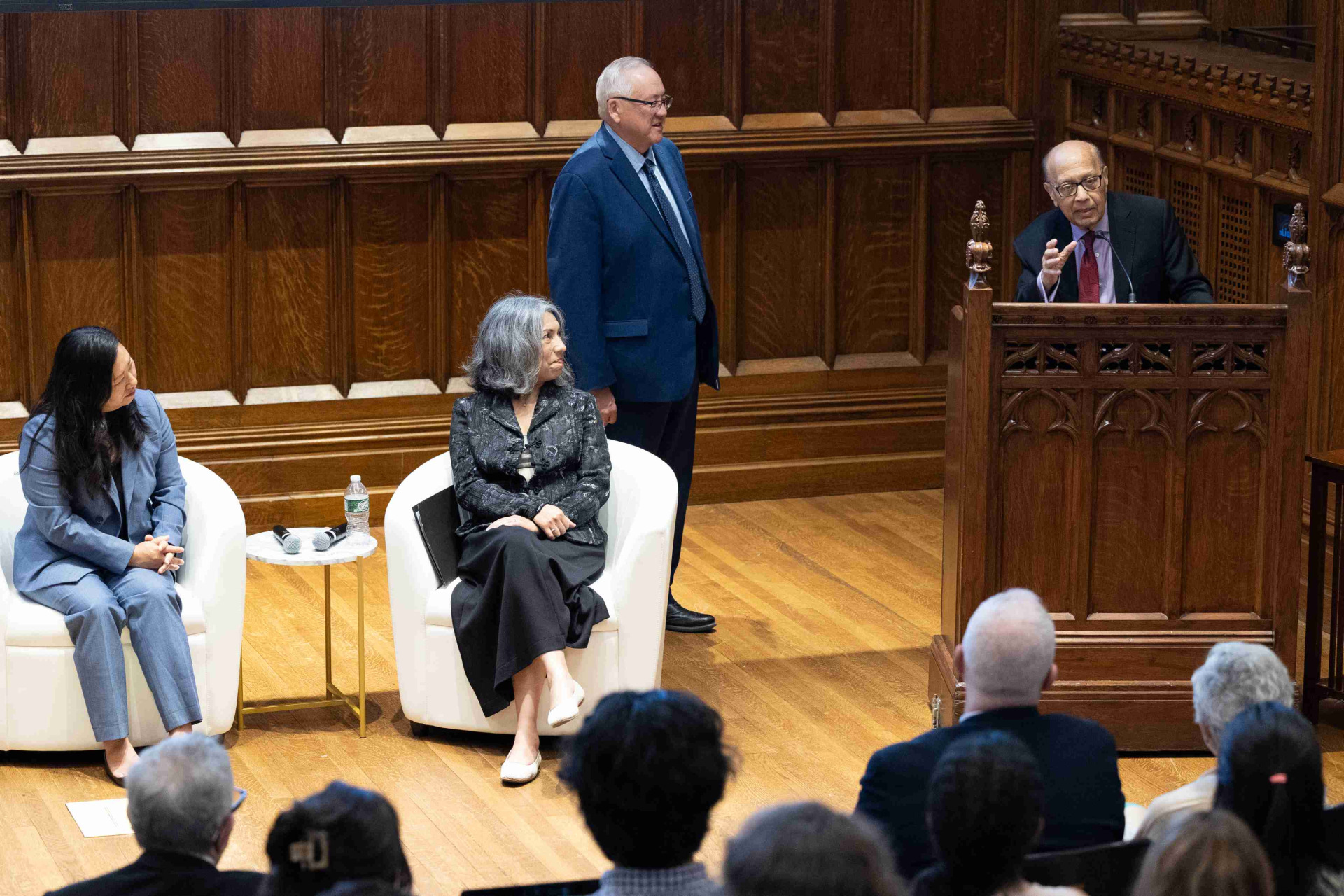
Bartoli, who is also the executive adviser of the Soka Institute for Global Solutions and president of the Sant’Egidio Foundation for Peace and Dialogue, was the first of four panelists who presented at “30 Years of Daisaku Ikeda’s Vision: Wisdom, Courage, and Compassion in Action.” The event commemorated “Thoughts on Education for Global Citizenship,” a speech SUA founder Ikeda delivered in the same room at Teachers College exactly 30 years earlier. In addition to Bartoli, panelists included SUA President Edward M. Feasel; Ruby Nagashima, director of student leadership and service engagement at SUA; and Isabel Nuñez, professor of educational studies, dean of the School of Education at Purdue University Fort Wayne, and SUA Board of Trustees member.
“Ikeda delivered that speech five years before our campus opened in Aliso Viejo,” said President Feasel in an interview prior to the event. “It was not only foundational for SUA — it introduced a paradigm shift for education in general.”
Ikeda’s address at Teachers College has inspired educators worldwide and “remains one of his most referenced and quoted works,” said Jason Goulah, professor and director of the Value-Creating Education for Global Citizenship doctoral program and the Institute for Daisaku Ikeda Studies in Education at DePaul University, and distinguished visiting professor of Daisaku Ikeda studies at SUA.
“Delivered against the backdrop of dynamic geopolitical changes and pressing crises facing humanity and the planet,” Goulah said, “the address advances an approach to education for global citizenship that is clear-eyed and aspirational, practical and philosophical, uniquely Eastern and quintessentially universal.”
In the speech, Ikeda lays out three essential qualities of a global citizen: “the wisdom to perceive the interconnectedness of all life; the courage not to fear or deny difference but to grow from encounters with people of different cultures; and the compassion to maintain an imaginative empathy that extends to those suffering in distant places.”
Significantly, the accessibility of wisdom, courage, and compassion makes global citizenship not a privilege afforded only to those who can travel widely, but a set of values that anyone can embody.
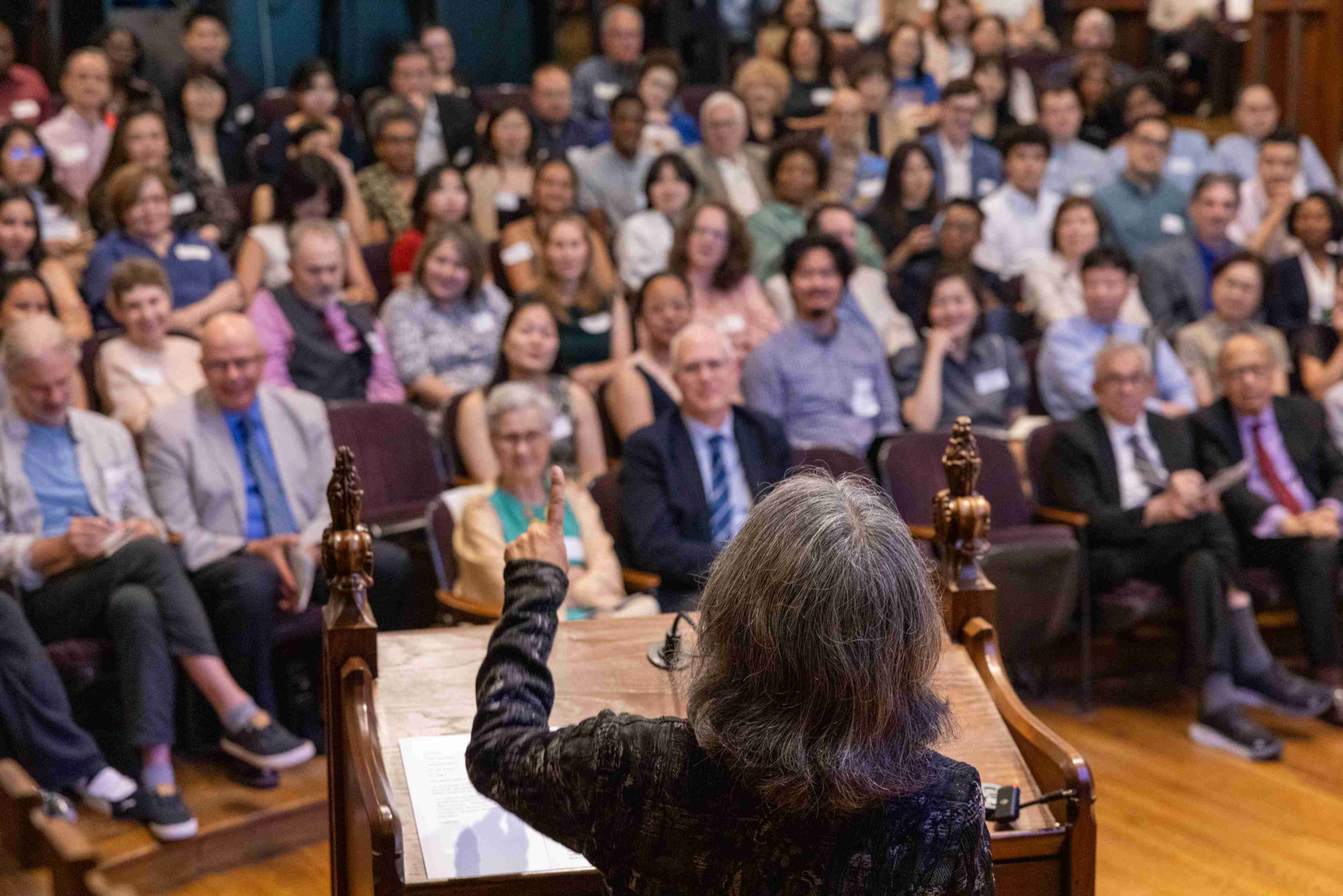
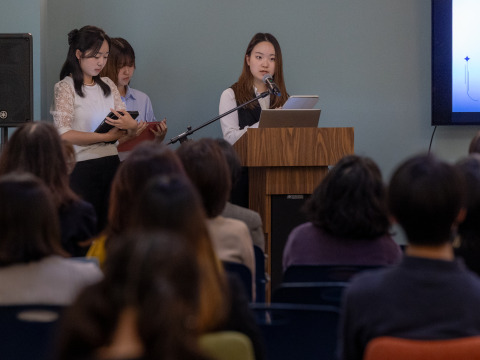
Isabel Nuñez addresses event attendees at Teachers College, Columbia University, on June 13.
From Words to Action: What It Means to Foster Global Citizens
The three essential qualities of global citizenship — and how SUA can continue putting them into practice — formed the basis of Saturday’s panel discussion. Following opening remarks by emcee Marina Inoue ’25 and a screening of a short video excerpt of Ikeda’s original address, Bartoli discussed the enduring power of Ikeda’s vision.
“What struck me most was that the speech was like a conversation,” Bartoli said. “Ikeda was helping two remarkable educators — John Dewey and Tsunesaburo Makiguchi — speak with one another across time and space.” Ikeda drew connections between the way both scholars “imagine human beings capable of acting responsibly in a larger human community,” Bartoli explained.
“For me, that remains a powerful insight from Ikeda’s address,” he said. “Yes, it is possible for human beings to learn from one another across boundaries that appear insurmountable. And yes, it is possible to cultivate a vision of life that is global without becoming abstract, universal without losing sight of individual human beings.”
President Feasel spoke about how students can apply what they learn at SUA to real-world challenges in the four areas of global citizenship education Ikeda laid out in the same 1996 address: peace, human rights, development, and sustainability.
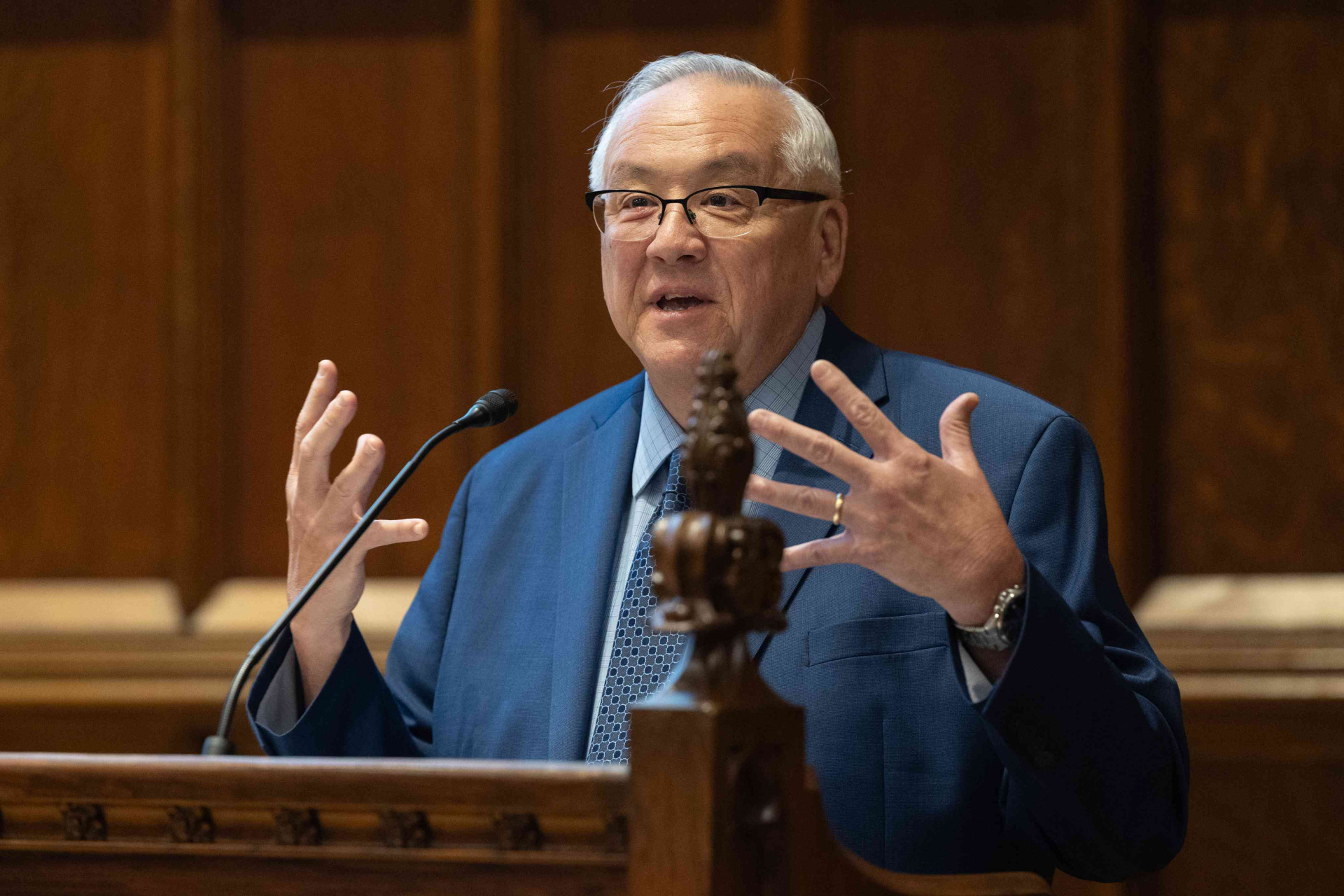
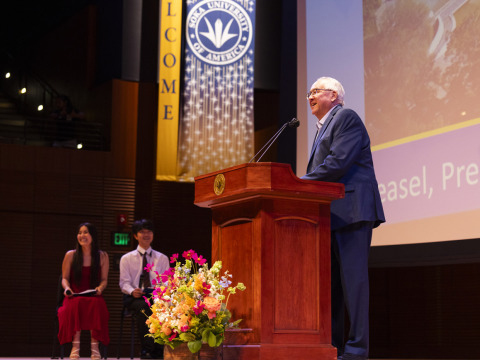
President Edward M. Feasel discusses SUA’s approach to global citizenship education.
“The hallmark of this approach is the Learning Cluster, a small research seminar in which 12 students and one faculty member address a particular issue,” President Feasel said. “At many universities, students don’t have a research seminar like that until they are a junior or senior. We have students take Learning Clusters in their first and second years to encourage an ethos of problem-based inquiry, of trying to solve problems that humanity is confronting.”
He highlighted SUA’s many other initiatives to foster global citizenship through research centers like the Soka Institute for Global Solutions and institutional partnerships with organizations like Earth Charter International. SUA will host 100 young people from 24 countries at the first Earth Charter Youth Summit in July.
Alumna and staff member Nagashima ’06 spoke movingly about her own growth as an SUA student with the support of peers, staff, and faculty. “Looking back, I realized that my education was shaped by an entire community dedicated to fostering human potential,” she said.
She also shared observations from her work leading Alternative Spring Break, a yearlong service-learning program “that invites students to learn with, rather than simply about, communities facing social challenges.” For the past several years, SUA students participating in this program have learned about refugeehood and volunteered directly with refugee families resettling in Southern California — work that she has seen them undertake with dedication and care.
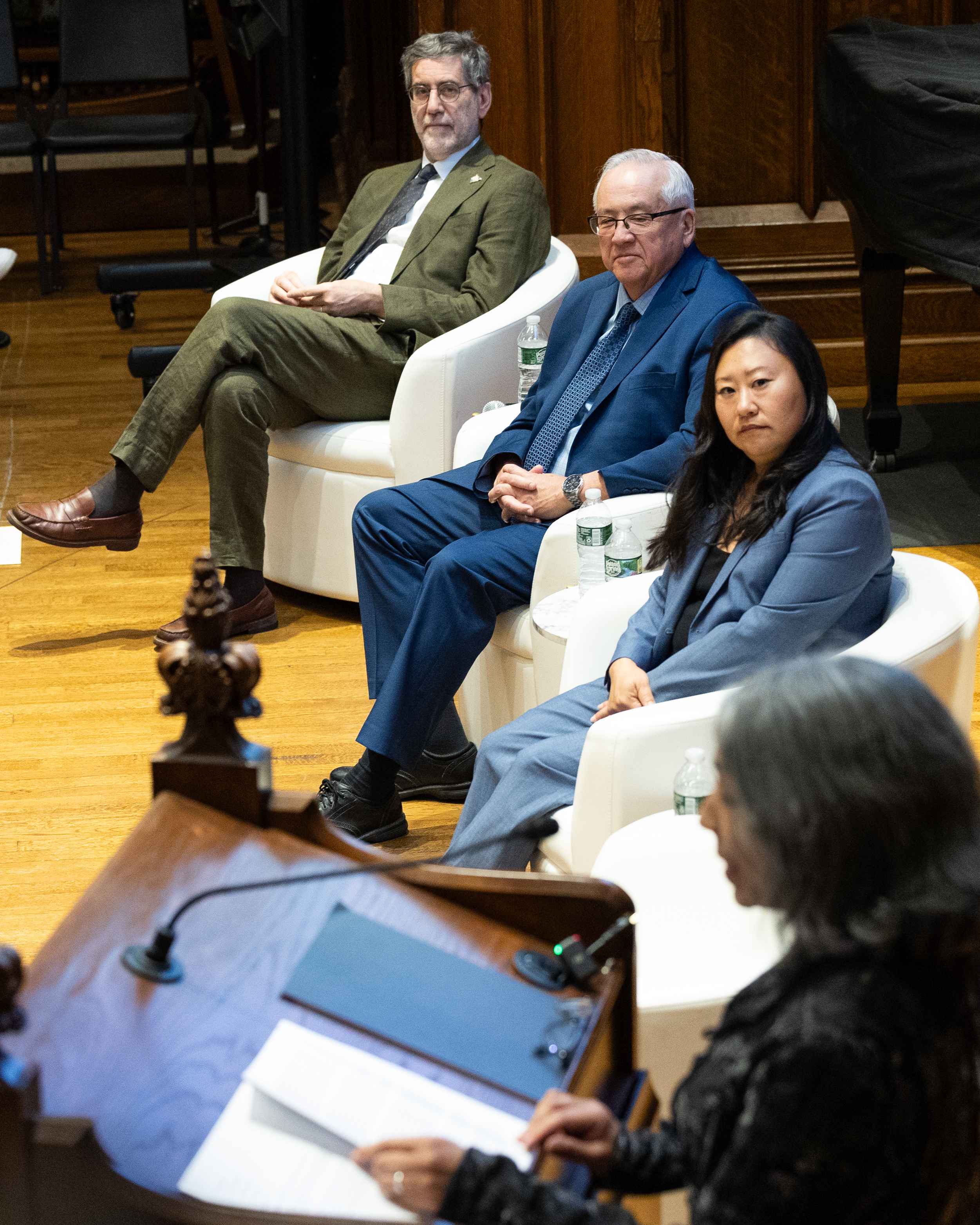
Panelists from left to right: Andrea Bartoli, Edward M. Feasel, Ruby Nagashima, and Isabel Nuñez.
“My students have been some of the greatest teachers in helping me understand what global citizenship looks like in practice,” Nagashima said. “Through quiet moments of human connection, they have convinced me that some of the most meaningful expressions of global citizenship are found not in extraordinary acts, but within the ways we choose to engage with one another each day.”
In her remarks, Nuñez celebrated SUA’s close-knit, internationally diverse community as uniquely suited to cultivating global citizens. In small classes that tackle critical world issues, she said, “students can’t just sit in the back of a large lecture hall and choose not to participate … What becomes crucial, then, is the ability to disagree respectfully. Practicing how to express different views while maintaining respect for others is extremely important.”
She also highlighted the way SUA facilitates the kind of human connections that make compassion possible.
“In his 1996 talk, Ikeda started with his story of his family’s own heartbreaking experience of World War II,” she said. “Stories are how we get to imaginative empathy, as Ikeda modeled by sharing so personally.”
And in a learning environment like SUA, where the student population is fewer than 500 and half of the student body is international, meaningful relationships blossom. At SUA, Nuñez said, “young people from all over the world learn each other’s stories and learn that the lives of those in distant places are just as real as their own.”
Ambassador Anwarul K. Chowdhury delivers remarks after the announcement of a new $20,000 scholarship in his honor.
New Commitments, Enduring Values
The Q&A touched on how to inspire global citizenship outside academia, the role of artists in this work, and how community members can support SUA’s mission.
The program ended with two significant announcements. President Feasel signed a memorandum of understanding with the Ikeda Center for Peace, Learning, and Dialogue. He then announced — to a standing ovation — the establishment of the Ambassador Anwarul K. Chowdhury Scholarship, an annual award of $20,000 for an SUA student. Ambassador Chowdhury, who was present at the event, offered heartfelt remarks expressing his gratitude for the honor. A longtime friend of the university, he served as the undergraduate commencement speaker for SUA’s first graduating class in 2005, taught 10 Learning Clusters at SUA, co-founded an annual campus event for the International Day of Peace with Feasel, and was awarded the first Soka Global Citizen Award in 2021.
As the event concluded, friends and colleagues engaged in warm conversation under the stained-glass windows in Milbank Chapel. For many, the occasion had inspired personal reflection, a renewed commitment to global citizenship, and a hopeful outlook on the future.
As Nagashima said earlier that afternoon: “It is ordinary people choosing day after day to live with wisdom, courage, and compassion that will bring about a new day. And if Soka University of America can continue nurturing that belief in students over the next 30 years, then I believe its greatest contributions are still ahead of us.”
Watch the full recording of the June 13 event below.
Soka University of America has named this year’s top scholars — recipients of the Ikeda Scholarship, the John D. Montgomery Scholarship, the Soka Merit Award, and the Academic Excellence awards. Presi...
“If you believe in global citizenship education,” said eminent education scholar Carlos Alberto Torres during his lecture after receiving the 2026 Soka Global Citizen Award, “find a social movement an...
Team practices may have paused over the summer, but for SUA student-athletes, the season offered a different kind of training ground. High jumper Mili Fukada ’28 interned at U.S. Bank and taught balle...
When local residents Steve and Carol Theiss signed up for a community gardening program on SUA’s campus this summer, they expected to learn about growing organic produce and pick up a few tips for eco...
Nearly five decades apart, two institutions of higher learning were founded on a shared conviction — that education can help move the world toward peace and intercultural understanding.The Monterey In...
Dear Soka Community,I'm writing today to share a significant expansion of the Soka Opportunity Plan, made possible in part by the strength of our donor community.Beginning with the 2027–2028 academic ...
Dear Soka Community,After completing our negotiations with Middlebury College, I am pleased to announce that Soka University of America will establish a second campus in Monterey, California, continui...
Soka University of America (SUA) has named Carlos Alberto Torres the recipient of the 2026 Soka Global Citizen Award in recognition of his lifelong contributions to the intellectual foundations of glo...
“There is a beautiful lesson from nature that we can draw from,” said Mirian Vilela, executive director of Earth Charter International and recipient of the 2024 Soka Global Citizen Award, addressing 1...
In a region shaped by war, colonialism, and contested memory, what does genuine reconciliation require?The Soka Institute for Global Solutions (SIGS) continued exploring this question at the third and...
“Our story starts now,” said Marcos Vinicius Reginaldo de Souza, M.A. ’26, giving voice to the palpable excitement in the room as he addressed his fellow graduates during commencement on May 22.Friend...
On May 2, SUA welcomed students, alumni, faculty, families, and friends back to campus for Homecoming 2026, a celebration of the university's 25th anniversary in Aliso Viejo.The festivities kicked off...
Soka University of America has named this year’s top scholars — recipients of the Ikeda Scholarship, the John D. Montgomery Scholarship, the Soka Merit Award, and the Academic Excellence awards. Presi...
“If you believe in global citizenship education,” said eminent education scholar Carlos Alberto Torres during his lecture after receiving the 2026 Soka Global Citizen Award, “find a social movement an...
Team practices may have paused over the summer, but for SUA student-athletes, the season offered a different kind of training ground. High jumper Mili Fukada ’28 interned at U.S. Bank and taught balle...
When local residents Steve and Carol Theiss signed up for a community gardening program on SUA’s campus this summer, they expected to learn about growing organic produce and pick up a few tips for eco...
Nearly five decades apart, two institutions of higher learning were founded on a shared conviction — that education can help move the world toward peace and intercultural understanding.The Monterey In...
Dear Soka Community,I'm writing today to share a significant expansion of the Soka Opportunity Plan, made possible in part by the strength of our donor community.Beginning with the 2027–2028 academic ...
Dear Soka Community,After completing our negotiations with Middlebury College, I am pleased to announce that Soka University of America will establish a second campus in Monterey, California, continui...
Soka University of America (SUA) has named Carlos Alberto Torres the recipient of the 2026 Soka Global Citizen Award in recognition of his lifelong contributions to the intellectual foundations of glo...
“There is a beautiful lesson from nature that we can draw from,” said Mirian Vilela, executive director of Earth Charter International and recipient of the 2024 Soka Global Citizen Award, addressing 1...
In a region shaped by war, colonialism, and contested memory, what does genuine reconciliation require?The Soka Institute for Global Solutions (SIGS) continued exploring this question at the third and...
“Our story starts now,” said Marcos Vinicius Reginaldo de Souza, M.A. ’26, giving voice to the palpable excitement in the room as he addressed his fellow graduates during commencement on May 22.Friend...
On May 2, SUA welcomed students, alumni, faculty, families, and friends back to campus for Homecoming 2026, a celebration of the university's 25th anniversary in Aliso Viejo.The festivities kicked off...