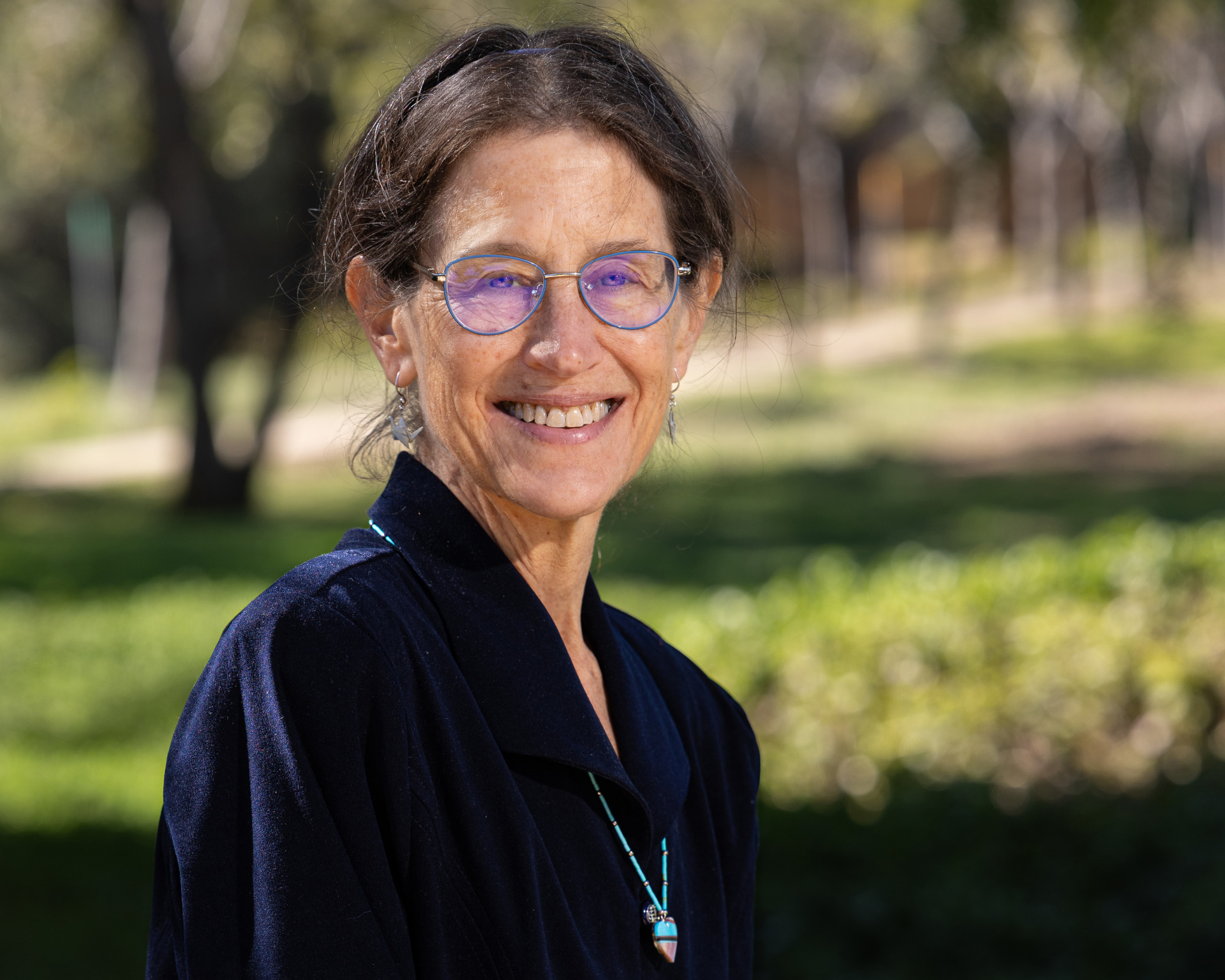
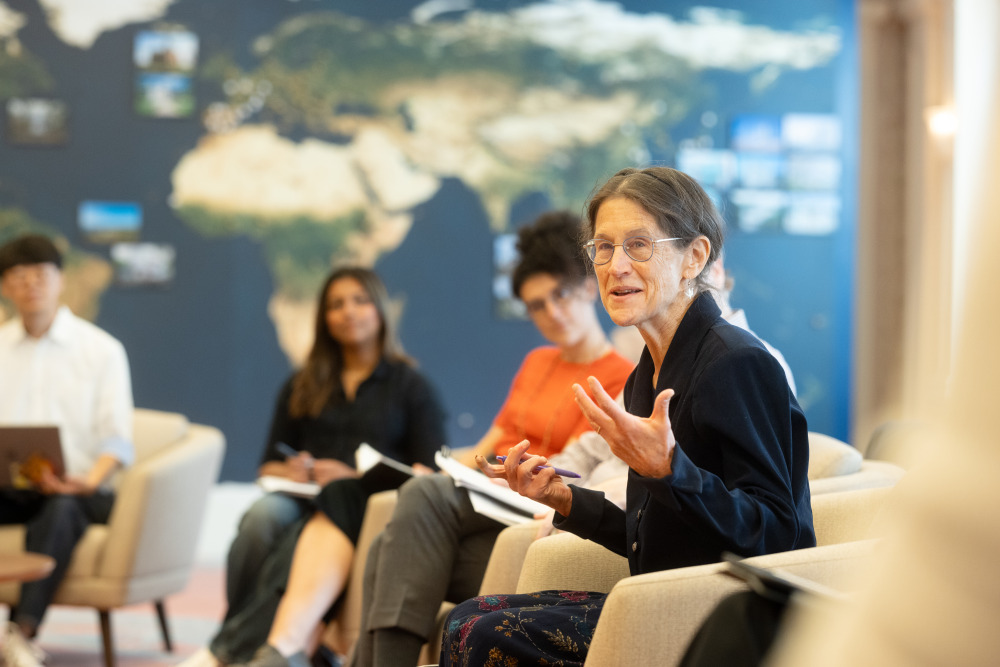
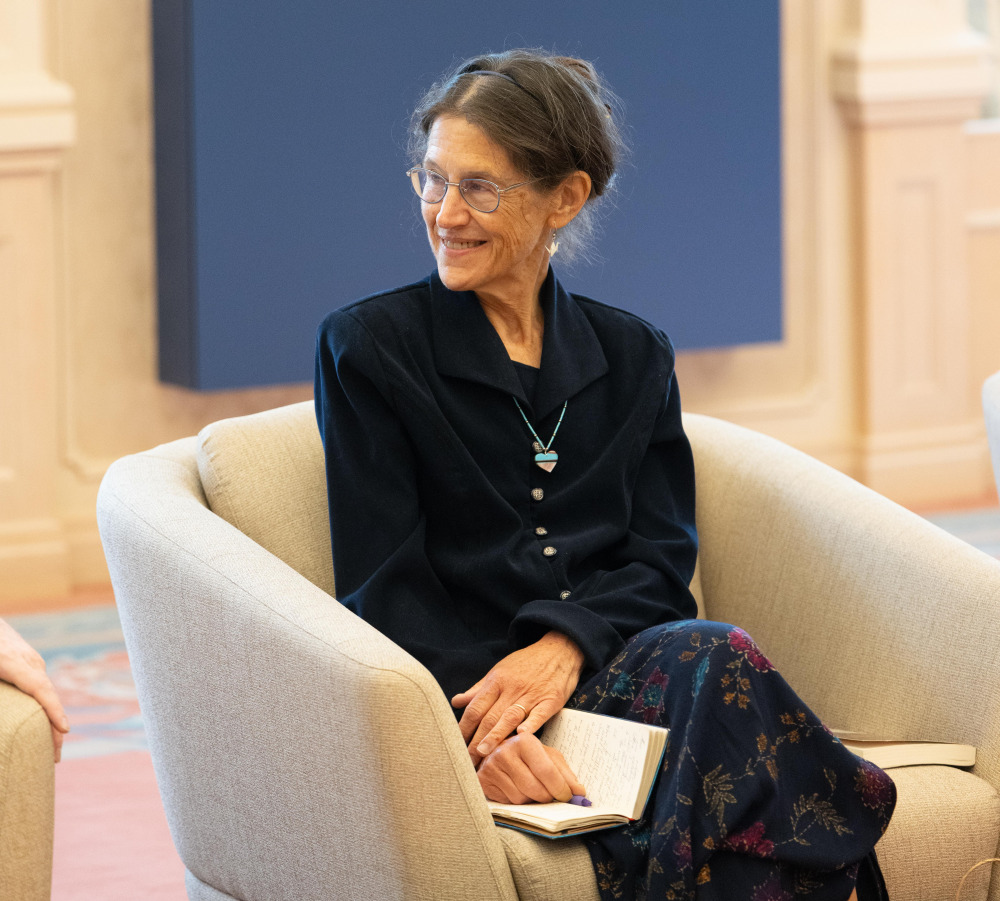
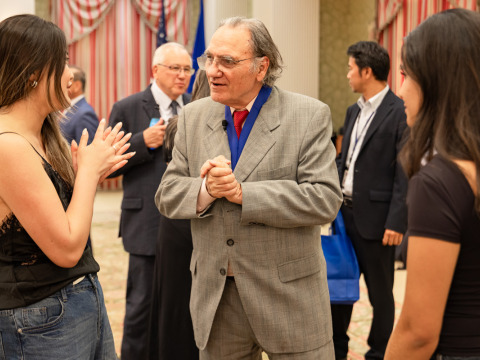
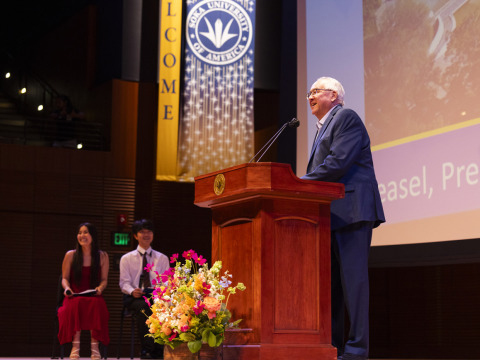
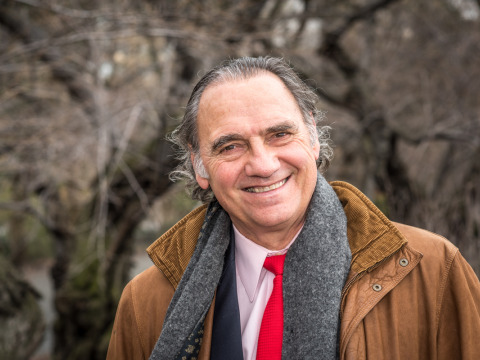
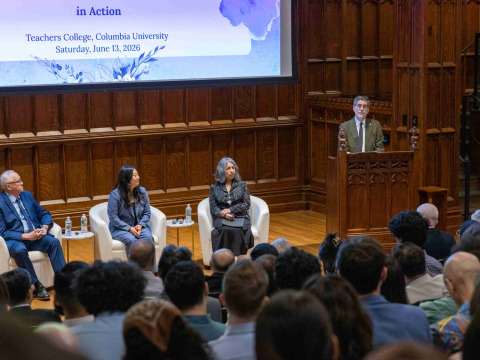
“Be willing to be interrupted,” said Dr. Sarah Ann Wider, emerita professor of English and women, gender, and sexuality studies at Colgate University, addressing the SUA community in Founders Hall on November 4. “Attend to the moment. In every moment, look always for what encouragement can be offered, especially if that moment may be one of interruption, even disruption. What encouragement does this moment call for?”
A scholar of Ralph Waldo Emerson and the Transcendentalist movement, Wider delivered a University Talk titled “Dialogue’s Poetic Heart: Daisaku Ikeda’s Ethos of Encouragement.” Her talk — which she characterized as “an extended, musing meditation” — drew on Transcendentalist literature, contemporary Native American poetry, and “The Art of True Relations,” Wider’s dialogue with SUA founder Daisaku Ikeda.
The tools of dialogue, Wider posited, can uncover intricate connections between disparate topics, places, and moments in time — a concept she demonstrated in the very structure of her presentation, which wove academic expertise with personal reflections and vivid descriptions of evolving landscapes in her hometown of Albuquerque. Her poetic lecture illustrated the creative possibilities that we can cultivate through dialogue, from individual human connections to entire social structures based on generosity and community care.
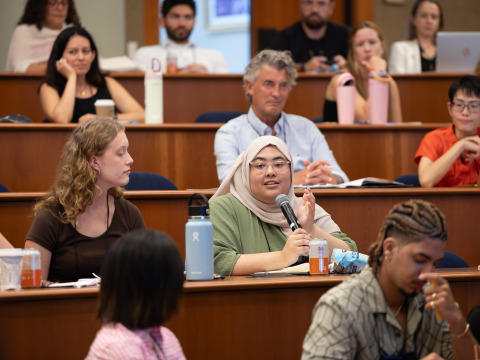
Prior to her talk, she discussed Ikeda’s philosophy with students in a class taught by Jason Goulah, distinguished visiting professor of Ikeda studies.
“The students are as wonderful as I remember them from my last visit to SUA,” she said, noting how impressed she was with Soka students’ level of engagement and commitment to lifelong learning.
In an interview during her campus visit, Wider shared more thoughts on the connections between Transcendentalism and the humanistic values at the heart of SUA’s mission to educate global citizens.
One of the founding principles of SUA is to foster leaders for the creative coexistence of nature and humanity. What do you think we can learn from Transcendentalist thinkers, writers, and artists about what “a creative coexistence with nature” means and what that coexistence might look like?
Henry David Thoreau relished the deeply woven interconnectedness that constituted all existence, and sought to “wake up” his readers so that they too would live within the knowledge of interrelatedness. His lively, detailed descriptions engage all the senses. For example, his words evoke the distinct character of each pond, enabling us to see them individually, not generically, and certainly not as a commodity used for ice, which was how many ponds were exploited in his day.
This was true whether he was writing about rivers, animals, or trees. He would greet certain trees as old friends. In our modern terms, he was “individuating.” He was showing how we can create a relationship with everything in the world around us.
Some of my students would say, “I can’t go talk to a tree.” Well, why not? Don’t have expectations. Just go, be, sit, and observe. Let that be the moment that it is.
Another Transcendentalist I think of is Caroline Sturgis. She closely observed the sky and the clouds, feeling an affinity with their ever-changing forms. She also identified with the ocean and its ever-moving water, contrasting that with her perception of Emerson as a person of mountains and pine. One wasn’t better than the other: it was about understanding things relationally.
Unfortunately, many people today don’t take the time — or don’t even have the opportunity — to be outside, and in that loss, we lose compassion, openness, curiosity. Try to step outside, wherever you are, and feel the air. And if the air quality is not good, take time not only to feel that sorrow, but also to value what is still there.
People often develop a certain understanding of nature that’s abstract or only fits a certain image. But nature is all around us. Even in the most urban areas, there are things that are continuing to grow. So, look for these things. I learned that kind of close attention from the Transcendentalists.
Some students might encounter Emerson, Thoreau, and other Transcendentalists for the first time during their undergraduate career at SUA. Do you have any advice for undergraduates about how to parse Transcendentalist literature, which students may initially find difficult to understand?
Emerson himself called his sentences “infinitely repellent particles” — they were always going all over the place. And he wrote really striking sentences. So I’ve often said to students, “Just see what strikes you as you’re reading.”
Emerson also talked about reading for what he called “the lustres.” A sentence that sparkles to you is not going to be the same one that sparkles to another reader. If you find a sentence that’s radiant to you, stop there and savor it.
I also try to help students get away from the idea that they have to “understand the argument” when something is written in essay form. These are not thesis-driven essays. They’re based on observations and reflection, grounded in moments that are designed to speak differently to different individuals.
Emerson distrusted the familiarly sequential forms of writing because he didn’t want people to repeat what he had said. Rather, he sought to free readers from rote, lockstep repetition, and he instead encouraged what he called “creative reading.”
Turning to Thoreau, he gives us richly detailed descriptions that may be challenging for today’s readers. We are so conditioned by the few — if any — words that are associated with texting and memes. Even in his day, there were concerns that humans were oblivious to their surroundings, substituting cliches and unquestioned assumptions for direct experience. His detailed descriptions record the three-dimensional world in which he lived each moment. Granted, the plants he described or the animals he saw might not be anything like those that students see at SUA or that they know from their hometowns, but I would love for students to ask themselves, “If I had been Thoreau, what plants and animals would I have been writing about?”
Could you explain Emerson’s concept of “self-reliance” and why it is often misunderstood? Do you see a connection between self-reliance and global citizenship?
Emerson’s concept of self-reliance is often misunderstood because it can be conflated with a self-aggrandizing individualism — the idea of “me first.” This is what we would now call “the commodified self,” or the self that arises within a capitalist-driven, consumption-centered society.
But that was the very thing Emerson was pushing back against. Self-involvement was not self-reliance; just the opposite. Fixation on the self diminished an individual to their most limited version. He called that version “personality,” a word he used quite differently than our meaning today. We would say egotism, or even narcissism.
Emerson saw an exquisite structure within the universe. He believed there was a much larger, divine (with a small “d”), fundamentally creative spirit that each of us can crystallize in our own beings. I think Ikeda would have called this “the greater self.” We each have a way of manifesting it — but only if we forego self-aggrandizement.
Emerson reminded his audiences that true self-reliance meant standing strong within principles far greater than any limited human being. He called each person to practice a rigorous honesty with themselves, making certain they did not fall prey to their own desire for fame or popular recognition. That honesty required courage because it often meant standing against an unjust status quo.
I see that as mapping on to global citizenship in interesting ways, especially in the United States, where people often have the notion that this is the greatest country on Earth or that we are “the be all and end all” of human societies. Sadly, much that is dominant within current U.S. society could well be the “end all,” not only of human life, but of the life-sustaining Earth itself.
When I think about “global citizenship,” it centers non-hierarchical relations. It means understanding one’s relationality in complex terms. Yes, we each have a perspective, but it’s only one small perspective. How do we contribute that perspective and say, “This is what I see. What do you see? What are the problems we need to solve? How do we pool our best insights and then build something even more helpful from that?”
What was the inspiration behind your essay in the forthcoming book, “Daisaku Ikeda, Transnationalism, and American Literature: Dialogues of the Heart”? What are some of the main questions or topics that you explore?
Anita Patterson, professor of English at Boston University, came up with the idea of collecting a group of essays in the spirit of Ikedean “dialogues of the heart,” at this moment when we need such dialogues all the more. Last fall, I was thinking about how people get through difficult times. If a person is tortured or imprisoned, what keeps them going? There are stories about the poems Nelson Mandela had internalized so that he not only could survive, but continue his work for a more just and equitable world. And that seems to be common. Those who are imprisoned, tortured, or experiencing the worst at the hands of other human beings survive and persist partly because they carry within their consciousness the words of others who also sought to end oppression, who also strove for a different way of humans being in the world.
I’ve always been interested in Ikeda’s short poems. I had been asked to contribute an essay on Ikeda and Emerson, and I thought, hmmm, Emerson also wrote many short poems. Why did each turn to what was brief, took up little space, but carried such richness of meaning? And what are those short poems saying to us now? That was how it developed — seeing how each of them used the short form to speak directly to particular audiences, conveying thoughts and images that readers could readily carry with them.
I was also fascinated by how these poems could speak to different audiences. But if they’re written with a true spirit of connection — with Emerson’s self-reliance — then they’ll connect very far beyond one person in one situation. The deeply woven interconnectedness of our existences makes that possibility a ready reality, if we pay attention.
One of the founding values of SUA, as Ikeda outlined in his speech on global citizenship education at Teachers College, Columbia University, in 1996, is “the compassion to maintain an imaginative empathy that reaches beyond one’s immediate surroundings and extends to those suffering in distant places.” How might Emerson’s concept of the imagination and its role in our lives help us understand what Ikeda meant by “an imaginative empathy”?
For Emerson, imagination was the ability to see things anew, in different ways and in different lights. He even used the example of a child turning themselves upside down to look through their own legs and see the world from a new perspective. For him, imagination was that sense of being able to get yourself out of a rut, out of the way you had always seen things.
To me, that connects so closely with how we build empathy. Yes, you can draw on your own experiences, but at some point you have to say, “Well, this is only my experience. Maybe I need to learn more to know — let alone understand — what a person is going through. I need to listen and draw upon my imagination if I want to step closer to what another person has lived.”
On my first trip to Japan, I was invited to the Soka Junior and Senior High School in Tokyo. We were having a conversation with the students about why it’s important to read literature, and a young man said that reading books from different cultures and time periods was building his imaginative empathy, his capacity to relate to and feel for others. It was wonderful to hear that. That was 20 years ago, and it has become one of the resonant moments I carry with me every day.
Everybody has such depth of story in them. Valuing the stories people want to share and, in turn, asking them full-hearted questions about their stories can truly, I believe, help us move toward peace.