Across Desert Trails and Rocky Shores: A Learning Cluster Takes Students Into Southern California’s Ecosystems
As the rotating tram car steadily climbed 8,500 feet to Mountain Station on Mount San Jacinto, the small group of SUA students inside watched in wonder while the landscape beneath them shifted from desert canyon to alpine forest.
“When you go up the mountain, you can see snow, forest, and water cutting through,” said Christian Obergfell ’29 of Rockland County, New York. “The elevation has an effect, and the whole ecosystem is different.”
Obergfell and his classmates were on a field trip as part of a Learning Cluster taught by Robin Fales, assistant professor of marine ecology, on the natural history and ecology of Southern California. A cornerstone of education at SUA, Learning Clusters are intensive 3.5-week courses that engage students with real-world issues through hands-on learning experiences. Taking place in January prior to the start of the spring semester, the focused schedule and small class sizes enable these seminars to travel regionally or even internationally to immerse students in a topic.
Fales’s Learning Cluster took advantage of Southern California’s uniquely diverse geography to help students learn about five distinct biomes: deserts, alpine forests, chaparral, estuaries, and rocky intertidal zones. Students studied the plants, animals, climate, and geology of each region before experiencing them in person. In addition to Palm Springs and Mount San Jacinto State Park, the class visited Irvine Regional Park, the Upper Newport Bay Nature Preserve and Ecological Reserve, and Shaw’s Cove in Laguna Beach.
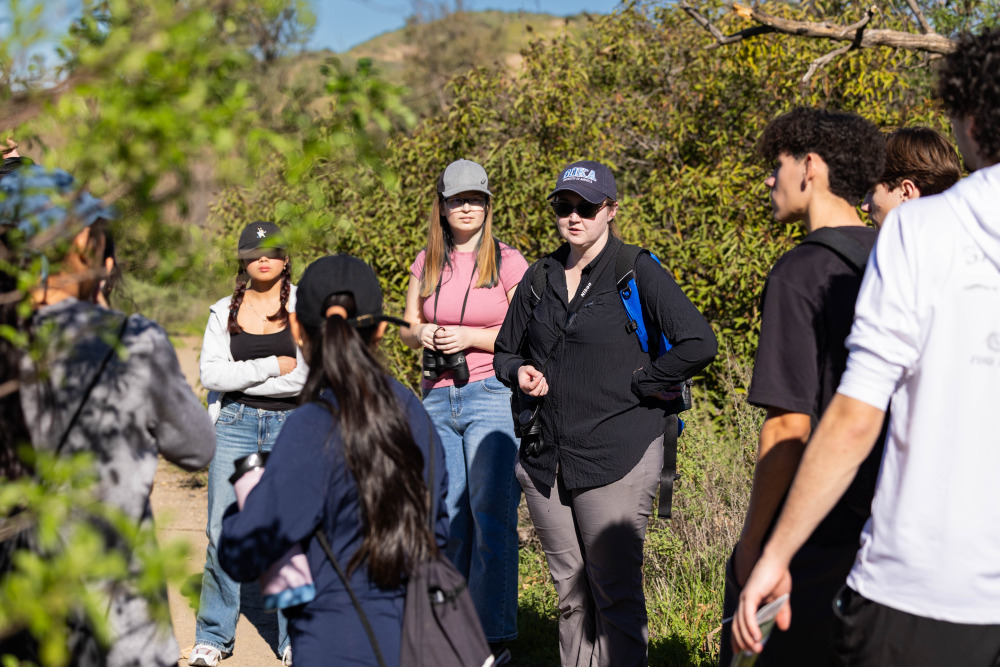
Robin Fales, assistant professor of marine ecology, leads students on a field trip to study chaparral ecosystems in Irvine Regional Park in Orange, California.
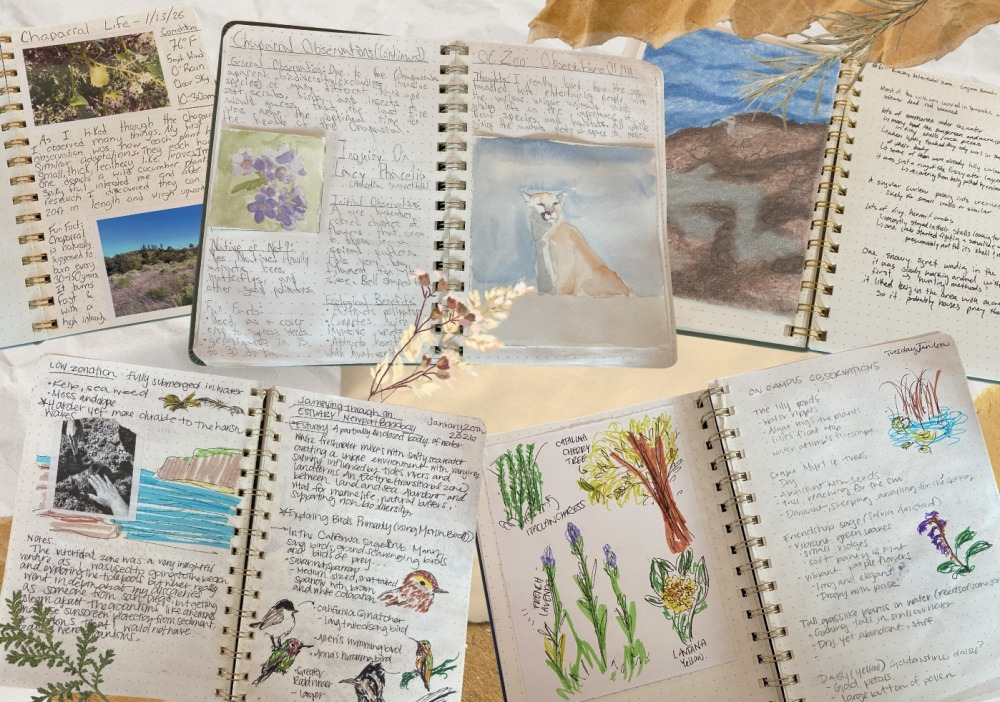
At each site, students collected ecological data using scientific surveying techniques. They also explored independently and recorded their observations in natural history journals. The latter activity is at the heart of the course, which asks students to slow down and carefully observe organisms in their environment. While this kind of natural history practice is often deprioritized in scientific research today, Fales said, it remains crucial to understanding how species live and interact within ecosystems.
In their journals, students not only described what they saw and noted thoughts and reflections; they also represented their observations through creative media such as poetry, fine-art photography, pencil or ink drawings, pastel illustrations, or watercolor paintings. A great example of the interdisciplinarity at the core of Learning Clusters and education at SUA, this activity allowed multiple points of entry into the subject matter and benefited students with wide-ranging academic interests.
A sample of work from several students’ natural history journals.
The course also encouraged students to make connections between their local ecological knowledge and global environmental issues, diving into topics in nature conservation and habitat restoration that are relevant to biomes around the world.
“There are so many lessons to be learned in Southern California that we can apply globally,” Fales said. “When we examine issues like overfishing or fire frequency, we also talk about how this can apply to other ecosystems.”
The class engaged in many discussions about human environmental impact and compared the success of different conservation efforts.
“It was really interesting to learn about how the same human intervention can have negative or positive effects in different biomes,” said Keegan Nichols ’28 of Johnstown, Colorado. “Each ecosystem has its own needs.”
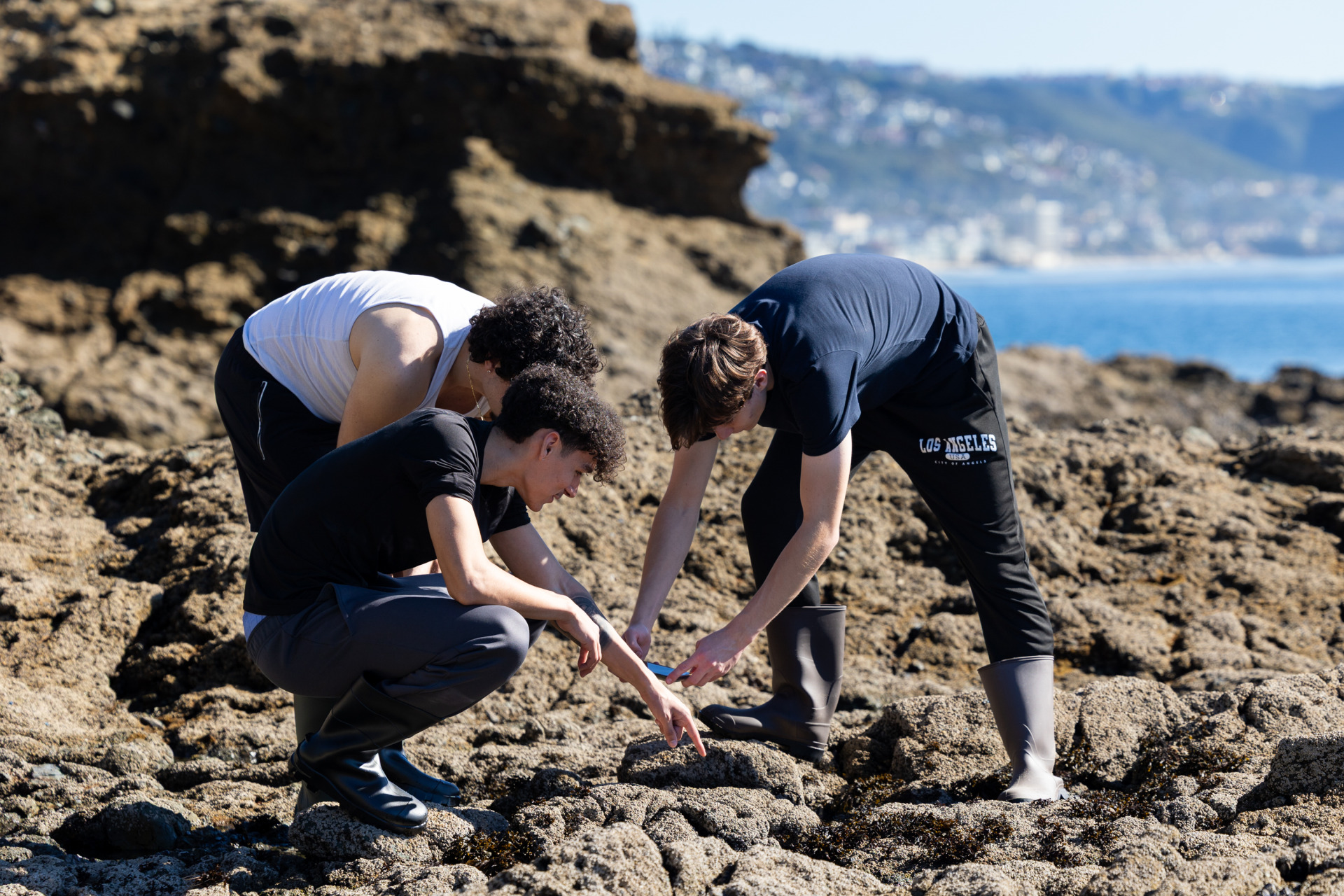
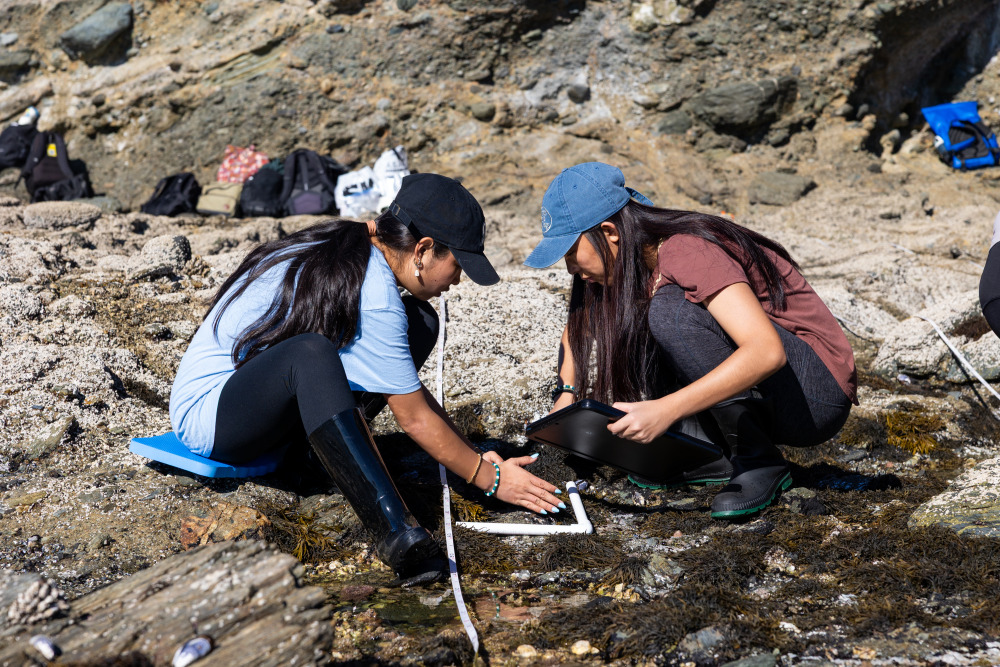
Among the most impactful experiences for students was an ecological survey of the tide pools at Shaw’s Cove. Teams of students spread out across the rocks, laid out transect (measuring) tape, and counted all the organisms within 625 square centimeters.
Learning Cluster students conduct an ecological survey in Shaw’s Cove, Laguna Beach.
“I felt like a scientist while I was doing it, peeling away the seaweed and really looking at everything there,” Obergfell said. He found it especially meaningful when, back in the classroom, they put together the data they had collected in the field and analyzed how species coverage changes from the tide pools’ low zones to the middle and high zones.
Students also tried their hand at timed surveys during their field trip to Upper Newport Bay, where they recorded all the birds they saw and heard within a set amount of time. Isabella Shelton ’29 of Huntington Beach, California, particularly enjoyed identifying birds using the Cornell Lab of Ornithology’s Merlin app. Along with a few of her classmates, she has continued using the app around SUA’s campus.
“I’ll take a second, listen to a bird, and try to figure out what bird it is,” Shelton said. “I didn’t do that very often before. It’s nice to get a new perspective.”
This perspective shift, Fales said, was part of the purpose of the birding activity –– and the Learning Cluster as a whole.
“It helps students realize that there is a lot more wildlife around them,” she said, “especially on our beautiful campus, which is next to a canyon with a lot of natural habitat.”
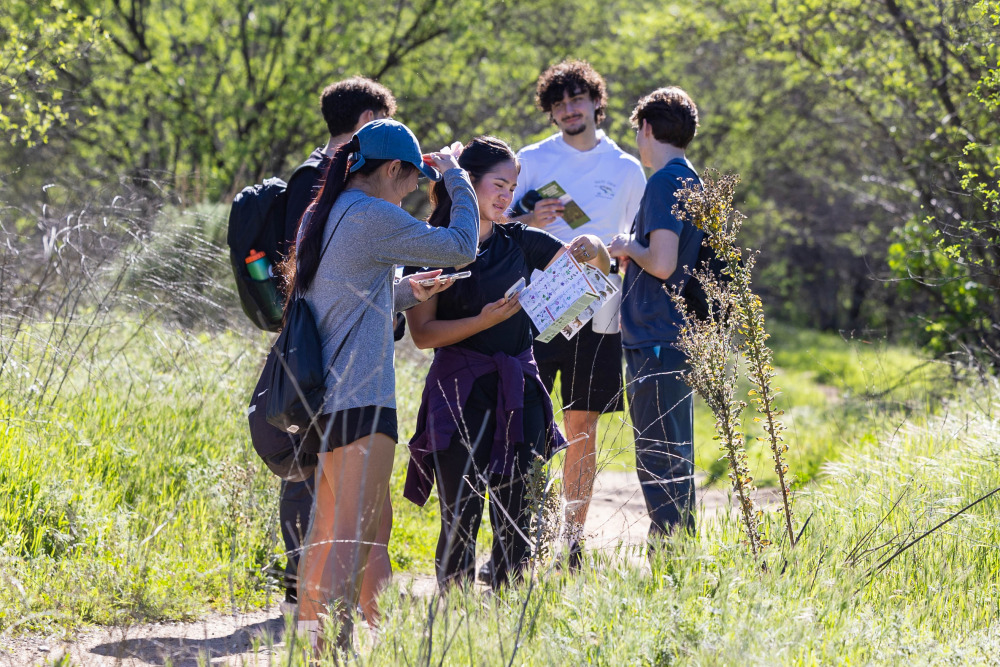
Students identify native plant species while hiking in Irvine Regional Park.
2026 Learning Clusters
Faculty Member
Course Title
Tanushree Agrawal
UX Research: Exploring a Social and Behavioral Sciences Career in Tech
Yang Allen
The Politics of Public Space
Murrell Brooks
Study of the African Diaspora in New Orleans
George Busenberg
Energy and Environment
Pablo Camus-Oyarzun
Reviving Indigenous Identity in Hawai’i
Elena Cardona
Photography and Writing as Critical Memory Practices
Tomás Crowder-Taraborrelli
Audiovisual Production
Chika Esiobu
Traditional Knowledge Insights for Living Well
Robin Fales
Natural History of Southern California
Alexander Harang
Nuclear Disarmament Education
Dongyoun Hwang
Contemporary Korean Society and Culture Through Film
Osamu Ishiyama
English-Japanese Translation
Owen H. Jones
NGOs: Local to Global Community Impact
Robert Levenson
Genetic Engineering
Junyi Liu
Machine Learning in Finance and Public Health
Duminda Liyanage
Health Is Wealth
Hiroshi Matsumoto
Japanese Language and Society
Kevin Moncrief
John F. Kennedy and Education for Peace and Global Citizenship: The Role of the University
Tetsushi Ogata
K-12 Global Citizenship Education
Deike Peters
Encountering and Memorializing the Berlin Wall
Ian Read
Environmental Sustainability in Costa Rica
James Spady
#LandBack: Mapping Acjachemen Sovereignty, Law, and Sustainability
Leda Katebian Tse
Food Microbiology
David Vivian
Ethical Consumption Under Capitalism
Susan Walsh
Computational Cell Biology of the Nucleus
For Shelton, a defining moment of the course occurred during a hike in a preserve near Palm Springs, where Fales directed the class’s attention to the fan palms. Unlike the palm trees students are used to seeing in landscaped areas around Orange County, the trunks of these trees were covered in layers of dead fronds reaching nearly to the ground. In a protected area, Fales had explained, the dead fronds are left on palm trees because they are an important habitat for birds.
“Little tidbits like that really make you think more deeply about the human impact on the environment,” Shelton said. While Shelton was already planning to concentrate in environmental studies prior to taking the Learning Cluster, she now feels especially confident in that choice.
The course has also left a lasting impression on classmates taking different academic paths. Obergfell, who is concentrating in life sciences and plans to pursue a career in medicine, has been inspired to potentially incorporate environmental research questions when he begins his senior capstone in a couple of years.
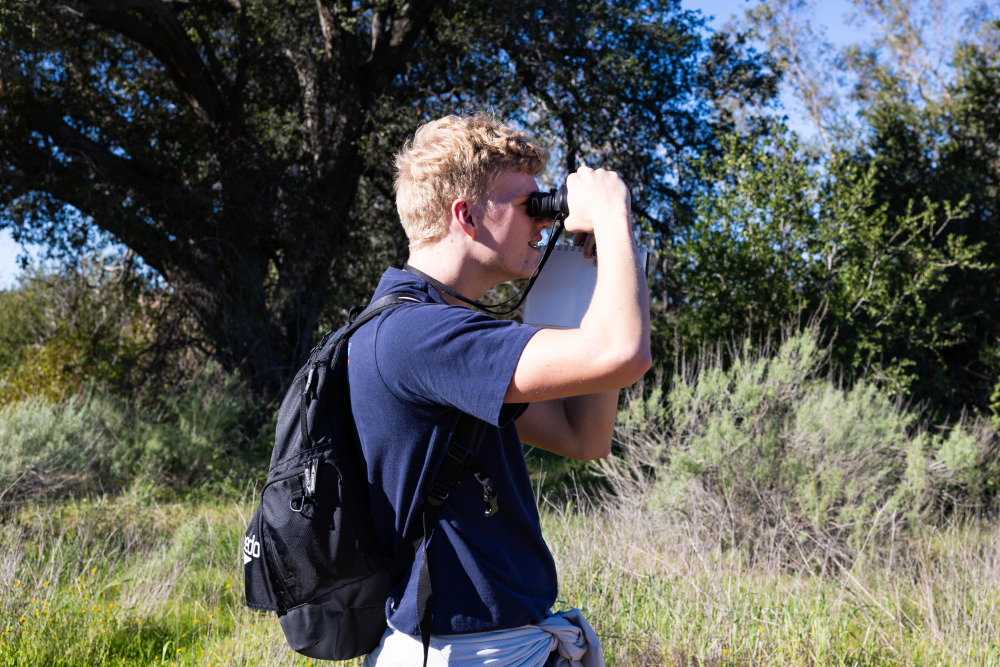
Keegan Nichols ’28 observes wildlife during a field trip to Irvine Regional Park.
As a humanities concentrator, Nichols plans to use his ecological knowledge to enrich his understanding of art history. The Learning Cluster has also given him new tools for observing nature that he can bring into his own art practice, and he is looking forward to doing more plein air painting.
For Fales, this type of academic exploration and self-reflection makes Learning Clusters an invaluable part of education at SUA.
“I really like that Learning Clusters are early on in students’ academic paths,” she said. “Students do them in their first and second years. It’s something that allows them to dive into their interests and think about how they want to grow as a student and as a person.”
Soka University of America has named this year’s top scholars — recipients of the Ikeda Scholarship, the John D. Montgomery Scholarship, the Soka Merit Award, and the Academic Excellence awards. Presi...
“If you believe in global citizenship education,” said eminent education scholar Carlos Alberto Torres during his lecture after receiving the 2026 Soka Global Citizen Award, “find a social movement an...
Team practices may have paused over the summer, but for SUA student-athletes, the season offered a different kind of training ground. High jumper Mili Fukada ’28 interned at U.S. Bank and taught balle...
When local residents Steve and Carol Theiss signed up for a community gardening program on SUA’s campus this summer, they expected to learn about growing organic produce and pick up a few tips for eco...
Nearly five decades apart, two institutions of higher learning were founded on a shared conviction — that education can help move the world toward peace and intercultural understanding.The Monterey In...
Dear Soka Community,I'm writing today to share a significant expansion of the Soka Opportunity Plan, made possible in part by the strength of our donor community.Beginning with the 2027–2028 academic ...
Dear Soka Community,After completing our negotiations with Middlebury College, I am pleased to announce that Soka University of America will establish a second campus in Monterey, California, continui...
Soka University of America (SUA) has named Carlos Alberto Torres the recipient of the 2026 Soka Global Citizen Award in recognition of his lifelong contributions to the intellectual foundations of glo...
“There is a beautiful lesson from nature that we can draw from,” said Mirian Vilela, executive director of Earth Charter International and recipient of the 2024 Soka Global Citizen Award, addressing 1...
"The world is not healed by cynicism,” said SUA Board of Trustees member Andrea Bartoli, addressing a packed house in Milbank Chapel at Teachers College, Columbia University, on June 13. “The world is...
In a region shaped by war, colonialism, and contested memory, what does genuine reconciliation require?The Soka Institute for Global Solutions (SIGS) continued exploring this question at the third and...
“Our story starts now,” said Marcos Vinicius Reginaldo de Souza, M.A. ’26, giving voice to the palpable excitement in the room as he addressed his fellow graduates during commencement on May 22.Friend...
Soka University of America has named this year’s top scholars — recipients of the Ikeda Scholarship, the John D. Montgomery Scholarship, the Soka Merit Award, and the Academic Excellence awards. Presi...
“If you believe in global citizenship education,” said eminent education scholar Carlos Alberto Torres during his lecture after receiving the 2026 Soka Global Citizen Award, “find a social movement an...
Team practices may have paused over the summer, but for SUA student-athletes, the season offered a different kind of training ground. High jumper Mili Fukada ’28 interned at U.S. Bank and taught balle...
When local residents Steve and Carol Theiss signed up for a community gardening program on SUA’s campus this summer, they expected to learn about growing organic produce and pick up a few tips for eco...
Nearly five decades apart, two institutions of higher learning were founded on a shared conviction — that education can help move the world toward peace and intercultural understanding.The Monterey In...
Dear Soka Community,I'm writing today to share a significant expansion of the Soka Opportunity Plan, made possible in part by the strength of our donor community.Beginning with the 2027–2028 academic ...
Dear Soka Community,After completing our negotiations with Middlebury College, I am pleased to announce that Soka University of America will establish a second campus in Monterey, California, continui...
Soka University of America (SUA) has named Carlos Alberto Torres the recipient of the 2026 Soka Global Citizen Award in recognition of his lifelong contributions to the intellectual foundations of glo...
“There is a beautiful lesson from nature that we can draw from,” said Mirian Vilela, executive director of Earth Charter International and recipient of the 2024 Soka Global Citizen Award, addressing 1...
"The world is not healed by cynicism,” said SUA Board of Trustees member Andrea Bartoli, addressing a packed house in Milbank Chapel at Teachers College, Columbia University, on June 13. “The world is...
In a region shaped by war, colonialism, and contested memory, what does genuine reconciliation require?The Soka Institute for Global Solutions (SIGS) continued exploring this question at the third and...
“Our story starts now,” said Marcos Vinicius Reginaldo de Souza, M.A. ’26, giving voice to the palpable excitement in the room as he addressed his fellow graduates during commencement on May 22.Friend...