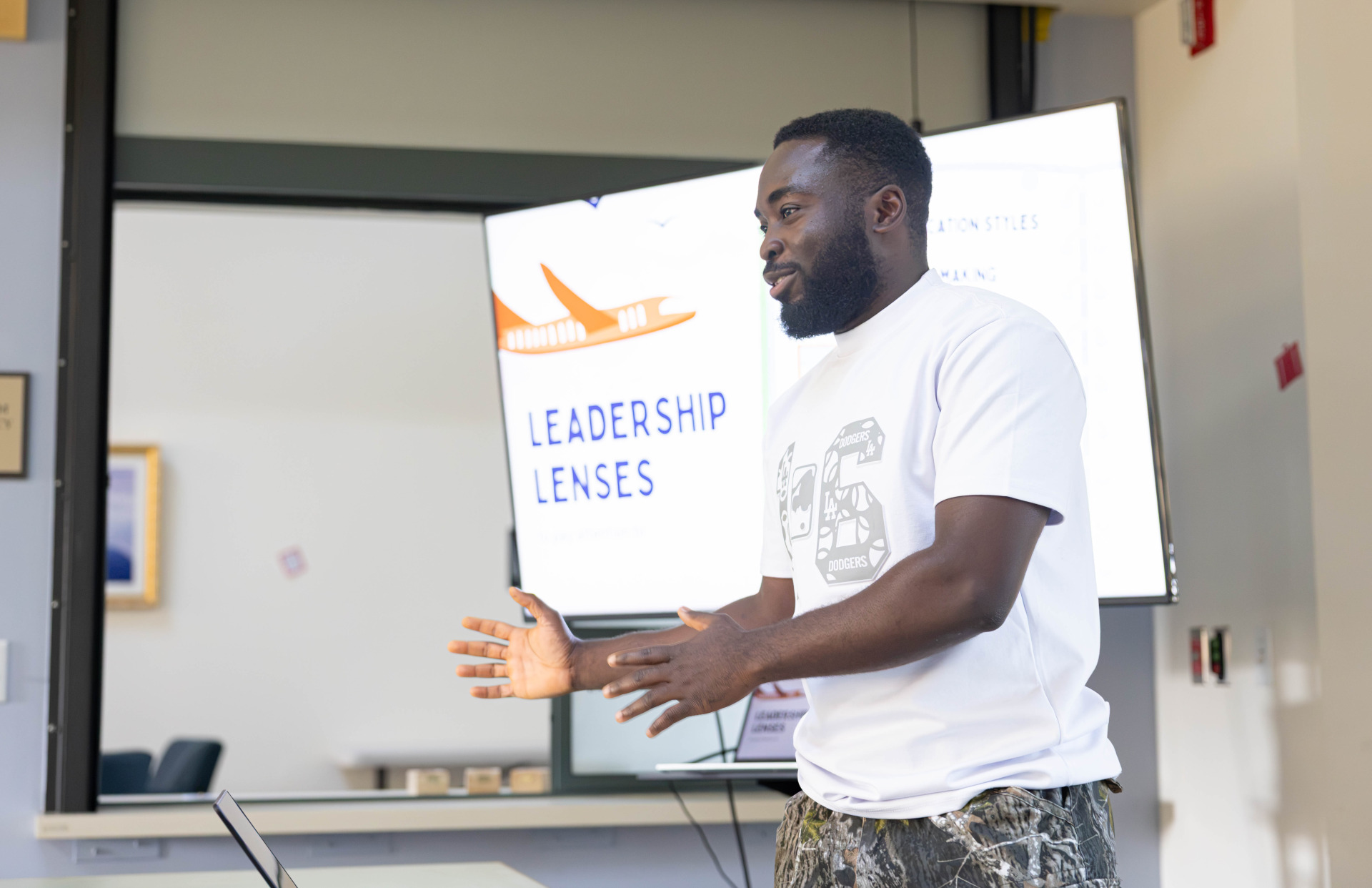
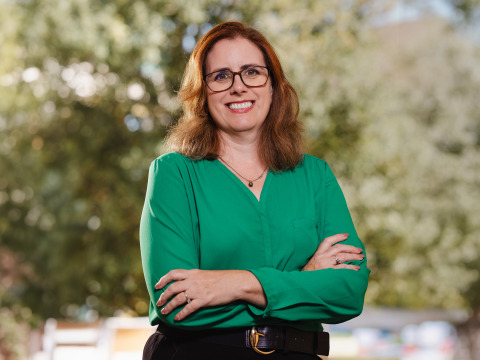
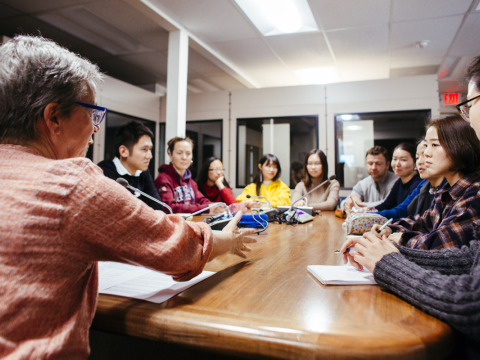
Chris Ohene Boadi ’28 leads a discussion with fellow students during a leadership workshop.
October 21, 2026
7 Min Read
Emerging Leaders Program Builds Confidence Through Serving Others
Kate Selfe ’27 of Plettenberg Bay, South Africa, signed up for the Emerging Leaders Program because it felt complementary to the work she was already doing at her campus job. At the time, she was a first-year student working at the Office of Student Leadership and Service Engagement, and the program sounded like a great way to learn about different leadership styles. But what she actually got out of the program was much deeper. It changed her understanding of leadership in a way that has shaped the rest of her experience at SUA.
The Emerging Leaders Program, launched in 2022-23, awards students a digital badge for attending eight leadership workshops, completing 15 hours of volunteer service at a single organization, and submitting a reflection project. The workshops are based on the Soka Contributive Leadership Framework, a university-wide blueprint for student leadership development that focuses on four core concepts: developing self, cultivating potential in others, building and strengthening collective engagement, and creating value through interconnectedness.
“Leadership can be defined in so many different ways,” said Director of Student Leadership and Service Engagement Ruby Nagashima ’05, who developed the framework. “I wanted to create a framework based on who we are as an institution and the kind of global citizens our university wants to develop and foster.”
At a fundamental level, this means helping students define what makes a good leader beyond conventional perceptions of leadership, which are often based on personality traits like extroversion and charisma.
“Developing leaders at Soka is about fostering people with character and integrity,” Nagashima said, “people who can go out into society, create value wherever they are, and seek out ways to contribute meaningfully to the lives of others, their organizations, and the world around them.”
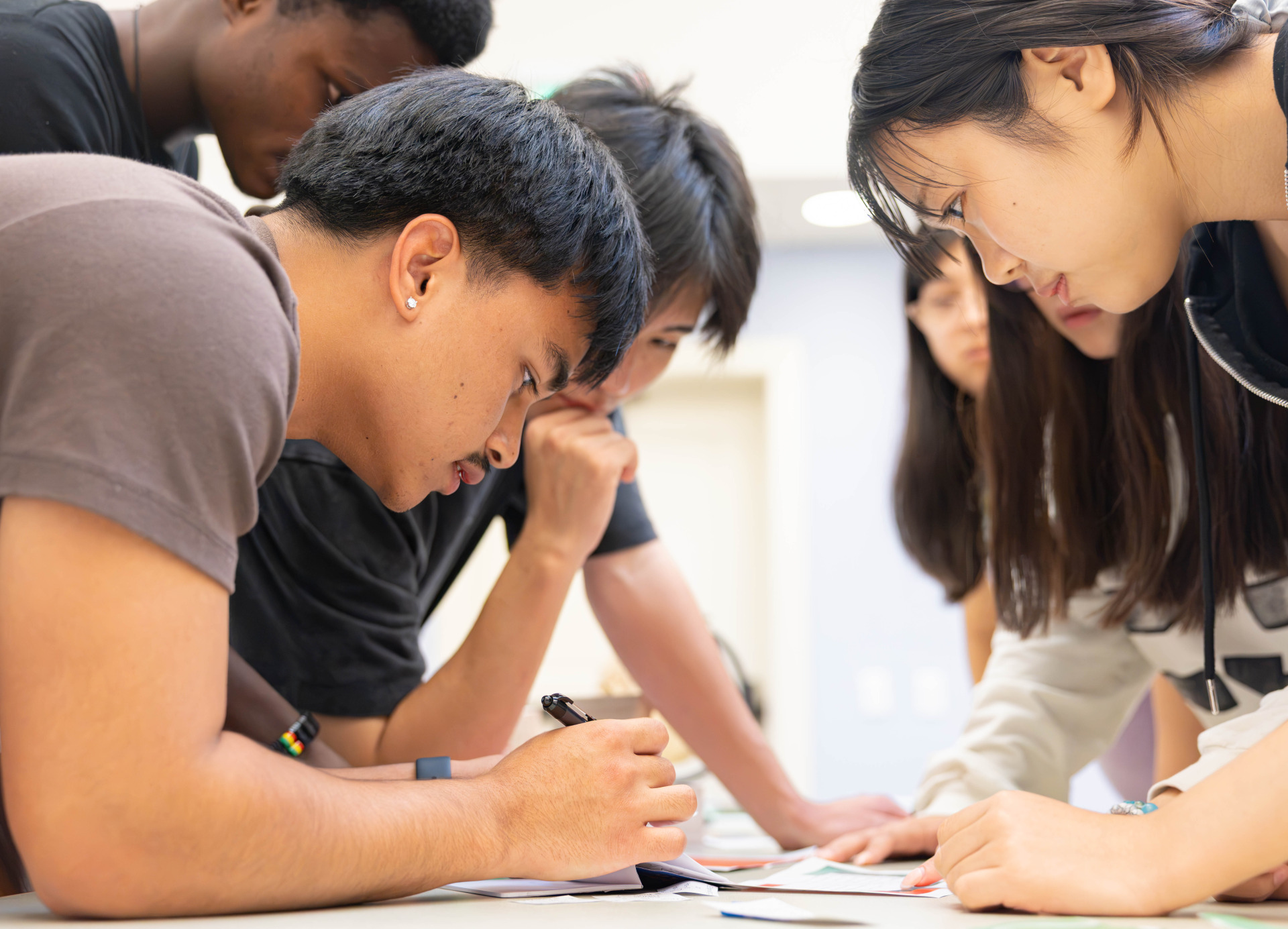
Students work together to solve puzzles during a leadership-themed escape room activity.
Several students who completed the Emerging Leaders Program found this reframing of leadership especially eye-opening. The program helped them realize that anyone can be a leader if they are passionate about serving others and intentionally cultivating their personal growth.
Hironobu Shinomiya ’29 of Osaka, Japan, said that idea truly sank in when he saw his peers putting the concepts he was learning into practice.
“What motivated me most were the lectures and workshops led by student leaders,” he said, “because they taught us that everyone, including students, has the potential to take action as a leader, starting within the Soka community.”
The program’s workshops enabled Shinomiya to learn new skills, increase his confidence, and discover the ways he can lead using his unique strengths. This year, he is the president of the sophomore class senate. He credits the Emerging Leaders Program with teaching him “a broad perspective and systemic view” that helps him plan inclusive student events.
Like Shinomiya, Selfe particularly appreciated learning about systems thinking. She recalled a workshop led by Dean of Students Hyon Moon that asked students to imagine they were implementing a change within an organization. Based on who this change would affect, students had to figure out who they would need to consult and collaborate with to make the change happen.
“That was very good practice in shifting perspectives and realizing that you may need to involve more people than you think necessary at first,” Selfe said. “Systems thinking is a way to think through problems, issues, or challenges through a wider lens. You can see how one thing can have a much wider effect than you first thought it would.”
Kelsea Wardrope Grant ’29 said the workshops about servant leadership, power dynamics, and addressing bias resonated most powerfully with her.
“The biggest thing I learned was how to communicate better,” said Wardrope Grant, who calls both Queens, New York City, and Colón, Panama, home. “It’s about not contributing to bias, but having an open mind to accept people. Those are things we might think we already do, but we often aren’t working on them consciously.”
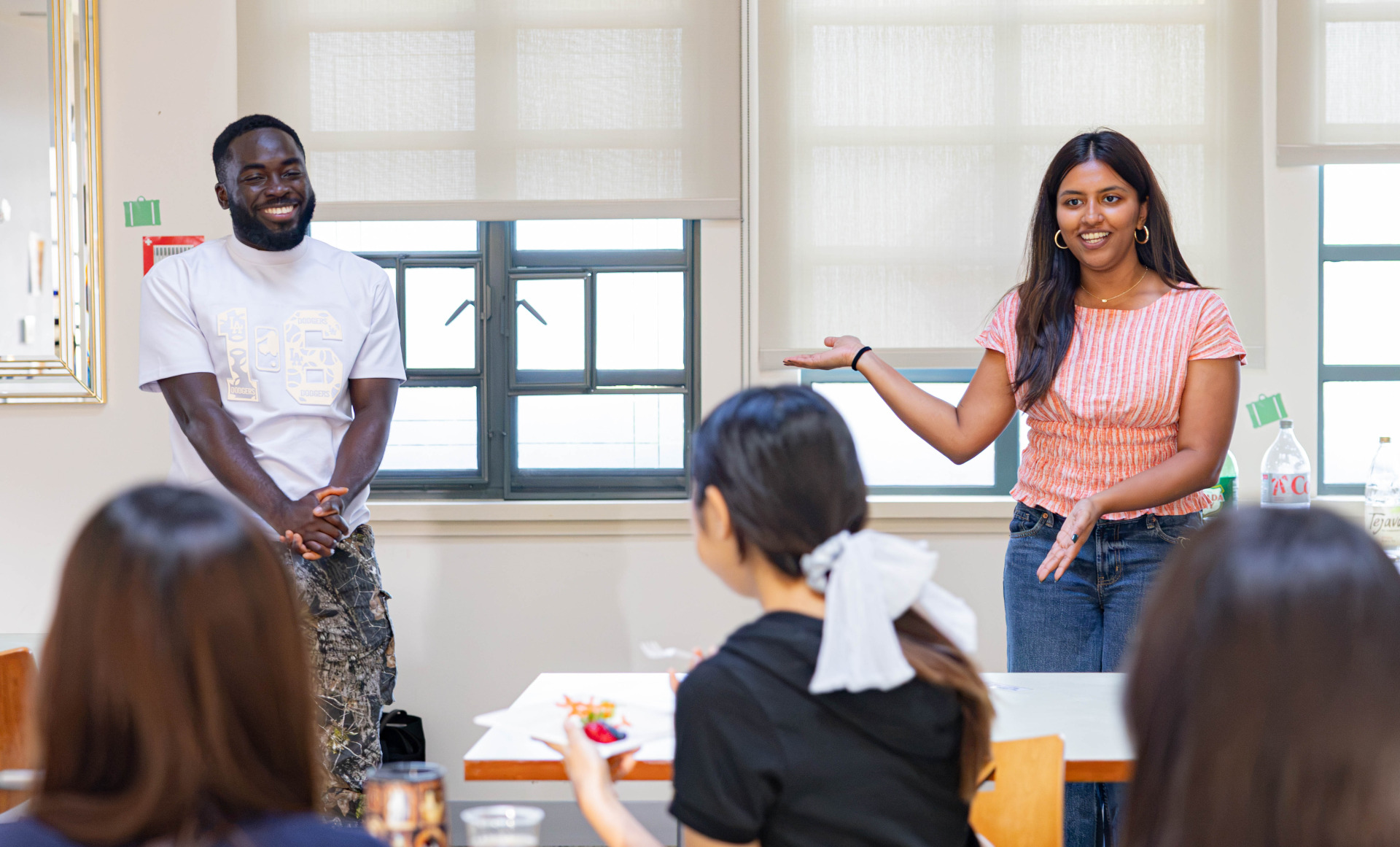
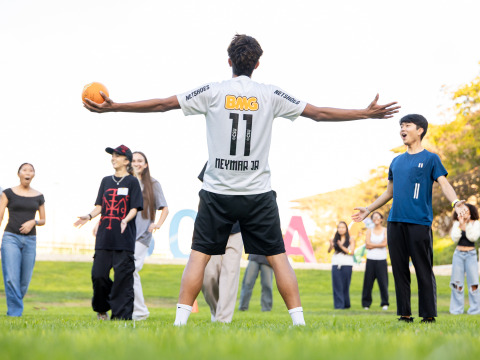
Chris Ohene Boadi ’28 and Sia Tholath ’26 lead an activity at a leadership workshop.
The Emerging Leaders Program also emphasizes the importance of hands-on experience, which students acquire by volunteering at an organization that supports a cause they care about. Consistently working with the same organization facilitates meaningful interactions and relationship-building while giving students a chance to apply a range of skills and see the impact of their work.
“Service is integral to leadership,” Nagashima said. “You have to see yourself as someone who can contribute to your community in order to be a leader.”
Students can choose from a list of local nonprofits that the Office of Student Leadership and Service Engagement has already established relationships with, or they can find a different organization where they’d like to volunteer. Nagashima encourages students to follow their passion, whether that means lending a hand at an animal shelter, a food bank, or a free tutoring center.
Selfe volunteered with Tiyya Foundation, a nonprofit that supports refugees and immigrants resettling in Orange County. She spent multiple afternoons organizing creative activities for children at Tea & Tots, an event where young immigrant families can socialize and build community in their new home. Shinomiya contributed to Tiyya’s economic advancement program, going door-to-door at a local shopping center and putting together a list of job openings to help immigrants find meaningful employment.
“This changed my perspective because it was the first time I felt I was able to contribute to immigrants and refugees’ survival and happiness,” he said. “That day, I realized that there is something I can do for them outside of classroom settings.”
Students who have completed the Emerging Leaders Program have gone on to participate in student government, as Shinomiya has, work as resident assistants and student orientation leaders, serve as officers in student clubs, take on leadership roles on sports teams, and contribute to campus sustainability initiatives.
On Oct. 16, the Office of Student Leadership and Service Engagement launched a pilot program for students who currently have a leadership role on campus and have already completed the Emerging Leaders Program or taken the Leadership 100 course. Called The Orbit: Where Leadership Learning Comes Full Circle, this program brings a small cohort of students together once a month to learn from each other. They’ll share how they applied different leadership topics, reflect on what worked and how they can keep growing, and then build an action plan for practicing a new leadership concept the following month.
But the impact of the Emerging Leaders Program is not limited to the work students are doing in official leadership roles. For many, the introspective nature of the program led them to reflect on how they’ll apply what they learned across all areas of their lives.
“It’s always been really important to me to connect with people,” Selfe said. “The program helped teach me how to do that more consciously and how to recognize people’s different strengths. You get to engage with people with a lot of different viewpoints.”
Wardrope Grant feels she now has a deeper understanding of global citizenship, which has helped shape her dream of becoming a pediatrician who advocates for accessible healthcare worldwide. Contributing to the local community through volunteer work, in addition to sharing her personal reflections with peers during workshops, has boosted her confidence across the board.
“I changed my mindset,” she said, “from ‘What will people think of me?’ to ‘How can I help this person?’”
To hear more about how Emerging Leaders Program alumni are carrying these lessons into their lives and work, watch the first episode of the Emerging Leaders’ Podcast, featuring Mareva Dijoux ’26:
Soka University of America President Edward M. Feasel and Tetsushi Ogata, managing director of the Soka Institute for Global Solutions, spent two days in September at the Hazel Henderson Center in St....
What can education do for students, communities, and entire societies worldwide? Karen Moran Jackson often facilitates discussions around this question with graduate students. She directs the M.A. in ...
“Our students are striving to become global citizens who contribute to the world,” Soka University of America President Edward M. Feasel said in his remarks to donors at the 22nd annual Peace Gala on ...
SUA students spent part of the summer in New York City and the Amazon rainforest, exploring how their education can address global challenges. The Luis and Linda Nieves Family Foundation funded both t...
The Campus Green was buzzing on Sept. 23 as students, faculty, and staff gathered for SUA’s annual Welcome Back Community Event, an afternoon of food, games, and friendly competition to kick off the n...
Soka University of America has named this year’s top scholars — recipients of the Ikeda Scholarship, the John D. Montgomery Scholarship, the Soka Merit Award, and the Academic Excellence awards. Presi...
“If you believe in global citizenship education,” said eminent education scholar Carlos Alberto Torres during his lecture after receiving the 2026 Soka Global Citizen Award, “find a social movement an...
Team practices may have paused over the summer, but for SUA student-athletes, the season offered a different kind of training ground. High jumper Mili Fukada ’28 interned at U.S. Bank and taught balle...
When local residents Steve and Carol Theiss signed up for a community gardening program on SUA’s campus this summer, they expected to learn about growing organic produce and pick up a few tips for eco...
Nearly five decades apart, two institutions of higher learning were founded on a shared conviction — that education can help move the world toward peace and intercultural understanding.The Monterey In...
Dear Soka Community,I'm writing today to share a significant expansion of the Soka Opportunity Plan, made possible in part by the strength of our donor community.Beginning with the 2027–2028 academic ...
Dear Soka Community,After completing our negotiations with Middlebury College, I am pleased to announce that Soka University of America will establish a second campus in Monterey, California, continui...