Wall Street Prep, Campus Jobs, and a Pitch Contest: This Fall in Career Development
Does a liberal arts education at Soka University of America give students an edge in the job market? Events and programs this fall from the Career Development Office and Bridges to Business suggest it does. They helped students prepare for careers from social work to investment banking. Here are five highlights:
CareerCore: Connecting the Liberal Arts With Hireable Skills
CareerCore, a new professional development program created by the Career Development Office, helps students identify the skills they are already honing with a liberal arts education and learn how to effectively market these skills to employers. Alisa Proctor, assistant director of internships, designed the program around the 10 core career competencies measured by RATE, a digital self-assessment tool used at liberal arts colleges across the country.
Unique to SUA, CareerCore offers workshops that provide additional training and support in understanding RATE competencies like ethical reasoning, digital literacy, and oral and written communication. Students then reflect on how they have applied these skills in areas like academic coursework, athletics, leadership, clubs, volunteer work, or campus jobs. They earn a digital badge for their résumé once they have covered all 10 competencies.
“The goal is for students to recognize that they are already building these competencies,” Proctor said. Each workshop concludes with students drafting a résumé bullet point about the competency and practicing an interview response that illustrates their proficiency in the target skill set. Equivalent professional development, like job training to become a resident assistant, can sometimes count in place of a CareerCore workshop, providing multiple avenues for students to participate without too much additional strain on their schedules. Participants also get to go on field trips to local employers; anticipated visits this academic year include Poppy Bank and John Wayne Airport.
Students can complete CareerCore over their four years at SUA, but Mika Kinoshita ’30 has found it so useful that she encourages her peers to start participating as early as possible. Kinoshita, who is from Torrance, California, attended workshops in October and November that covered critical thinking, applied problem-solving, teamwork, leadership, and engaging diversity. She found the guidance for composing interview responses to be especially helpful.
“I always had a problem with keeping my interview answers short and direct while also being able to give all of myself so that the interviewers know who I am,” she said. “The workshops gave me a good structure to answer the question while clearly delivering the message I had in mind.”
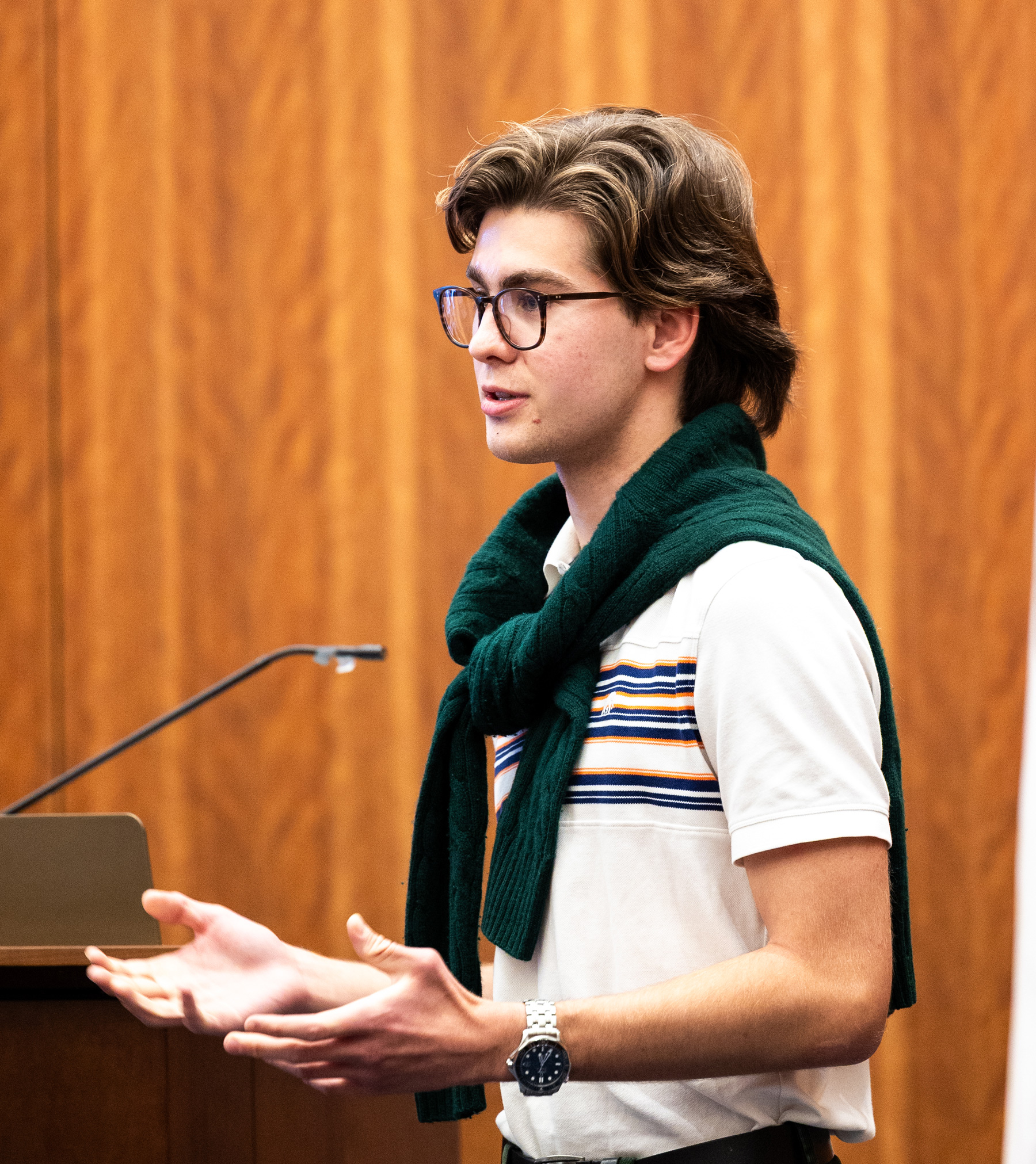
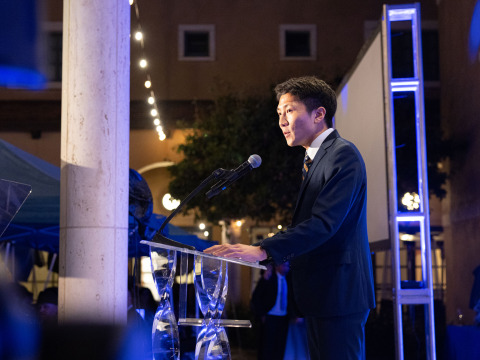
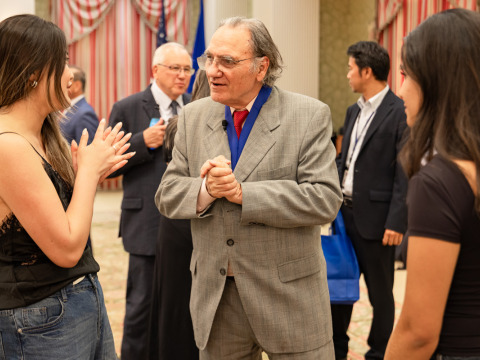
Mark Pliushchanskii ’27 at the Bridges to Business kickoff event in September.
Finance Accelerator: Where Peer Learning Prepares Students for Wall Street
“There is a giant misconception that studying the liberal arts is bad for careers in finance,” said Mark Pliushchanskii ’27, organizer of the Finance Accelerator Program, a new initiative sponsored by Bridges to Business. “This couldn’t be more wrong. In my experience and that of Soka graduates working in the field, numerous people at the senior level actually come from philosophy, political science, and other liberal arts backgrounds.”
Pliushchanskii, who is from Siberia, Russia, and is graduating this spring, completed internships in investment banking and private equity and has accepted a full-time role in mergers and acquisitions in New York City. He decided to organize and lead the Finance Accelerator together with Puja Khatri ’28 of Dhading, Nepal, to help other SUA students navigate the highly competitive process of launching a career on Wall Street.
“The vast majority of recruiting for fields like investment banking happens in your sophomore year,” Pliushchanskii said. “You not only need to have the necessary technical knowledge, but also the contacts and network, and you need to start preparing as early as your first year of college.”
The six-week Finance Accelerator Program complements the rigorous intellectual training students already receive through SUA’s curriculum with workshops in technical skills like Excel modeling and sessions covering networking and the interview process. The program has also benefited from Pliushchanskii and Khatri’s experience interning in SUA’s finance office, where they received mentorship and guidance from Eric Reker ’09, director of investments, and investment analyst Eddie Ng ’13. Above all, Pliushchanskii hopes the accelerator empowers students with the resources and skills to approach a career in finance with confidence.
“We try to help folks understand what kind of industries exist in this sector, what roles they can pursue after college, and what they can do now to prepare,” he said. “We want to make sure that Soka students are not only familiar with the competitive recruiting process, but also know how to stand out.”
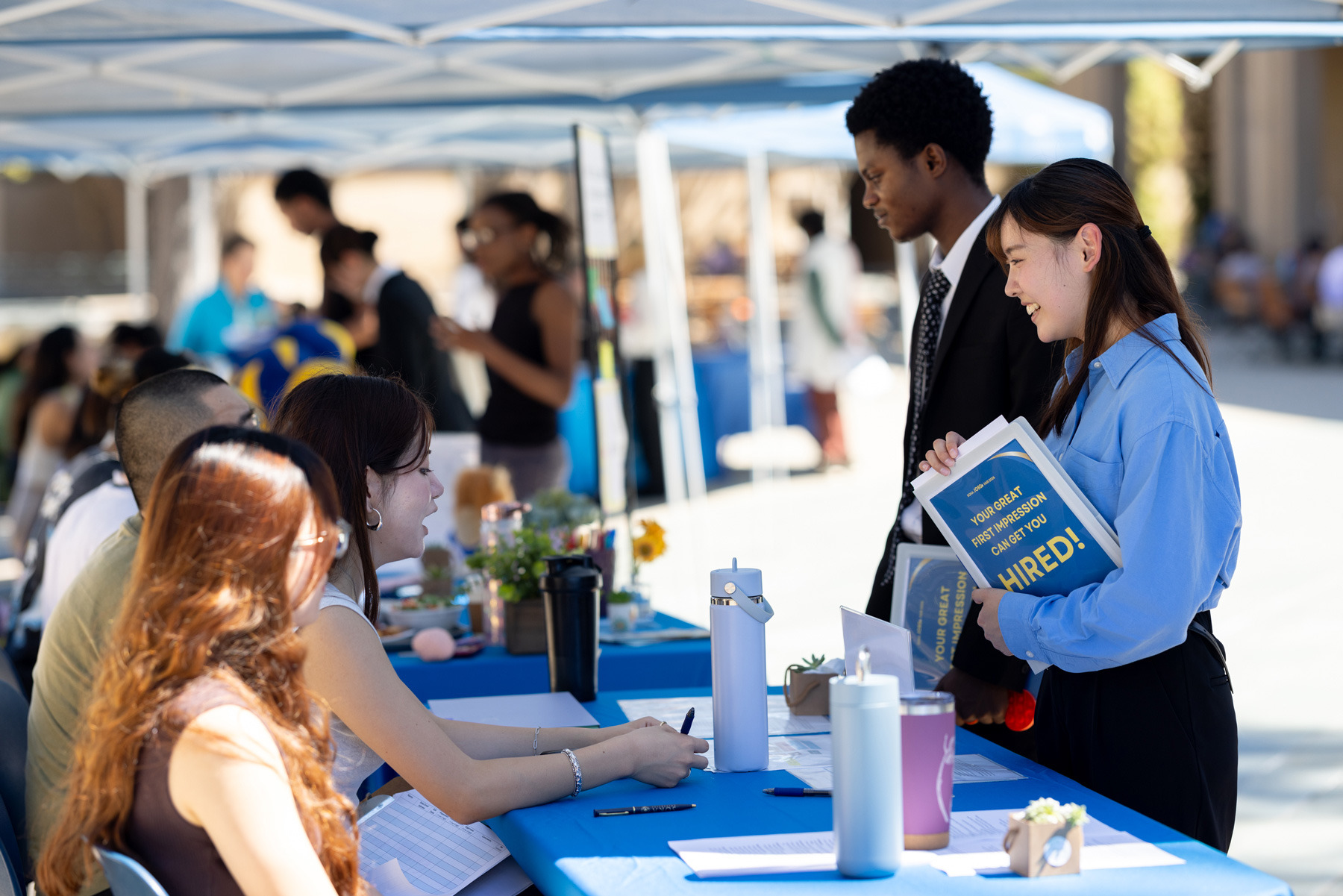
Students meet representatives from various campus departments at the Soka Jobs+ Fair on Oct. 2.
Soka Jobs+ Fair: Introducing Students to Campus Employers
In October, the Career Development Office hosted the Soka Jobs+ Fair, drawing 95 students — roughly 20% of the student population. Developed last year by career counselor Young Choi-Plass, the annual event seeks to connect students with campus areas that are hiring student workers.
“Students often want campus jobs very badly, but they don’t always understand all the different departments on campus, who is hiring, or who might be hiring in the future,” Proctor said. On the other side, department hiring teams may not always have direct connections with students, making it harder to get the word out about the work they do and find interested candidates.
The Soka Jobs+ Fair does an excellent job bridging that gap, bringing students and employers together in a lively career fair environment. This year, 20 campus employers — from the library to the cafeteria to the Soka Performing Arts Center — had tables at the event.
Andy Acquaye ’30 of Accra, Ghana, attended the event and was hired shortly afterward as a social media engagement management assistant in the Office of Student Affairs. He found the prep session, held the evening before the job fair and led by Choi-Plass and Director of Career Development and Internships Jonathan Wray, to be especially helpful. Attended by 60 students, the session covered how to present themselves professionally, approach employers, and craft a brief “elevator pitch” to stand out. Acquaye said he picked up useful networking tips, like making sure to actively listen during conversations with employers.
“I realized that the event was about more than getting a job on campus,” he said. “What I learned there can actually help me in other areas.” He said the experience boosted his confidence and was excellent practice for the career fair this spring, when external employers will visit SUA’s campus.
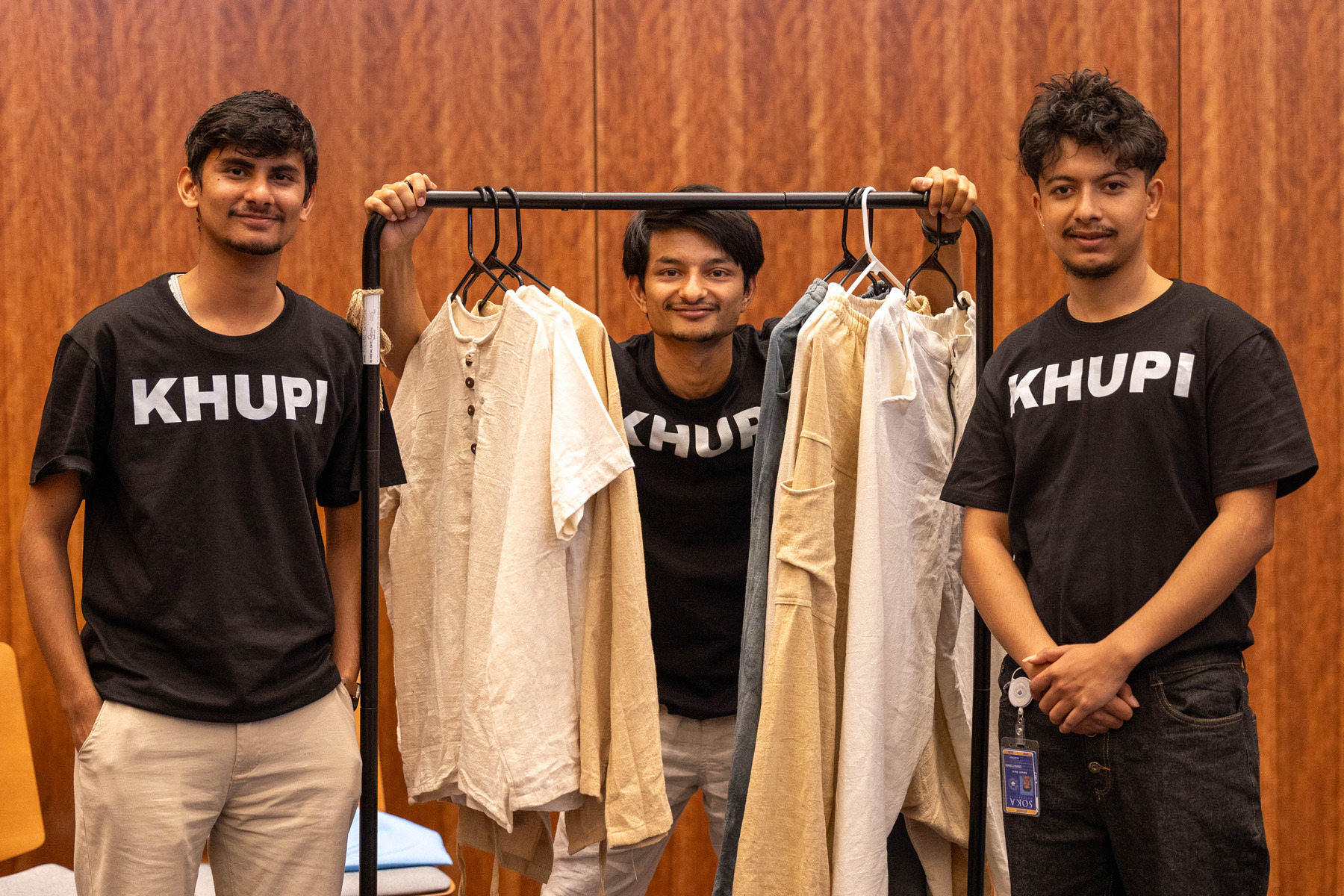
From left to right: Second-place winners Gaurabh Sapkota ’29, Bikram Poudel ’29, and Aakash Baral ’29 pose with clothing samples from their hemp-based fashion brand, Khupi.
Solving Real-World Problems at Impactathon
From Nov. 7 to 8, Impactathon returned to SUA for its 10th year. Hosted by Bridges to Business and convened by Innov8Social, this social impact entrepreneurship competition brought together 12 teams of SUA students to pitch ideas for businesses or projects that address practical problems, from campus sustainability initiatives to programs that promote literacy in rural communities. This year, the winning team received $1,250 in seed funding to build Suander, a swipe-style marketplace for students to trade items on campus.
“Impactathon is a flagship Bridges to Business event where any SUA student can experience what it’s like to apply an entrepreneurial mindset to a social problem. They ideate, create a team, pitch an idea, get feedback, and sometimes move ahead with seed funding,” said Mary Patrick Kavanaugh, director of innovation, entrepreneurship, and special projects. “Students learn how to solve something at the root cause, and it can be a defining event for them to take that skill set anywhere from the classroom to the interview room.”
Workshop leaders this year included Neetal Parekh, founder of Innov8Social and Impactathon, and Frances Tang, founder of Awkward Essentials. Throughout the weekend, students had access to mentorship from social entrepreneurs who helped them refine their ideas. The second-place team pitched Khupi, a sustainable, hemp-based fashion brand that won $750 in seed funding. Books Beyond Valley, an initiative to bring digital education resources to students in rural Nepal, took the $500 third-place prize and the People’s Choice Award.
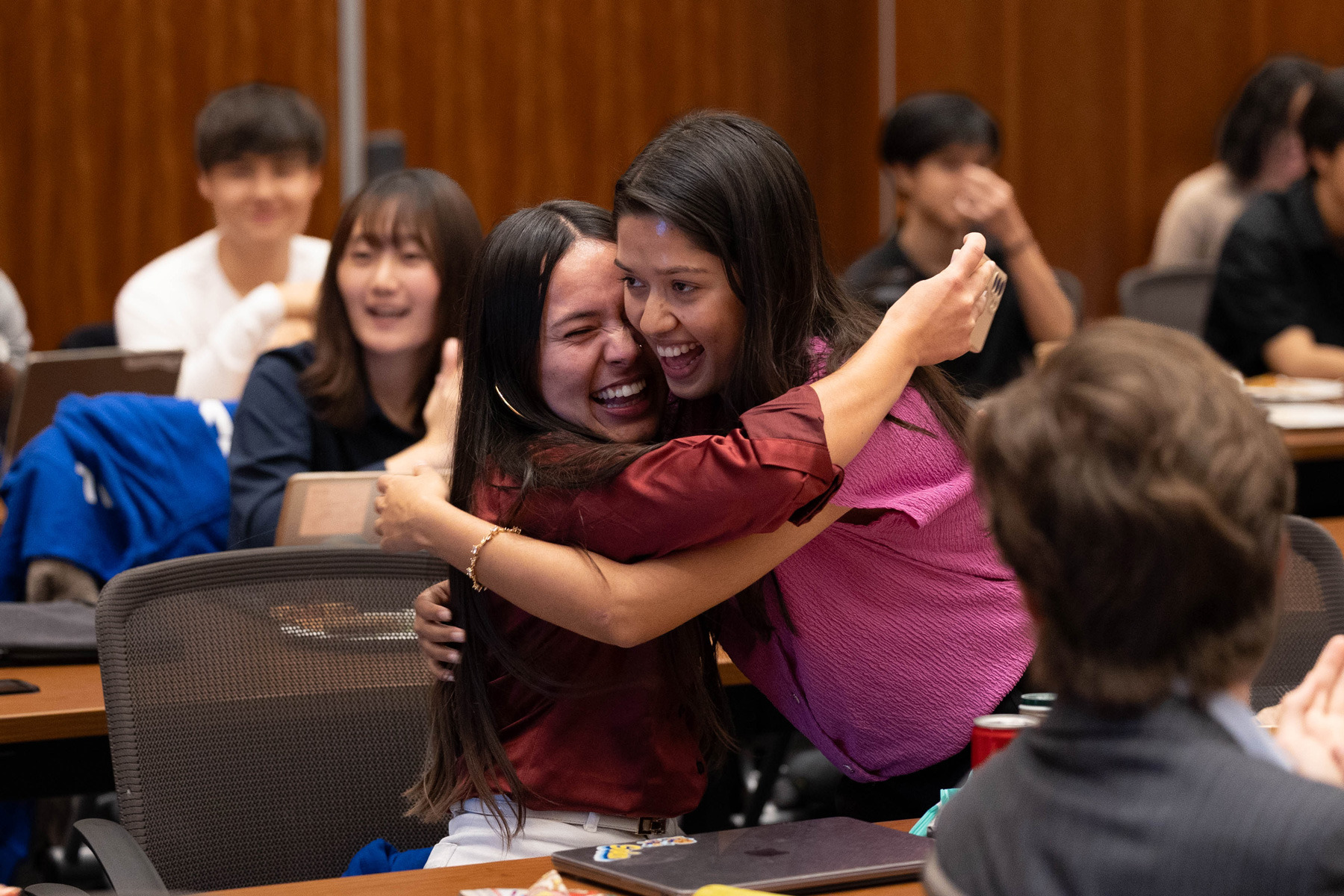
Saheli founders Puja Khatri ’28 (left) and Rojina Paudel ’30 celebrate winning $750 to compete in e-Fest.
Two additional teams — Care4Care, a digital platform for caregivers, and Saheli, an initiative to reduce cultural stigma around menstruation in Sri Lanka — received $750 to prepare for e-Fest, a national undergraduate entrepreneurship competition at the University of St. Thomas in St. Paul, Minnesota. Impactathon participants often continue working on their ideas and pitch them elsewhere, with an external competition win rate of more than 90% at events like the Fowler Global Social Innovation Challenge, SoCal Celebrates Entrepreneurship, and the Hult Prize. Contributing factors to this success, Kavanaugh believes, are the diversity of the teams and Soka students’ deep and often personal understanding of the social problems they’re working on.
“They’re bringing problems out of their own communities,” Kavanaugh said, “and they’re solving them in creative ways that get traction because they intimately understand the root cause of these problems.”
This year’s Impactathon saw an unprecedented number of teams — eight out of 12 — focus on solutions for the Soka campus community. Ideas included a student-run campus bike-share, an event series to foster personal connection, and an app to help students better understand and maximize their healthcare benefits. On Dec. 8, Bridges to Business will host the first Soka Solutions pitch event, enabling these teams to share their ideas with staff and faculty who can offer feedback and resources to make these ideas a reality.
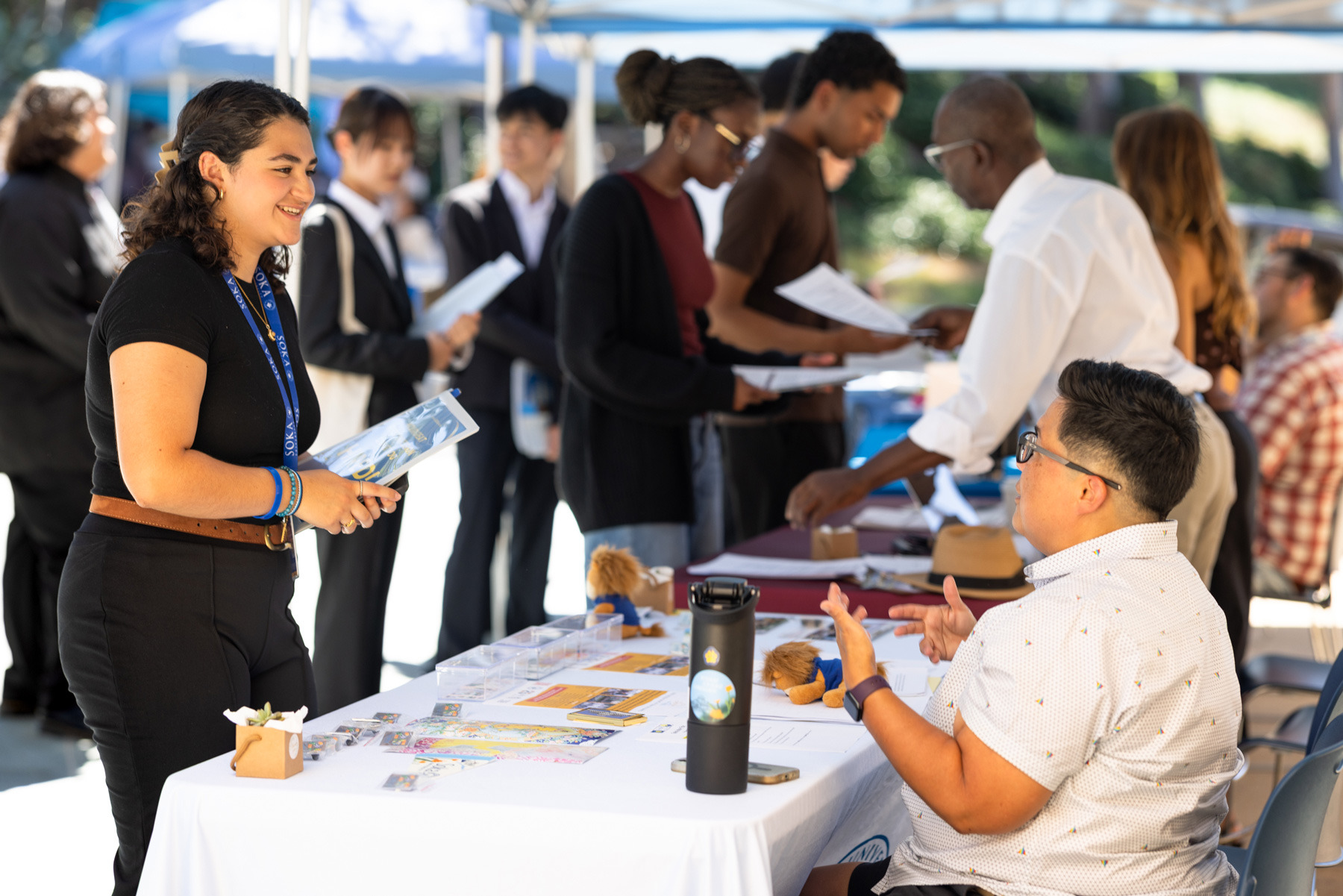
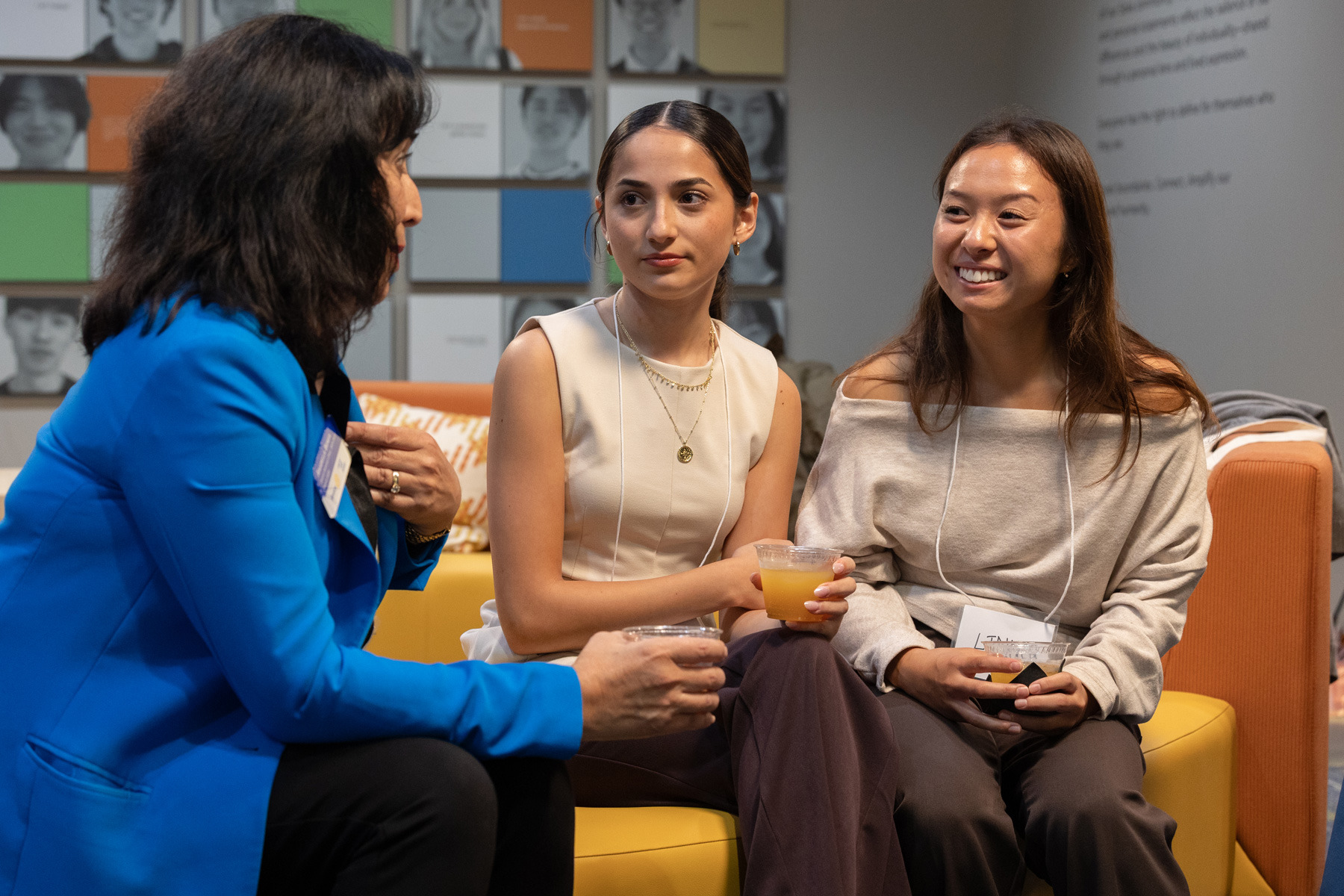
Students converse with an organization representative at Networking Happy Hour in 2025.
Making Professional Connections at Networking Happy Hour
Now in its fifth year, the annual Networking Happy Hour hosted by the Career Development Office provides a welcoming space for students to mingle with employers and practice networking skills.
“Every time, students make connections, and we have a history of students coming away with great connections that have led to jobs or internships,” Proctor said.
Set for Nov. 19, this year’s event will include representatives from 20 organizations, including the Chapman University School of Pharmacy and the Monterey Institute of International Studies. Over mocktails and appetizers, students will meet a range of professionals, from members of the local Rotary Club to a retired U.S. diplomat. A prep session prior to the event will help students polish their professional presentation and networking skills.
While students often begin the evening feeling nervous about networking, Proctor said, their growth in confidence is always visible by the end of the event.
“They are chatting with professionals and realizing that these are just real people,” she said. “It’s great practice for the real world in a safe environment.”
What’s Next for Career Development at SUA
Students will continue building career skills in 2027 with upcoming programming like Career Week, the spring career fair, and the Bridges to Business Leadership Circle’s visit to Silicon Valley.
To learn more about upcoming events, book an appointment with a career counselor, or explore internship opportunities, students can visit the CareerHub.
In medical school, Dr. Victoria Smith sat through lectures on conditions like shock. The professor would explain that a patient in shock turns pale, then show a slide of a white patient.“I would raise...
For 15 Soka University of America students considering where their education might take them next, a day in Monterey offered more than a tour of a graduate campus: It gave them a chance to imagine how...
Soka University of America will add women’s volleyball in Fall 2027, giving head coach Taylor Kushner a second program to build from scratch.Kushner has coached the men’s team since it launched in 202...
Kate Selfe ’27 of Plettenberg Bay, South Africa, signed up for the Emerging Leaders Program because it felt complementary to the work she was already doing at her campus job. At the time, she was a fi...
Soka University of America President Edward M. Feasel and Tetsushi Ogata, managing director of the Soka Institute for Global Solutions, spent two days in September at the Hazel Henderson Center in St....
What can education do for students, communities, and entire societies worldwide? Karen Moran Jackson often facilitates discussions around this question with graduate students. She directs the M.A. in ...
“Our students are striving to become global citizens who contribute to the world,” Soka University of America President Edward M. Feasel said in his remarks to donors at the 22nd annual Peace Gala on ...
SUA students spent part of the summer in New York City and the Amazon rainforest, exploring how their education can address global challenges. The Luis and Linda Nieves Family Foundation funded both t...
The Campus Green was buzzing on Sept. 23 as students, faculty, and staff gathered for SUA’s annual Welcome Back Community Event, an afternoon of food, games, and friendly competition to kick off the n...
Soka University of America has named this year’s top scholars — recipients of the Ikeda Scholarship, the John D. Montgomery Scholarship, the Soka Merit Award, and the Academic Excellence awards. Presi...
“If you believe in global citizenship education,” said eminent education scholar Carlos Alberto Torres during his lecture after receiving the 2026 Soka Global Citizen Award, “find a social movement an...
Team practices may have paused over the summer, but for SUA student-athletes, the season offered a different kind of training ground. High jumper Mili Fukada ’28 interned at U.S. Bank and taught balle...