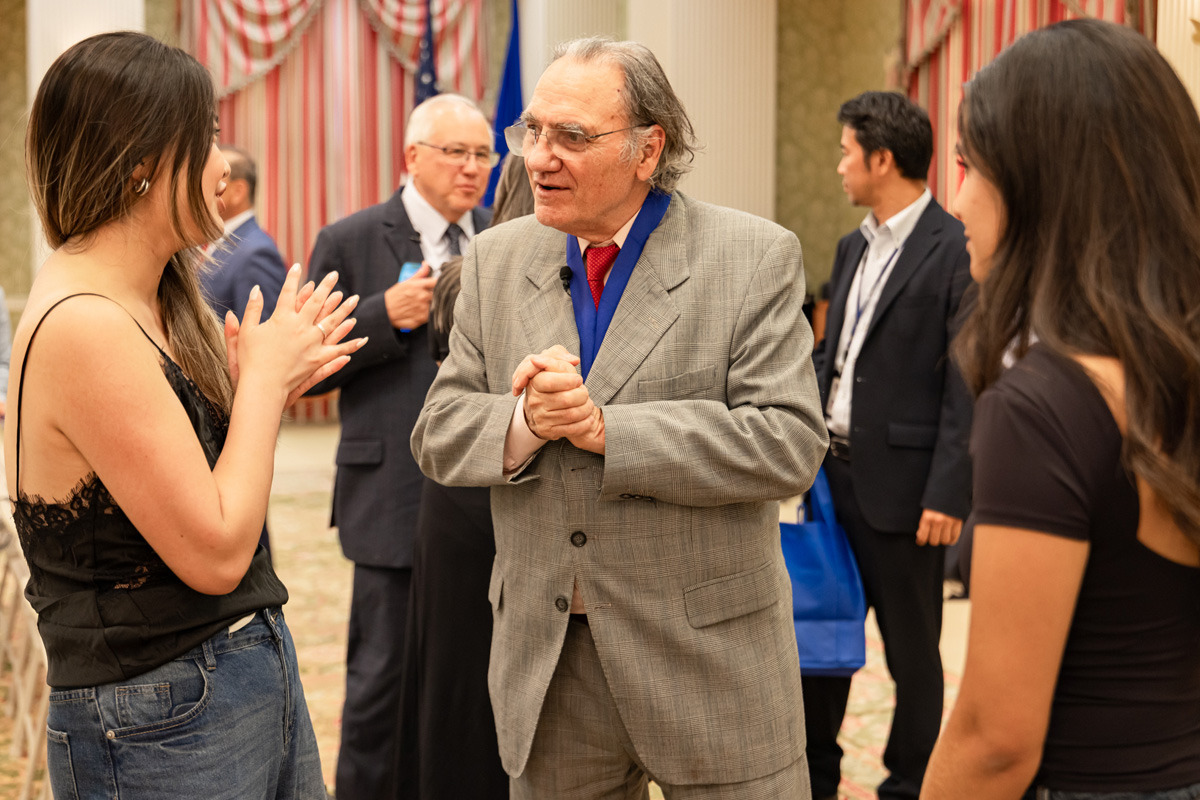
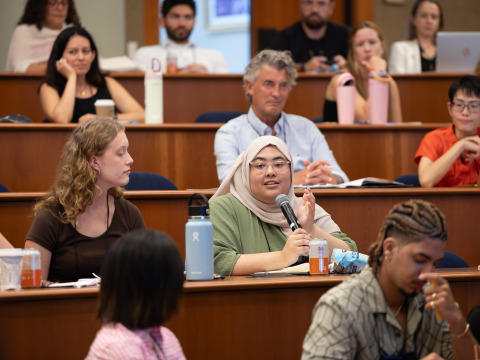
Carlos Alberto Torres talks with students after the award ceremony.
September 17, 2026
7 Min Read
Promoting Peace as a ‘Precondition for a Better World’: An Interview with 2026 Soka Global Citizen Award Recipient Carlos Alberto Torres
“If you believe in global citizenship education,” said eminent education scholar Carlos Alberto Torres during his lecture after receiving the 2026 Soka Global Citizen Award, “find a social movement and commit an area of your life to defending this planet through civic engagement.”
Established in 2021, the Soka Global Citizen Award recognizes an individual for efforts addressing critical world issues. Torres, a distinguished professor at the UCLA School of Education and Information Studies, co-founded the Paulo Freire Institute in São Paulo, Brazil, with Brazilian philosopher and critical social theorist Paulo Freire and served as its founding director. He accepted the award at a ceremony in Founders Hall on Sept. 9. His scholarship has helped generations of educators and students understand how education can prepare people to live responsibly as global citizens who foster social justice, human dignity, and democratic participation.
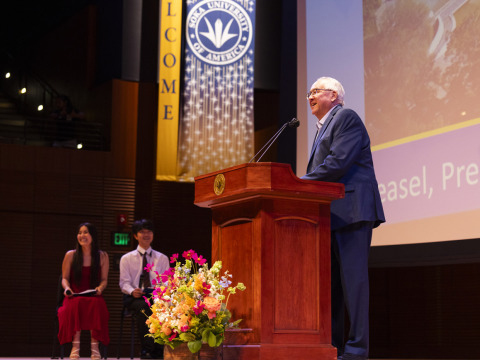
“Our university founder, Daisaku Ikeda, highlighted four areas of global citizenship education — peace, human rights, development, and the environment,” said President Edward M. Feasel in his opening remarks. “As one of the world’s leading scholars in global citizenship education, this year’s recipient has had a profound, wide-reaching impact in all four of these areas.”
The ceremony also included the signing of a memorandum of understanding between Soka University of America and the Paulo Freire Institute, laying the foundation for SUA students to participate in a study tour focused on sustainable agriculture at the institute’s small farms in Argentina.
In an interview prior to the award ceremony, Torres shared more thoughts about the challenges facing global citizenship education today and how this approach to education can effect meaningful and lasting social change.
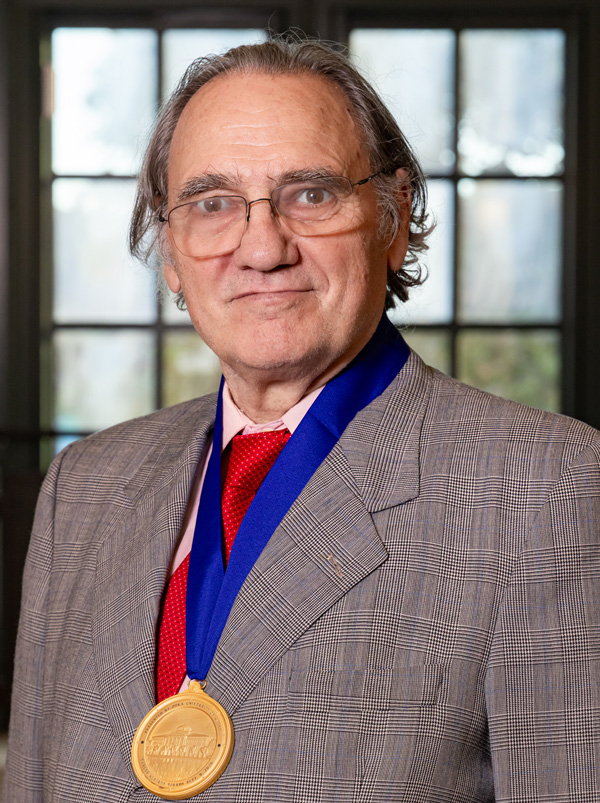
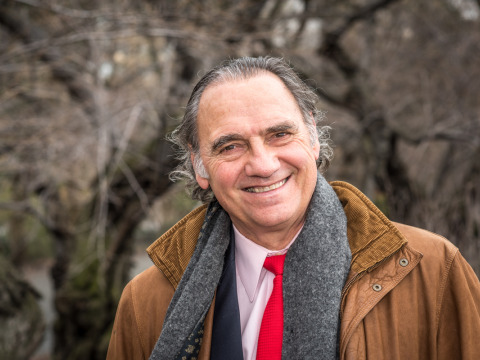
Carlos Alberto Torres, distinguished professor at the UCLA Graduate School of Education and Information Studies and recipient of the 2026 Soka Global Citizen Award
How would you describe the role of global citizenship education in fostering more democratic, just, and peaceful societies?
Solidarity, peace, human rights, empathy — all of these elements are supposed to come with the effort to implement global citizenship education. In practice, global citizenship education is a great challenge because it will be confronted by nationalism, fascism, and religious fundamentalism. It’s a challenge to implement it and make sure that you are making a contribution to national citizenship. To speak only of global citizenship without saying what it adds to national citizenship is a recipe for problems.
Now, we have to remember how the whole process started. Ban Ki-moon, the eighth secretary-general of the United Nations, organized the Global Education First Initiative (GEFI) in 2015. The two great elements of GEFI were the question of education for all and the question of the quality of education, which was controversial because it’s very difficult to define what quality education is. Ban Ki-moon added the concept of global citizenship as the linchpin connecting both of these elements. Interestingly enough, when the U.N. decided which organization would promote global citizenship, UNESCO was chosen. UNESCO then added “education,” so the term became “global citizenship education.”
We are now in a moment in which the model that we defined and began to implement in 2015 is changing because the world has changed. The world at that time was a typical liberal democratic world. Models of equality and equity were present. The global system was very successful. Countries were growing a great deal, China particularly. Global citizenship education was influenced by the hopeful scenario of that moment.
At this moment, we are in a completely different spirit. We have nationalism, right-wing populism, and fascism emerging in different societies and affecting the way laws are implemented. The model of global citizenship is also affected by the global system of economics. So there is serious ambiguity that requires attention.
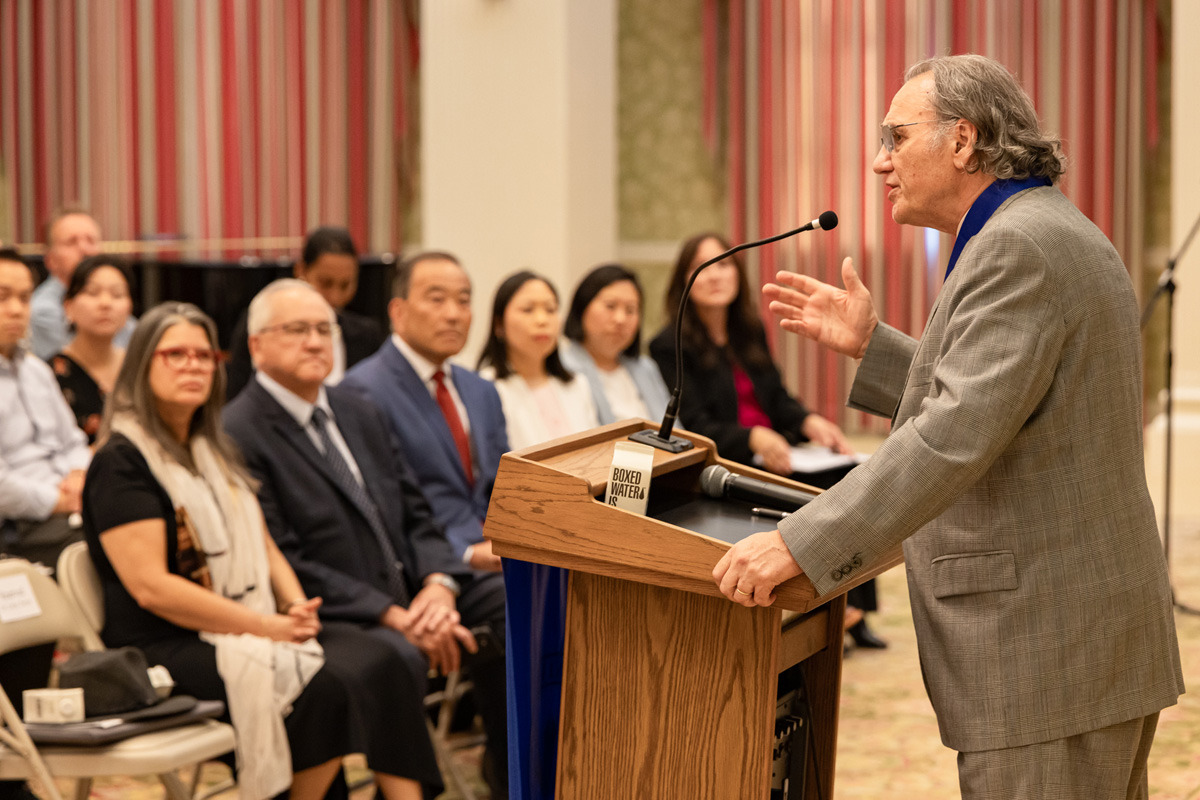
Torres delivers a talk on global citizenship education during the award ceremony in Founders Hall.
What are the biggest challenges to fostering global citizens today? And how can educational institutions like SUA help address those challenges?
The challenges are quite traditional. First, there is not enough money. Second, global citizenship education is a model that requires support from at least two institutions in each government: the ministry or secretary of education and that of foreign affairs. If these two institutions don’t put their weight behind the project, then it is up to NGOs, social movements, or the school system — which is powerful in making changes over time, but not very powerful economically.
Anything that affects participatory democracy is a problem [for global citizenship education]. The other part of the story is that [global citizenship education] initiatives are supported by individuals, governments, and the U.N. But the U.N. does not currently have the same power that it had during Ban Ki-moon’s administration.
Global citizenship education is a model that creates conflicts and tensions. People have different interpretations of global citizenship education, and these interpretations don’t always agree with each other. For example, if you are a neoliberal, global citizenship education is about the ability to have better trade. If you are somebody who is very critical of cosmopolitanism, then you will not defend the cosmopolitan part of global citizenship education, and so on. And the implementation of global citizenship education will always be controversial. My perspective is that global citizenship education should defend human rights and peace. It should create conditions for models of support to the poor via soft power.
Now, how can universities support global citizenship education? I think SUA is a good example because it’s channeling a lot of energy into supporting global citizenship education through its courses, professors, and students. Soka is making an important contribution. The way other universities could help is by creating courses that document, elevate, inform, analyze, discuss, and criticize the whole implementation of global citizenship education.
The idea that peace is a precondition for a better world — universities, the global system, and the welfare state all have a major responsibility in promoting that. And institutions like churches and temples are also responsible for promoting global citizenship education.
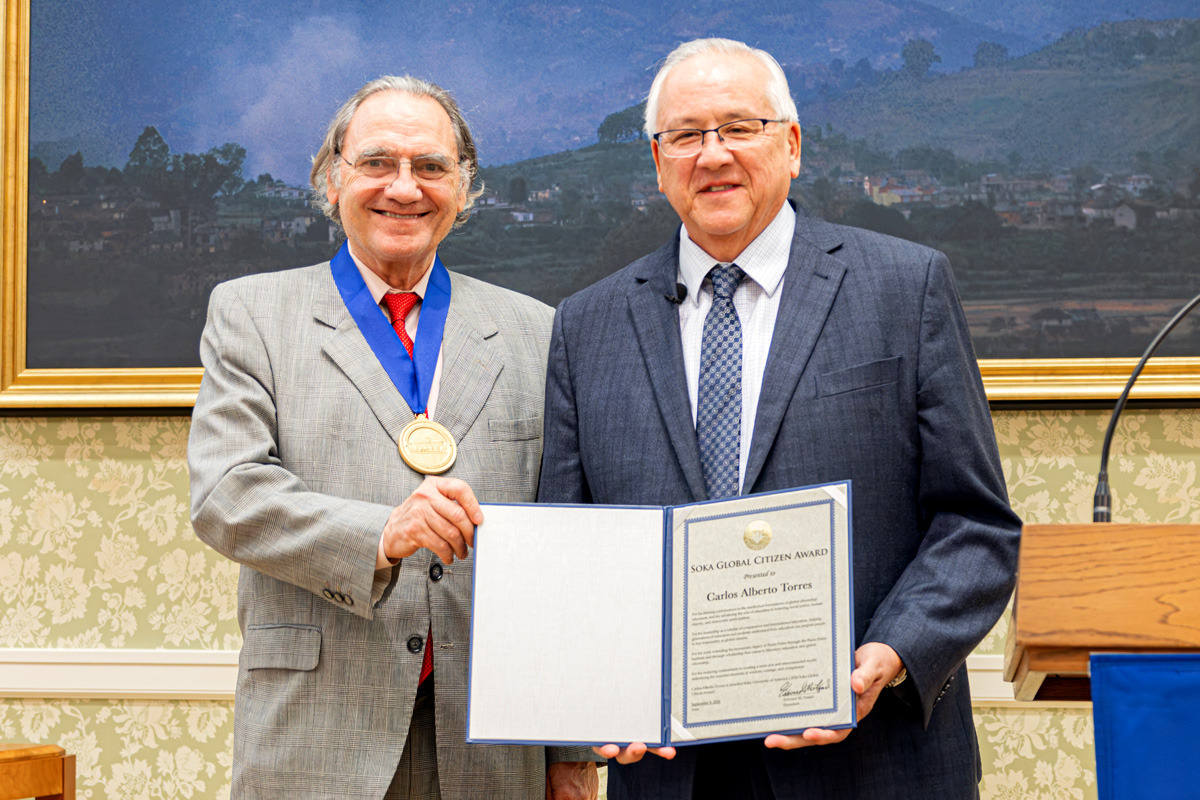
Torres (left) poses for a photo with President Feasel after receiving the Soka Global Citizen Award.
What do you think are some of the most interesting or exciting new developments in global citizenship education?
[Paulo Freire’s] pedagogy of the oppressed is not new, but it’s very exciting. It’s a pedagogy that is not looking at a particular identity. It’s looking at alienation. If you are oppressed, you are alienated. If you are an oppressor, you are alienated. So when you begin to reconsider the pedagogy of the oppressed in those terms, it’s fundamental for global citizenship.
I would argue for an assemblage of multiple pedagogies. Freire has seven different pedagogies. One is the pedagogy of the question, which is about asking a question and working on the answer in collaboration with students.
I would also argue for [sociologist] Hartmut Rosa’s new model of resonance, which represents the critical theory model of the Frankfurt School in Germany. If we can connect global citizenship education with the practice of teaching and the resonance that should exist for a school to really make a difference in people’s lives, then you have a pedagogy of resonance.
Another pedagogy to add to the assemblage is the pedagogy of peace that UNESCO has endorsed for a long time. In China, there is also a pedagogy of ecological civilization — understanding nature as the basis for constructing a new model of society.
Is there anything else you would like to add?
I am honored to receive the Soka Global Citizen Award. I never tried to create a legacy. I did what I had to do because I felt that I was the page that I wrote. I wanted to write because otherwise, I would not be me. You have to use your creativity to the full extent that it exists and see what difference it makes. We cannot change the world without creativity.
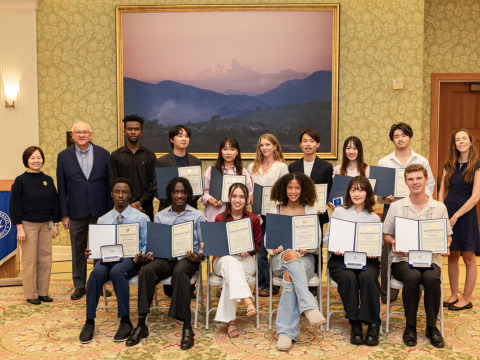
Soka University of America has named this year’s top scholars — recipients of the Ikeda Scholarship, the John D. Montgomery Scholarship, the Soka Merit Award, and the Academic Excellence awards. Presi...
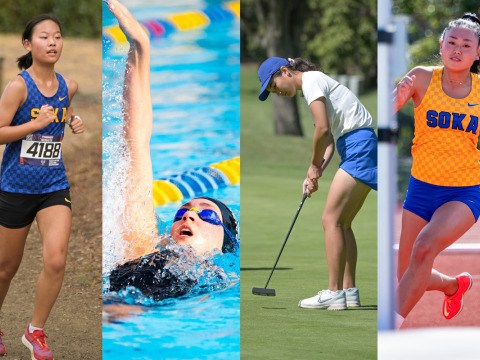
Team practices may have paused over the summer, but for SUA student-athletes, the season offered a different kind of training ground. High jumper Mili Fukada ’28 interned at U.S. Bank and taught balle...
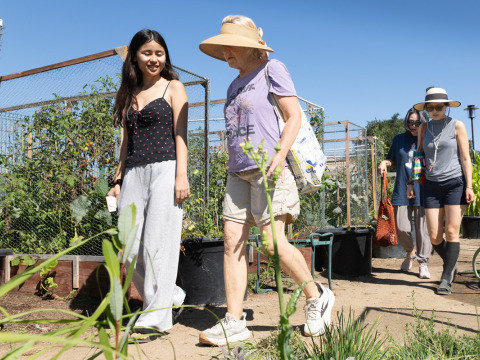
When local residents Steve and Carol Theiss signed up for a community gardening program on SUA’s campus this summer, they expected to learn about growing organic produce and pick up a few tips for eco...
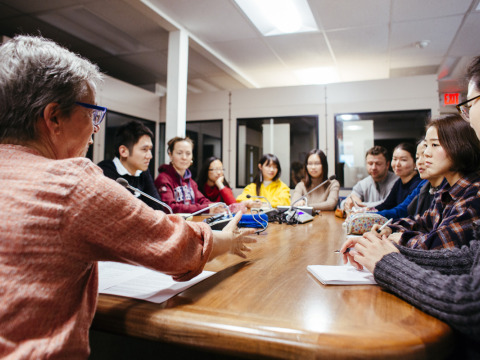
Nearly five decades apart, two institutions of higher learning were founded on a shared conviction — that education can help move the world toward peace and intercultural understanding.The Monterey In...
Dear Soka Community,I'm writing today to share a significant expansion of the Soka Opportunity Plan, made possible in part by the strength of our donor community.Beginning with the 2027–2028 academic ...
Dear Soka Community,After completing our negotiations with Middlebury College, I am pleased to announce that Soka University of America will establish a second campus in Monterey, California, continui...
Soka University of America (SUA) has named Carlos Alberto Torres the recipient of the 2026 Soka Global Citizen Award in recognition of his lifelong contributions to the intellectual foundations of glo...
“There is a beautiful lesson from nature that we can draw from,” said Mirian Vilela, executive director of Earth Charter International and recipient of the 2024 Soka Global Citizen Award, addressing 1...
"The world is not healed by cynicism,” said SUA Board of Trustees member Andrea Bartoli, addressing a packed house in Milbank Chapel at Teachers College, Columbia University, on June 13. “The world is...
In a region shaped by war, colonialism, and contested memory, what does genuine reconciliation require?The Soka Institute for Global Solutions (SIGS) continued exploring this question at the third and...
“Our story starts now,” said Marcos Vinicius Reginaldo de Souza, M.A. ’26, giving voice to the palpable excitement in the room as he addressed his fellow graduates during commencement on May 22.Friend...
On May 2, SUA welcomed students, alumni, faculty, families, and friends back to campus for Homecoming 2026, a celebration of the university's 25th anniversary in Aliso Viejo.The festivities kicked off...
Soka University of America has named this year’s top scholars — recipients of the Ikeda Scholarship, the John D. Montgomery Scholarship, the Soka Merit Award, and the Academic Excellence awards. Presi...
Team practices may have paused over the summer, but for SUA student-athletes, the season offered a different kind of training ground. High jumper Mili Fukada ’28 interned at U.S. Bank and taught balle...
When local residents Steve and Carol Theiss signed up for a community gardening program on SUA’s campus this summer, they expected to learn about growing organic produce and pick up a few tips for eco...
Nearly five decades apart, two institutions of higher learning were founded on a shared conviction — that education can help move the world toward peace and intercultural understanding.The Monterey In...
Dear Soka Community,I'm writing today to share a significant expansion of the Soka Opportunity Plan, made possible in part by the strength of our donor community.Beginning with the 2027–2028 academic ...
Dear Soka Community,After completing our negotiations with Middlebury College, I am pleased to announce that Soka University of America will establish a second campus in Monterey, California, continui...
Soka University of America (SUA) has named Carlos Alberto Torres the recipient of the 2026 Soka Global Citizen Award in recognition of his lifelong contributions to the intellectual foundations of glo...
“There is a beautiful lesson from nature that we can draw from,” said Mirian Vilela, executive director of Earth Charter International and recipient of the 2024 Soka Global Citizen Award, addressing 1...
"The world is not healed by cynicism,” said SUA Board of Trustees member Andrea Bartoli, addressing a packed house in Milbank Chapel at Teachers College, Columbia University, on June 13. “The world is...
In a region shaped by war, colonialism, and contested memory, what does genuine reconciliation require?The Soka Institute for Global Solutions (SIGS) continued exploring this question at the third and...
“Our story starts now,” said Marcos Vinicius Reginaldo de Souza, M.A. ’26, giving voice to the palpable excitement in the room as he addressed his fellow graduates during commencement on May 22.Friend...
On May 2, SUA welcomed students, alumni, faculty, families, and friends back to campus for Homecoming 2026, a celebration of the university's 25th anniversary in Aliso Viejo.The festivities kicked off...