Growing Together: Community and Sustainability Flourish in SIGS Summer Gardening Program
When local residents Steve and Carol Theiss signed up for a community gardening program on SUA’s campus this summer, they expected to learn about growing organic produce and pick up a few tips for eco-friendly living. But what they actually took away from the program went much deeper, encompassing a holistic approach to sustainability, an appreciation of Indigenous land stewardship, and new friendships with neighbors they might not otherwise have met.
Sponsored by the Soka Institute for Global Solutions (SIGS), the SIGS Summer Gardening Program was organized by Geoffrey Westropp, associate director of academic computing, and Gloria Takahashi, who was then a coordinator at SIGS. As part of SUA’s partnership with Earth Charter International, Westropp and Takahashi took an online course in 2025 on the principles of the Earth Charter and how to put this framework for global sustainability into practice. As their final project, they submitted a proposal to partner with the Environmental Studies Concentration to use the Soka Instructional Garden to educate the community about sustainability.
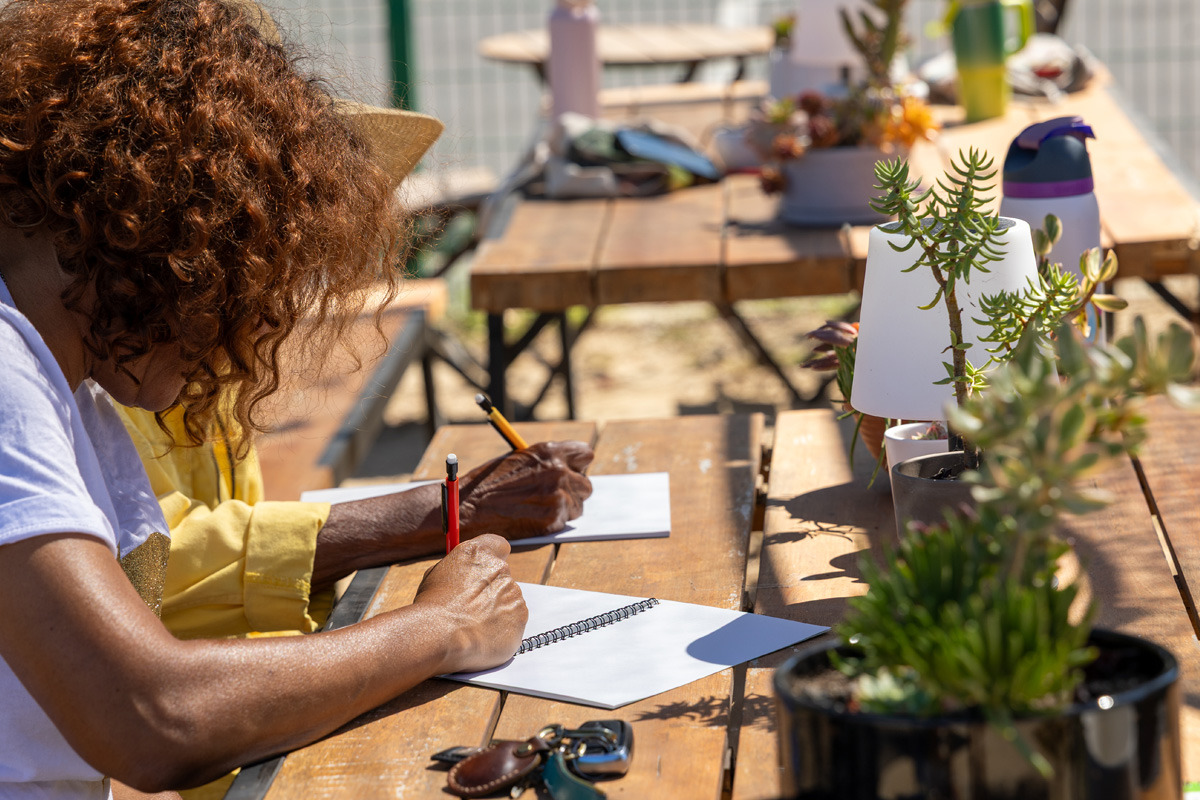
Participants take time to reflect during the last session of the SIGS Summer Gardening Program on Aug. 8.
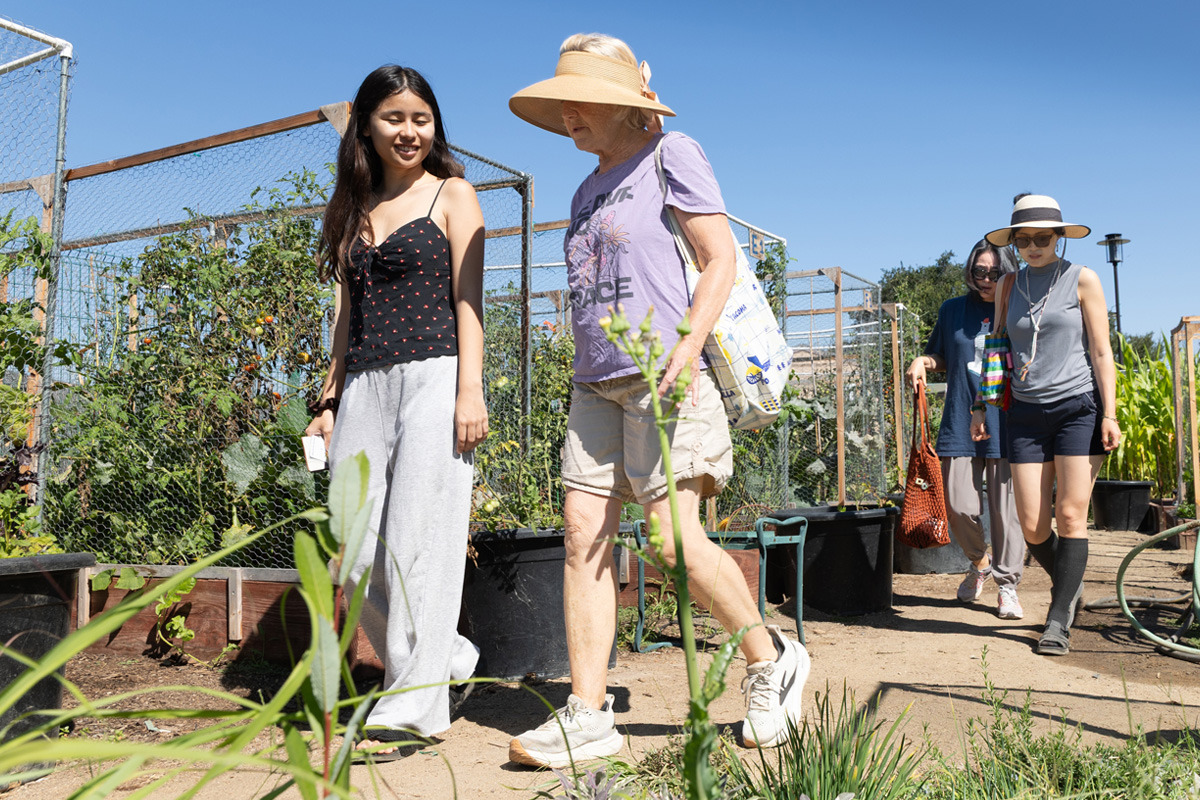
“The Earth Charter program was really the impetus for everything,” Westropp said, explaining how the course inspired him to develop a program that would make sustainable gardening accessible to anyone, regardless of the space and resources available to them. For participants, the chance to grow their own food in the Soka Instructional Garden, which is perched on a hillside with expansive views across Aliso and Wood canyons, was a powerful draw.
“We don’t have room for a community garden in our neighborhood,” said Carol Theiss, who has lived in the area with her husband, Steve, since the mid-1990s, “so the school sharing this garden with us has been so great.”
The SIGS Summer Gardening Program brought together equal numbers of local community members and SUA staff, meeting biweekly on Saturdays from May to August. Participants learned how to grow a variety of summer crops, from tomatoes and peppers to squash, beans, melons, and herbs. SIGS provided all the plants and gardening supplies, ensuring that cost would not be a barrier.
An important aspect of the program, Westropp said, was making sure participants who don’t live in single-family dwellings could still apply what they learned at home. While the program began with raised-bed gardening, over the seven sessions participants also learned how to grow food in containers and hydroponic gardens — methods that are achievable with limited or no outdoor space.
Homegrown zucchini may have been the initial hook for participants, but importantly, the summer gardening program was designed to provide a space for broader conversations about sustainability and humanity’s shared responsibility to care for the planet. The Earth Charter served as the backbone for those discussions, with the group reading and talking about different sections of the landmark document over several program sessions.
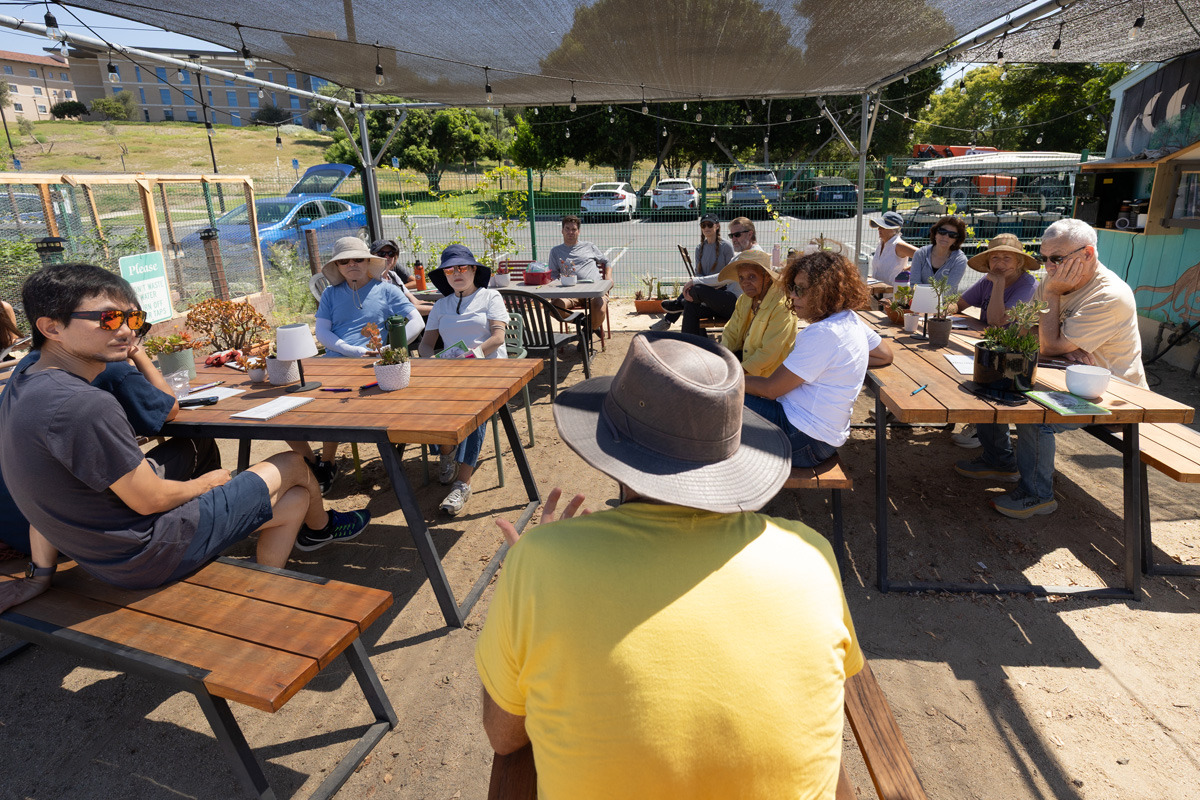
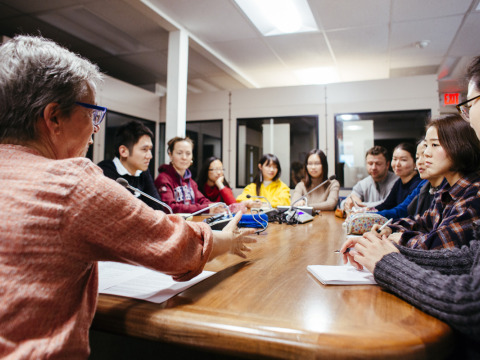
Program organizer Geoffrey Westropp facilitates a discussion with participants on Aug. 8.
The program also covered a wide range of sustainability topics beyond gardening, including renewable energy and greener modes of transportation. SUA faculty members joined as guest presenters and were a crucial part of the program’s success. Robin Fales, assistant professor of marine ecology and manager of the Soka Instructional Aquaculture Facility, shared insights on water use and conservation before the group started their hydroponic gardens in the aquaculture facility’s greenhouses. James Spady, associate professor of American history, shared knowledge on local native plants, and Dr. Jacqueline Mills, assistant teaching professor of global health, taught the group about the impact of the environment on human health and the importance of conscious consumption.
For the Theisses, the most meaningful part of the program was the session on Indigenous wisdom led by members of the Juaneño Band of Mission Indians, Acjachemen Nation, the original inhabitants of what is now Orange County. Sonia Carmen, tribal elder and former chairwoman, and Frank Barraza, tribal council member at large, visited the group to talk about traditional uses of native plants and how the Acjachemen continue to care for local ecosystems. The session raised fundamental questions about humans’ relationship to nature, underscoring humanity’s role as part of the natural world rather than separate from it.
This philosophical reframing was one of the major takeaways for participant Cheryl Meyer, administrative assistant at the SUA Writing Center.
“I appreciated being a part of the garden program,” she said, “because it was not just learning about gardening, but about the community that we live in together.”
That sense of community became one of the program’s defining features, as participants befriended each other and shared their excitement over growing food together.
“We all became friends while learning from each other,” said program organizer Takahashi, describing how new acquaintances blossomed into genuine friendships over the course of the summer. “I think that was the most beautiful part of the program. We learned from each other while learning the importance of taking care of and coexisting with our environment.”
Learn more about the SIGS Summer Gardening Program in this short video documenting participants’ experiences and reflections.
Kate Selfe ’27 of Plettenberg Bay, South Africa, signed up for the Emerging Leaders Program because it felt complementary to the work she was already doing at her campus job. At the time, she was a fi...
Soka University of America President Edward M. Feasel and Tetsushi Ogata, managing director of the Soka Institute for Global Solutions, spent two days in September at the Hazel Henderson Center in St....
What can education do for students, communities, and entire societies worldwide? Karen Moran Jackson often facilitates discussions around this question with graduate students. She directs the M.A. in ...
“Our students are striving to become global citizens who contribute to the world,” Soka University of America President Edward M. Feasel said in his remarks to donors at the 22nd annual Peace Gala on ...
SUA students spent part of the summer in New York City and the Amazon rainforest, exploring how their education can address global challenges. The Luis and Linda Nieves Family Foundation funded both t...
The Campus Green was buzzing on Sept. 23 as students, faculty, and staff gathered for SUA’s annual Welcome Back Community Event, an afternoon of food, games, and friendly competition to kick off the n...
Soka University of America has named this year’s top scholars — recipients of the Ikeda Scholarship, the John D. Montgomery Scholarship, the Soka Merit Award, and the Academic Excellence awards. Presi...
“If you believe in global citizenship education,” said eminent education scholar Carlos Alberto Torres during his lecture after receiving the 2026 Soka Global Citizen Award, “find a social movement an...
Team practices may have paused over the summer, but for SUA student-athletes, the season offered a different kind of training ground. High jumper Mili Fukada ’28 interned at U.S. Bank and taught balle...
Nearly five decades apart, two institutions of higher learning were founded on a shared conviction — that education can help move the world toward peace and intercultural understanding.The Monterey In...
Dear Soka Community,I'm writing today to share a significant expansion of the Soka Opportunity Plan, made possible in part by the strength of our donor community.Beginning with the 2027–2028 academic ...
Dear Soka Community,After completing our negotiations with Middlebury College, I am pleased to announce that Soka University of America will establish a second campus in Monterey, California, continui...
Kate Selfe ’27 of Plettenberg Bay, South Africa, signed up for the Emerging Leaders Program because it felt complementary to the work she was already doing at her campus job. At the time, she was a fi...
Soka University of America President Edward M. Feasel and Tetsushi Ogata, managing director of the Soka Institute for Global Solutions, spent two days in September at the Hazel Henderson Center in St....
What can education do for students, communities, and entire societies worldwide? Karen Moran Jackson often facilitates discussions around this question with graduate students. She directs the M.A. in ...
“Our students are striving to become global citizens who contribute to the world,” Soka University of America President Edward M. Feasel said in his remarks to donors at the 22nd annual Peace Gala on ...
SUA students spent part of the summer in New York City and the Amazon rainforest, exploring how their education can address global challenges. The Luis and Linda Nieves Family Foundation funded both t...
The Campus Green was buzzing on Sept. 23 as students, faculty, and staff gathered for SUA’s annual Welcome Back Community Event, an afternoon of food, games, and friendly competition to kick off the n...
Soka University of America has named this year’s top scholars — recipients of the Ikeda Scholarship, the John D. Montgomery Scholarship, the Soka Merit Award, and the Academic Excellence awards. Presi...
“If you believe in global citizenship education,” said eminent education scholar Carlos Alberto Torres during his lecture after receiving the 2026 Soka Global Citizen Award, “find a social movement an...
Team practices may have paused over the summer, but for SUA student-athletes, the season offered a different kind of training ground. High jumper Mili Fukada ’28 interned at U.S. Bank and taught balle...
Nearly five decades apart, two institutions of higher learning were founded on a shared conviction — that education can help move the world toward peace and intercultural understanding.The Monterey In...
Dear Soka Community,I'm writing today to share a significant expansion of the Soka Opportunity Plan, made possible in part by the strength of our donor community.Beginning with the 2027–2028 academic ...
Dear Soka Community,After completing our negotiations with Middlebury College, I am pleased to announce that Soka University of America will establish a second campus in Monterey, California, continui...