Subfields
Jump to a subfield
The Science and Mathematics Program at SUA offers exciting courses in three sub-areas: biological science, physical science, and mathematics. Each student must take one course from each sub-area but these courses may be taken in any order. Additional Science and Mathematics courses may be taken as electives.
General Education courses in the biological and physical sciences and mathematics enable students to:
Jump to a subfield
The human body is an amazing product of 3.5 billions of years of evolution. From our cells to our organ systems, our bodies are beautifully designed to thrive on planet Earth. In this course, we will explore the structure and function of various human organ systems including the circulatory system, respiratory system, digestive system, reproductive system, and portions of the endocrine system (kidneys and adrenal glands). Along the way, we will discuss challenges faced by each of these organ systems in this modern age that can result in disease such as air pollution, endocrine disrupting chemicals, overuse of antibiotics, chronic stress, and a highly-processed industrial diet. Students will perform various hands-on laboratory activities that will reinforce how their bodies function and how they can live a healthy life.
This course is an introduction to environmental issues—the interactions of humanity and industrial civilization with the natural environment of Earth. The course draws on scientific, technological, and social perspectives to examine current and future environmental challenges, including the impacts of human actions on natural ecosystems, natural resources, pollution, and climate change.
Have you ever wondered about DNA and how slight alterations to the genetic code have produced the amazing variety of life forms that inhabit our planet? This class will explore exciting topics in both genetics and evolutionary biology, some of which include: the genetics of cancer, reproduction and inheritance, epigenetics, GMOs, DNA forensics, antibiotic resistance, evolution of the “fat gene,” and how to build evolutionary trees. Students will explore these topics through lectures, case study work, and hands-on laboratory exercises.
Humanity’s ability to read and modify the genetic code of life within DNA has advanced exponentially in the preceding decades. This course introduces genetic engineering and how and why it is revolutionizing fields such as medicine, agriculture, and research. This course will utilize case studies, projects, and various laboratory activities to explore genetic engineering and the cell and molecular biology underlying it. We will explore topics such as CRISPR, genetically modified organisms (GMOs), gene therapies, and the human history and broader social impacts of genetic engineering. Not open to students who are enrolled in or who have taken and passed Integrated Biology & Chemistry (IBC) or Genetic Engineering Learning Cluster with at least a grade of C- or P.
This course explores the anatomical form and function of representatives from major animal phyla. Students will first learn about evolutionary processes that have generated the tremendous variety of form and function present in the animal kingdom.They will then learn about different lines of evidence that support the theory of common descent and examine how major lineages within the animal kingdom were created from key morphological innovations. Students will then take a tour of the major animal phyla. Students will explore these topics through lectures and hands-on laboratory activities that include live animal observations, dissections, field trips, and case studies.
This course focuses on the physical, chemical, and biological characteristics of marine habitats and the organisms occupying those habitats, and provides a survey of the patterns of distribution, diversity, and abundance of species in marine communities, with an emphasis on the dynamic interactions that shape these patterns. The course also includes analysis of human impacts on marine ecosystems.
This class is about two stories. The first story is that of a single human cell that endures multiple mutations to become cancer. What new traits are enabled? How does this cell ignore its neighbors and replicate in defiance of them? How does it steal resources and overcome the immune system? What weapons can we use to destroy it, and at what cost? The second story is that of the impact of disease. What is the human component? How have we discovered and communicated the dangers of common carcinogens? What is the war on cancer, and can we ever win it? Everyone knows someone who has been impacted by cancer. By merely surviving, our bodies are primed with the capacity to develop this disease. This course will explore the “war on cancer” in the context of human history, cell biology, and dramatic storytelling. Laboratory exercises will explore the biological basis of this disease.
This interdisciplinary course will focus on the molecular biology of cancer and the underlying chemistry of cell biology. Students will learn how proteins are encoded and the impact of genomic instability on protein structure and function; alterations of normal metabolism in cancer cells; and basic pathways of cell division and death. Complementary chemistry topics include chemical structure and bonding, biological polymerization, thermodynamics, enzyme kinetics, and redox reactions. Laboratory research will use model systems to understand cancer biology.
The human body is an amazing product of 3.5 billions of years of evolution. From our cells to our organ systems, our bodies are beautifully designed to thrive on planet Earth. In this course, we will explore the structure and function of various human organ systems including the circulatory system, respiratory system, digestive system, reproductive system, and portions of the endocrine system (kidneys and adrenal glands). Along the way, we will discuss challenges faced by each of these organ systems in this modern age that can result in disease such as air pollution, endocrine disrupting chemicals, overuse of antibiotics, chronic stress, and a highly-processed industrial diet. Students will perform various hands-on laboratory activities that will reinforce how their bodies function and how they can live a healthy life.
This course is an introduction to environmental issues—the interactions of humanity and industrial civilization with the natural environment of Earth. The course draws on scientific, technological, and social perspectives to examine current and future environmental challenges, including the impacts of human actions on natural ecosystems, natural resources, pollution, and climate change.
Have you ever wondered about DNA and how slight alterations to the genetic code have produced the amazing variety of life forms that inhabit our planet? This class will explore exciting topics in both genetics and evolutionary biology, some of which include: the genetics of cancer, reproduction and inheritance, epigenetics, GMOs, DNA forensics, antibiotic resistance, evolution of the “fat gene,” and how to build evolutionary trees. Students will explore these topics through lectures, case study work, and hands-on laboratory exercises.
Humanity’s ability to read and modify the genetic code of life within DNA has advanced exponentially in the preceding decades. This course introduces genetic engineering and how and why it is revolutionizing fields such as medicine, agriculture, and research. This course will utilize case studies, projects, and various laboratory activities to explore genetic engineering and the cell and molecular biology underlying it. We will explore topics such as CRISPR, genetically modified organisms (GMOs), gene therapies, and the human history and broader social impacts of genetic engineering. Not open to students who are enrolled in or who have taken and passed Integrated Biology & Chemistry (IBC) or Genetic Engineering Learning Cluster with at least a grade of C- or P.
This course explores the anatomical form and function of representatives from major animal phyla. Students will first learn about evolutionary processes that have generated the tremendous variety of form and function present in the animal kingdom.They will then learn about different lines of evidence that support the theory of common descent and examine how major lineages within the animal kingdom were created from key morphological innovations. Students will then take a tour of the major animal phyla. Students will explore these topics through lectures and hands-on laboratory activities that include live animal observations, dissections, field trips, and case studies.
This course focuses on the physical, chemical, and biological characteristics of marine habitats and the organisms occupying those habitats, and provides a survey of the patterns of distribution, diversity, and abundance of species in marine communities, with an emphasis on the dynamic interactions that shape these patterns. The course also includes analysis of human impacts on marine ecosystems.
This class is about two stories. The first story is that of a single human cell that endures multiple mutations to become cancer. What new traits are enabled? How does this cell ignore its neighbors and replicate in defiance of them? How does it steal resources and overcome the immune system? What weapons can we use to destroy it, and at what cost? The second story is that of the impact of disease. What is the human component? How have we discovered and communicated the dangers of common carcinogens? What is the war on cancer, and can we ever win it? Everyone knows someone who has been impacted by cancer. By merely surviving, our bodies are primed with the capacity to develop this disease. This course will explore the “war on cancer” in the context of human history, cell biology, and dramatic storytelling. Laboratory exercises will explore the biological basis of this disease.
This interdisciplinary course will focus on the molecular biology of cancer and the underlying chemistry of cell biology. Students will learn how proteins are encoded and the impact of genomic instability on protein structure and function; alterations of normal metabolism in cancer cells; and basic pathways of cell division and death. Complementary chemistry topics include chemical structure and bonding, biological polymerization, thermodynamics, enzyme kinetics, and redox reactions. Laboratory research will use model systems to understand cancer biology.
Chemistry asks what is matter made of and how does it interact? A basic understanding of chemistry is a prerequisite for good citizenship in our changing and technological society. This course introduces modern chemical concepts and processes in the context of their impact on health, the environment, and technology. Through inquiry-based learning, you will develop critical thinking skills and data-driven decision making toward the understanding of matter. This course has a moderate laboratory component and is appropriate for students not intending to continue in fields requiring foundational chemistry knowledge.
Just 20 chemical elements are essential for human nutrition. This course will explore the atomic composition and structure of these elements; examine how some of these elements combine to make larger macronutrients; and consider the role that micro- and macro-nutrients play in producing energy, assisting development, and preventing and fighting disease in the human body. Team-based learning exercises and a moderate laboratory component will emphasize critical thinking and real-world applications of chemistry to physiology, health, wellness, and nutrition. This course is appropriate for students not intending to continue in fields requiring foundational chemistry.
This course will explore how astronomers have been able to discover Earth’s place in the universe, and the structure of the local galaxy and universe. Within this exploration, astronomers have also discovered thousands of other planets, and have begun to map the deepest extents of time and space. From the discovery of distant galaxies and signatures of the origins of the universe, we also have begun to unravel the mysteries of the Big Bang, the formation of the first stars and galaxies, and how the earth arose from billions of years of cosmic evolution. The course will explore the search for exoplanets and the early universe with a mix of in-class exercises, analysis of space-based datasets, and observations with telescopes and instruments.
The physics of motion on earth and in the heavens is traced from ancient Greek times through the Dark and Middle Ages, to the Renaissance and Galileo, and to Newton and the Enlightenment. Humanistic, cultural, and historical perspectives are emphasized as is the scientific method/process. Science is shown to be inextricably linked to other human endeavors such as religion, art, politics, music, literature, philosophy, and commerce. High school knowledge of algebra, geometry, trigonometry, and scientific notation would be helpful. Concurrently, we will explore physics after Newton and up to the contemporary frontier of string/brane theory, covering topics such as relativity and quantum mechanics and utilizing modern physics labs.
Prerequisite: Previous and solid experience in physics and calculus plus instructor consent.
This heavily mathematical course with no lab requirement examines the changing conceptions of space and time from classical to modern to contemporary physics. Moving from Newtonian reality to Einstein’s relativity to quantum mechanics to current unification theories, we will explore mathematics as a tool to transcend our faulty perceptions and to reveal new phenomenal, though perhaps not narrative, truth.
This course is an introduction to general chemistry with an emphasis on developing problem-solving skills for students planning a professional career in science, engineering, and medical fields. We will explore basic concepts of chemistry along with the mathematics required for quantitative problem solving. The topics include elements and compounds, chemical calculations, atomic structure, bonding, stoichiometry, chemical equations, reactions in aqueous solutions, oxidation-reduction, energy and chemical changes, quantum mechanical atom, chemical equilibrium, and acids & bases & buffers. To improve student learning outcomes, the laboratory section of this course will follow a research project-based learning strategy. Each project will include identifying a problem, literature search to locate an appropriate synthesis method, design experimental procedure, synthesis and characterization, analysis, and reporting data.
What is color? Is color an intrinsic property of an object? Why is that your black screen turns colorful when it is on? In this course, we will investigate intriguing questions about colors through the lens of chemistry and physics. Using project-based and inquiry-based approaches, different mechanisms of having color will be introduced, discussed, and analyzed, such as absorption, reflection, and emission. The mechanisms can then be used to explain and predict a wide range of color phenomena, such as green leaves, blue skies, red paints, orange carrots, and all the colors of the screen you are looking at. At the end of the semester, students will apply the knowledge to do a science project related to colors.
Chemistry asks what is matter made of and how does it interact? A basic understanding of chemistry is a prerequisite for good citizenship in our changing and technological society. This course introduces modern chemical concepts and processes in the context of their impact on health, the environment, and technology. Through inquiry-based learning, you will develop critical thinking skills and data-driven decision making toward the understanding of matter. This course has a moderate laboratory component and is appropriate for students not intending to continue in fields requiring foundational chemistry knowledge.
Just 20 chemical elements are essential for human nutrition. This course will explore the atomic composition and structure of these elements; examine how some of these elements combine to make larger macronutrients; and consider the role that micro- and macro-nutrients play in producing energy, assisting development, and preventing and fighting disease in the human body. Team-based learning exercises and a moderate laboratory component will emphasize critical thinking and real-world applications of chemistry to physiology, health, wellness, and nutrition. This course is appropriate for students not intending to continue in fields requiring foundational chemistry.
This course will explore how astronomers have been able to discover Earth’s place in the universe, and the structure of the local galaxy and universe. Within this exploration, astronomers have also discovered thousands of other planets, and have begun to map the deepest extents of time and space. From the discovery of distant galaxies and signatures of the origins of the universe, we also have begun to unravel the mysteries of the Big Bang, the formation of the first stars and galaxies, and how the earth arose from billions of years of cosmic evolution. The course will explore the search for exoplanets and the early universe with a mix of in-class exercises, analysis of space-based datasets, and observations with telescopes and instruments.
The physics of motion on earth and in the heavens is traced from ancient Greek times through the Dark and Middle Ages, to the Renaissance and Galileo, and to Newton and the Enlightenment. Humanistic, cultural, and historical perspectives are emphasized as is the scientific method/process. Science is shown to be inextricably linked to other human endeavors such as religion, art, politics, music, literature, philosophy, and commerce. High school knowledge of algebra, geometry, trigonometry, and scientific notation would be helpful. Concurrently, we will explore physics after Newton and up to the contemporary frontier of string/brane theory, covering topics such as relativity and quantum mechanics and utilizing modern physics labs.
Prerequisite: Previous and solid experience in physics and calculus plus instructor consent.
This heavily mathematical course with no lab requirement examines the changing conceptions of space and time from classical to modern to contemporary physics. Moving from Newtonian reality to Einstein’s relativity to quantum mechanics to current unification theories, we will explore mathematics as a tool to transcend our faulty perceptions and to reveal new phenomenal, though perhaps not narrative, truth.
This course is an introduction to general chemistry with an emphasis on developing problem-solving skills for students planning a professional career in science, engineering, and medical fields. We will explore basic concepts of chemistry along with the mathematics required for quantitative problem solving. The topics include elements and compounds, chemical calculations, atomic structure, bonding, stoichiometry, chemical equations, reactions in aqueous solutions, oxidation-reduction, energy and chemical changes, quantum mechanical atom, chemical equilibrium, and acids & bases & buffers. To improve student learning outcomes, the laboratory section of this course will follow a research project-based learning strategy. Each project will include identifying a problem, literature search to locate an appropriate synthesis method, design experimental procedure, synthesis and characterization, analysis, and reporting data.
What is color? Is color an intrinsic property of an object? Why is that your black screen turns colorful when it is on? In this course, we will investigate intriguing questions about colors through the lens of chemistry and physics. Using project-based and inquiry-based approaches, different mechanisms of having color will be introduced, discussed, and analyzed, such as absorption, reflection, and emission. The mechanisms can then be used to explain and predict a wide range of color phenomena, such as green leaves, blue skies, red paints, orange carrots, and all the colors of the screen you are looking at. At the end of the semester, students will apply the knowledge to do a science project related to colors.
This course helps develop quantitative, statistical, and financial literacy, indispensable for an educated, socially engaged person in today’s society. Quantitative literacy involves developing confidence and competence with numbers and measures, and requires understanding of the number system, a repertoire of mathematical techniques, and an inclination and ability to solve quantitative or spatial problems in a range of contexts. Statistical literacy requires understanding of the ways in which data are gathered and represented. Financial literacy requires, besides an understanding of basic personal finance tools like savings and loans, some knowledge of today’s financial and economic realities and a willingness to consider their possible impact on personal finances.
Prerequisite: Strong pre-calculus background, including trigonometry, exponentials, and logarithms.
This course, suitable for students with a strong pre-calculus level background, focuses on differential calculus. Students will review properties of functions, learn the concept of mathematical limit, and study the properties and interpretations of the derivative, using some of the more common applications. Time permitting, students will be introduced to integrals and the Fundamental Theorem of Calculus. Calculus is widely used in the sciences, economics, and statistics for modeling and computations.
Prerequisite: A semester of university-level calculus, or a year of high-school-level calculus.
This course, suitable for students with a good background in differential calculus, focuses on integral calculus and infinite series. Students will review limits and derivatives, and study the properties and interpretations of the integral, using some of the more common applications. Students will also be introduced to infinite series, and their connection to differential calculus.
An introduction to probability theory with applications to statistics: basic combinatorics, permutations and combinations, sample space, events, mutual exclusivity, independence, conditional probability, Bayes’ theorem, random variables, distribution, expectation, variability, Chebyshev’s theorem, joint distribution, binomial distribution, normal distribution, Central Limit Theorem, estimation of and confidence intervals for binomial parameter, Bayesian approach to inference. Further topics may include theory of sampling, covariance, correlation, least squares, regression. Note: this is not a statistical methods course of the type that may be expected in areas such as health or social sciences, though it provides a good foundation for such courses.
This course, which requires no specific mathematical background, introduces valid deductive reasoning in a precise mathematical context. Students will learn formal languages encompassing elementary propositional and predicate logic, and techniques for assessing the validity of arguments expressible in those languages. Logic is foundational to mathematics, philosophy, and computer science, and indispensable in any reasonable debate.
This course is an introduction to the basic principles and great ideas of computer science. Computer science essentially deals with a particular class of problem-solving strategies called algorithms and the relative speed in which different algorithms reach similar solutions. Students will learn some of the essential topics of contemporary computer science through a mathematical perspective, and will use the Python programming language to implement their own algorithmic solutions to various problems.
Instructor consent required.
This course provides students opportunities to explore topics in mathematics, such as vector calculus, number theory, symbolic logic, differential equations, and linear algebra.
Instructor consent required.
This course provides students opportunities to explore advanced topics in mathematics, such as advanced calculus, complex analysis, abstract algebra, non-Euclidean geometry, and topology.
This course helps develop quantitative, statistical, and financial literacy, indispensable for an educated, socially engaged person in today’s society. Quantitative literacy involves developing confidence and competence with numbers and measures, and requires understanding of the number system, a repertoire of mathematical techniques, and an inclination and ability to solve quantitative or spatial problems in a range of contexts. Statistical literacy requires understanding of the ways in which data are gathered and represented. Financial literacy requires, besides an understanding of basic personal finance tools like savings and loans, some knowledge of today’s financial and economic realities and a willingness to consider their possible impact on personal finances.
Prerequisite: Strong pre-calculus background, including trigonometry, exponentials, and logarithms.
This course, suitable for students with a strong pre-calculus level background, focuses on differential calculus. Students will review properties of functions, learn the concept of mathematical limit, and study the properties and interpretations of the derivative, using some of the more common applications. Time permitting, students will be introduced to integrals and the Fundamental Theorem of Calculus. Calculus is widely used in the sciences, economics, and statistics for modeling and computations.
Prerequisite: A semester of university-level calculus, or a year of high-school-level calculus.
This course, suitable for students with a good background in differential calculus, focuses on integral calculus and infinite series. Students will review limits and derivatives, and study the properties and interpretations of the integral, using some of the more common applications. Students will also be introduced to infinite series, and their connection to differential calculus.
An introduction to probability theory with applications to statistics: basic combinatorics, permutations and combinations, sample space, events, mutual exclusivity, independence, conditional probability, Bayes’ theorem, random variables, distribution, expectation, variability, Chebyshev’s theorem, joint distribution, binomial distribution, normal distribution, Central Limit Theorem, estimation of and confidence intervals for binomial parameter, Bayesian approach to inference. Further topics may include theory of sampling, covariance, correlation, least squares, regression. Note: this is not a statistical methods course of the type that may be expected in areas such as health or social sciences, though it provides a good foundation for such courses.
This course, which requires no specific mathematical background, introduces valid deductive reasoning in a precise mathematical context. Students will learn formal languages encompassing elementary propositional and predicate logic, and techniques for assessing the validity of arguments expressible in those languages. Logic is foundational to mathematics, philosophy, and computer science, and indispensable in any reasonable debate.
This course is an introduction to the basic principles and great ideas of computer science. Computer science essentially deals with a particular class of problem-solving strategies called algorithms and the relative speed in which different algorithms reach similar solutions. Students will learn some of the essential topics of contemporary computer science through a mathematical perspective, and will use the Python programming language to implement their own algorithmic solutions to various problems.
Instructor consent required.
This course provides students opportunities to explore topics in mathematics, such as vector calculus, number theory, symbolic logic, differential equations, and linear algebra.
Instructor consent required.
This course provides students opportunities to explore advanced topics in mathematics, such as advanced calculus, complex analysis, abstract algebra, non-Euclidean geometry, and topology.
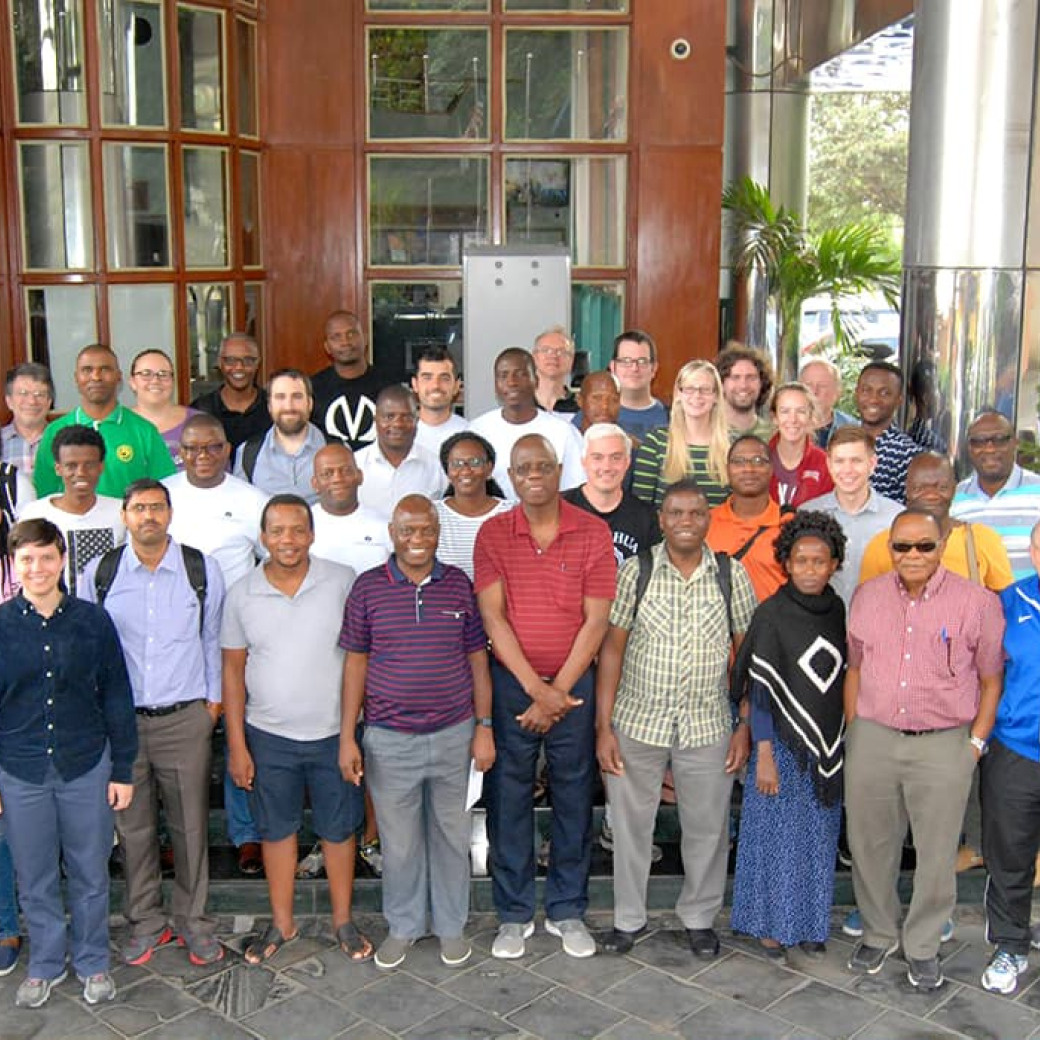
Prof. Katherine Perry on Mathematics Research and Outreach in Southern Africa
“Like Soka, the Masamu Program brings together people from different geographic and educational backgrounds. Everyone has been taught mathematics differently depending on where they’re from, which leads to new ideas when we all come together.”
Image Caption: Katherine Perry (in red jacket) and other Masamu Program participants gather in Tanzania, Nov. 2017.




The Life Sciences concentration offer a curriculum that provides a solid foundation in the sciences, including courses that embody the latest emerging discoveries in biology and chemistry, and a student-centered pedagogy that challenges you to apply what you have learned.