Is This Career Right for Me?
| This career may be a good fit if you… | You may prefer another health profession if you… |
|---|---|
|
|


Genetic counselors are healthcare professionals with specialized training in medical genetics and counseling. They help individuals and families understand how genetic conditions may affect their health by assessing family history, explaining genetic risks, discussing testing options, interpreting genetic test results, and providing emotional support to help patients make informed decisions.
Genetic counselors work in a wide range of specialties, including prenatal care, pediatrics, oncology, neurology, cardiology, reproductive medicine, and rare diseases. They practice in hospitals, academic medical centers, physician offices, fertility clinics, laboratories, public health programs, research institutions, and the biotechnology industry. The profession combines genetics, medicine, communication, ethics, and counseling to support patients facing complex medical and personal decisions.
| This career may be a good fit if you… | You may prefer another health profession if you… |
|---|---|
|
|
Genetic counselors spend much of their day meeting with patients and families, reviewing medical and family histories, assessing inherited disease risk, explaining genetic conditions and testing options, interpreting laboratory results, and helping patients understand their healthcare choices. They work closely with physicians and other healthcare professionals to coordinate care and determine appropriate testing and follow-up.

Depending on their specialty, genetic counselors may help expectant parents understand prenatal screening results, guide patients with hereditary cancer syndromes, assist families affected by rare genetic conditions, or support individuals considering predictive testing for inherited diseases.

Professional Degree
Master of Science in Genetic Counseling (MS)
Length of Professional School
Typically 2 years after completing a bachelor’s degree.
Admissions Exam
Most programs do not require a standardized admissions exam, although some may require the GRE.
Application Process
Most programs participate in the Genetic Counseling Admissions Match through the National Matching Services (NMS) after applications are submitted through individual programs or the Genetic Counseling Admissions Match Central Application (GCAS), depending on the program.
Certification
Graduates are eligible to take the American Board of Genetic Counseling (ABGC) certification examination.
Licensure
Many states require licensure for genetic counselors. Requirements vary by state.
Bachelor’s Degree
Complete prerequisite coursework, gain exposure to genetic counseling through shadowing or informational interviews, volunteer in healthcare or crisis counseling settings, develop strong communication skills, and explore opportunities in genetics, research, or patient advocacy.
Professional & Counseling Experience (Optional, but Common)
Many successful applicants spend one or more years strengthening their applications before graduate school. Common experiences include working as a genetic counseling assistant, research coordinator, crisis counselor, patient advocate, medical assistant, or in other healthcare, research, or human services roles. These experiences help applicants develop counseling skills, deepen their understanding of the profession, and demonstrate readiness for graduate training.
Apply to Professional School
Complete prerequisite courses, obtain letters of recommendation, and apply through participating application services and the Genetic Counseling Admissions Match, as required.
Professional School (Approximately 2 years)
Complete coursework in medical genetics, genomics, embryology, counseling techniques, ethics, research methods, and psychosocial care while participating in supervised clinical rotations across multiple specialties.
Certification
Pass the American Board of Genetic Counseling (ABGC) certification examination and obtain state licensure where required.
Practice
Begin practicing in hospitals, academic medical centers, specialty clinics, laboratories, public health agencies, industry, or research settings.
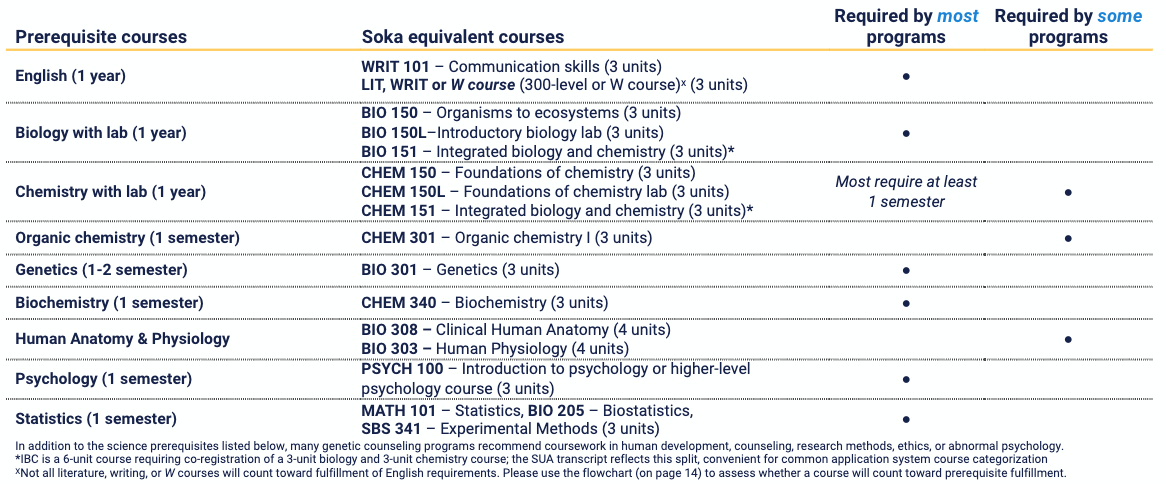
| Prerequisite courses | Soka equivalent courses | Required by most programs | Required by some programs |
| English (1 year) | WRIT 101 – Communication skills (3 units) LIT, WRIT or W course (300-level or W course)x (3 units) | ● | |
| Biology with lab (1 year) | BIO 150 – Organisms to ecosystems (3 units) BIO 150L–Introductory biology lab (3 units) BIO 151 – Integrated biology and chemistry (3 units)* | ● | |
| Chemistry with lab (1 year) | CHEM 150 – Foundations of chemistry (3 units) CHEM 150L – Foundations of chemistry lab (3 units) CHEM 151 – Integrated biology and chemistry (3 units)* | Most require at least 1 semester | ● |
| Organic chemistry with lab (1 year) | CHEM 301 – Organic chemistry I (4 units) | | ● |
| Genetics (1-2 semester) | BIO 301 – Genetics (3 units) | ● | |
| Biochemistry (1 semester) | CHEM 340 – Biochemistry (3 units) | ● | |
| Human Anatomy & Physiology | BIO 308 – Clinical Human Anatomy (4 units) BIO 303 – Human Physiology (4 units) | ● | |
| Psychology (1 semester) | PSYCH 100 – Introduction to psychology or other advanced psychology courses (3 units) | ● | |
| Statistics (1 semester) | MATH 101 – Statistics, BIO 205 – Biostatistics, SBS 341 – Experimental Methods (3 units) | ● |
In addition to the science prerequisites listed below, many genetic counseling programs recommend coursework in human development, counseling, research methods, ethics, or abnormal psychology.
* IBC is a 6-unit course requiring co-registration of a 3-unit biology and 3-unit chemistry course; the SUA transcript reflects this split, convenient for common application system course categorization
x Not all literature, writing, or W courses will count toward fulfillment of English requirements. Please use the flowchart (on HPA handbook page 14) to assess whether a course will count toward prerequisite fulfillment.
Competitive applicants typically demonstrate:
Unlike many clinical health professions, extensive direct patient care experience is generally not required before admission. Programs place considerable emphasis on applicants’ communication skills, counseling experiences, and understanding of the profession.
Demand for genetic counselors continues to grow as genetic testing becomes increasingly integrated into healthcare. Advances in genomic medicine, expanded cancer screening, prenatal testing, personalized medicine, and rare disease diagnosis have created new opportunities across clinical practice, research, biotechnology, and public health.
Most genetic counselors work in hospitals and academic medical centers, although employment opportunities continue to expand in commercial laboratories, pharmaceutical and biotechnology companies, telehealth services, and health policy.
Genetic counselors may specialize in:
Students interested in genetic counseling may also wish to explore: