Planning to Apply to Medical School?​

This page provides an overview of the medical profession and the pathway to becoming a physician. For detailed guidance on prerequisite coursework, course planning, the MCAT, application timelines, committee letters, school selection, interviews, and admissions strategies, please refer to the Soka Health Professions Advising Handbook.​

Declare Your Pre-Health Interest to receive personalized advising, the HPA Weekly Brief, information about research, clinical, and leadership opportunities, and more

Download the HPA Handbook​ Declare Your Pre-Health Interest

A medical team collaborating and reviewing documents together

Overview

Physicians diagnose, treat, and help prevent disease and injury while promoting health across the lifespan. They combine scientific knowledge, clinical reasoning, technical skills, and compassionate patient care to improve the lives of individuals and communities. Physicians evaluate patients, order and interpret diagnostic tests, prescribe medications, perform medical procedures, coordinate care, educate patients and families, and lead healthcare teams.​

Physicians work in hospitals, clinics, community health centers, academic medical centers, research institutions, government agencies, military settings, and humanitarian organizations. While all physicians complete broad medical training, they later specialize in fields such as family medicine, surgery, pediatrics, psychiatry, emergency medicine, obstetrics and gynecology, radiology, cardiology, oncology, and many others. The profession offers extraordinary opportunities to combine clinical care with research, teaching, leadership, policy, advocacy, entrepreneurship, and global health.​

Is This Career Right for Me?​

This career may be a good fit if you…​You may prefer another health profession if you…​
  • Enjoy science, medicine, and lifelong learning.​
  • Want to diagnose and manage complex medical conditions.​
  • Are motivated by serving patients during some of the most important moments of their lives.​
  • Thrive in intellectually challenging and fast-paced environments.​
  • Enjoy leadership, teamwork, and solving difficult problems.​
  • Are willing to commit to many years of education and training.​
  • Prefer a shorter pathway to independent practice.​
  • Want more predictable work hours throughout your career.​
  • Prefer a narrowly focused technical role over broad medical decision-making.​
  • Enjoy rehabilitation or prevention more than diagnosis and treatment.​
  • Are not interested in the long educational commitment required for physician training.​

Header

Professional Degree​
Doctor of Medicine (MD) or Doctor of Osteopathic Medicine (DO)​

Length of Medical School​
Typically 4 years after completing a bachelor's degree.​

Admissions Exam​
Medical College Admission Test (MCAT)​

Application Process​
Most MD programs participate in the American Medical College Application Service (AMCAS). Most DO programs participate in the American Association of Colleges of Osteopathic Medicine Application Service (AACOMAS). Texas public medical schools participate in the Texas Medical and Dental Schools Application Service (TMDSAS).​

Residency Training​
All physicians complete residency training after medical school. Residency length varies by specialty and typically ranges from 3 to 7 years. Some physicians complete additional fellowship training.​

Licensure​
Graduates complete the appropriate licensing examinations and obtain state medical licensure following residency training requirements.​

Bachelor's Degree (4 years)​
Complete prerequisite coursework while developing a strong academic foundation. Gain clinical exposure through volunteering, shadowing physicians, research, leadership, community service, and other meaningful extracurricular experiences.​

Clinical & Professional Experience (Often 1-2+ Gap Years)​
Many successful applicants spend one or more years strengthening their applications before medical school. Common activities include clinical employment, research, service programs, graduate education, public health, or other professional experiences that deepen clinical exposure, demonstrate commitment to service, and strengthen readiness for medical training.​

Apply to Medical School​
Complete prerequisite courses, prepare for the MCAT, obtain letters of recommendation, and submit applications through AMCAS, AACOMAS, or TMDSAS.​

Medical School (4 years)​
Complete two years of foundational biomedical science followed by two years of supervised clinical clerkships across multiple medical specialties.​

Residency (3-7 years)​
Complete specialty training while caring for patients under supervision and progressively assuming greater clinical responsibility.​

Optional Fellowship (1-3+ years)​
Some physicians pursue additional subspecialty training following residency.​

Independent Practice​
Begin practicing as an attending physician in hospitals, clinics, academic medical centers, community health centers, government agencies, industry, research, or other healthcare settings.​

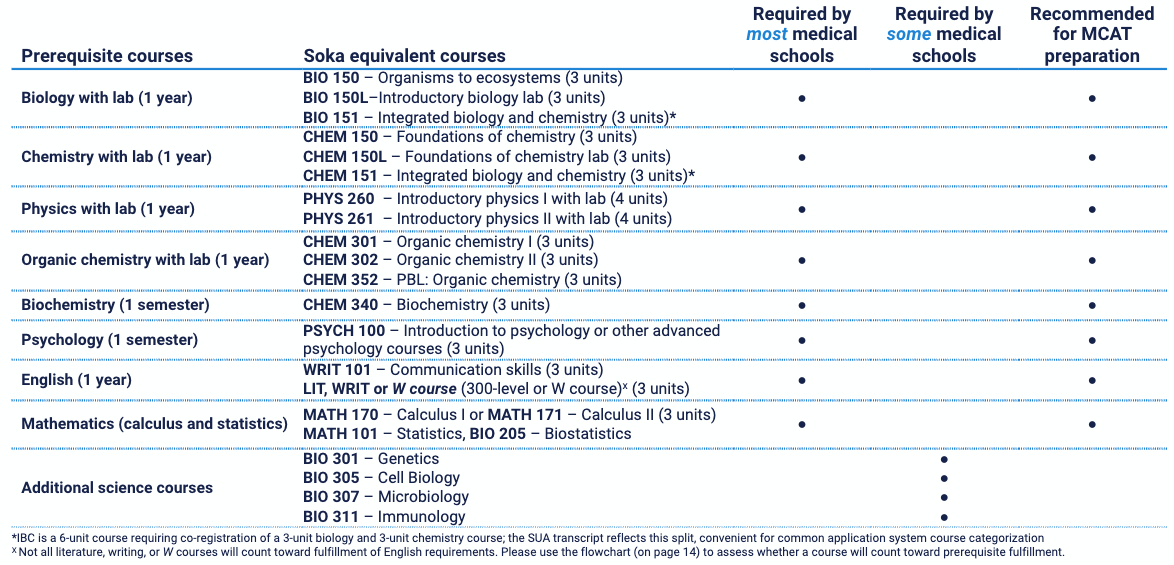
Prerequisite courses​Soka equivalent courses​Required by most programs​Required by some programs​

Recommended for MCAT preparation​

Biology with lab (1 year)​BIO 150 – Organisms to ecosystems (3 units)​
BIO 150L–Introductory biology lab (3 units)​
BIO 151 – Integrated biology and chemistry (3 units)*​
 
Chemistry with lab (1 year)​CHEM 150 – Foundations of chemistry (3 units)​
CHEM 150L – Foundations of chemistry lab (3 units)​
CHEM 151 – Integrated biology and chemistry (3 units)*​
 
Physics with lab (1 year)​PHYS 260  – Introductory physics I with lab (4 units)​
PHYS 261  – Introductory physics II with lab (4 units)​
 
Organic chemistry with lab (1 year)​CHEM 301 – Organic chemistry I (4 units)​
CHEM 302 – Organic chemistry II (3 units)​
CHEM 352 – PBL: Organic chemistry (3 units)
●​ 
Biochemistry (1 semester)​CHEM 340 – Biochemistry (3 units)​ 
Psychology (1 semester)​PSYCH 100 – Introduction to psychology or other advanced psychology courses (3 units)​ 
English (1 year)​WRIT 101 – Communication skills (3 units)​
LIT, WRIT or W course (300-level or W course)x (3 units)​
 
Mathematics (calculus and statistics)​MATH 170 – Calculus I or MATH 171 – Calculus II (3 units)​
MATH 101 – Statistics, BIO 205 – Biostatistics
 
Additional science courses​BIO 301 – Genetics​
BIO 305 – Cell Biology​
BIO 307 – Microbiology​
BIO 311 – Immunology ​


* IBC is a 6-unit course requiring co-registration of a 3-unit biology and 3-unit chemistry course; the SUA transcript reflects this split, convenient for common application system course categorization ​
x Not all literature, writing, or W courses will count toward fulfillment of English requirements. Please use the flowchart (on HPA handbook page 14) to assess whether a course will count toward prerequisite fulfillment.​​

Competitive applicants typically demonstrate:​

  • Outstanding academic performance.​
  • Strong performance in prerequisite science coursework.​
  • Competitive MCAT scores.​
  • Meaningful clinical experience.​
  • Physician shadowing.​
  • Research experience.​
  • Leadership and service to others.​
  • Excellent communication and interpersonal skills.​
  • Professionalism, resilience, ethical judgment, and cultural humility.​
  • A sustained commitment to serving others.​

Medical school admissions committees evaluate applicants holistically. While academic performance is essential, schools also seek applicants who have demonstrated compassion, leadership, intellectual curiosity, teamwork, and a commitment to improving the lives of others.​

Employment Outlook

Physicians continue to be in high demand due to population growth, an aging population, increasing healthcare needs, and physician workforce shortages in many specialties and geographic regions. Career opportunities exist in virtually every community and healthcare setting.​

Medicine also offers exceptional flexibility beyond direct patient care. Physicians contribute to biomedical research, healthcare leadership, public policy, biotechnology, entrepreneurship, education, global health, humanitarian response, and health system 
innovation.​

Areas of Practice​

Physicians may specialize in more than 150 medical and surgical specialties, including:​

Family Medicine​Internal Medicine​
Pediatrics​Emergency Medicine​
Obstetrics and Gynecology​Physical Medicine & Rehabilitation​
General Surgery​Orthopedic Surgery​​
Neurology​Cardiology
Oncology​Dermatology​
Anesthesiology​Radiology​
Ophthalmology​Otolaryngology (ENT)​
Pathology​Psychiatry
Preventive Medicine​Public Health​
Many additional subspecialties

Related Careers​

Students interested in medicine may also wish to explore:​

  • Physician Assistant/Associate​
  • Nursing​
  • Public Health​
  • Podiatric Medicine​
  • Anesthesiologist Assistant​
  • Pharmacy​
  • Physical Therapy​
  • Occupational Therapy​

Professional Resources​

  • Professional Association (MD): American Medical Association (AMA)​
  • Professional Association (DO): American Osteopathic Association (AOA)​
  • Application Services: AMCAS (MD), AACOMAS (DO), TMDSAS (Texas Public Medical Schools)​
  • Admissions Exam: Medical College Admission Test (MCAT)​
  • Accreditation: Liaison Committee on Medical Education (LCME) for MD programs; Commission on Osteopathic College Accreditation (COCA) for DO programs​