Is This Career Right for Me?
| This career may be a good fit if you… | You may prefer another health profession if you… |
|---|---|
|
|


Physician assistants/associates (PAs) are licensed healthcare professionals who diagnose illness, develop treatment plans, prescribe medications, perform medical procedures, assist in surgery, and provide preventive care under the supervision or collaboration of physicians, depending on state law and practice setting. PAs are educated as medical generalists and may practice in virtually every area of medicine.
PAs work in hospitals, physician offices, urgent care centers, community health clinics, surgical services, emergency departments, and specialty practices. They care for patients across the lifespan and often serve as a patient’s primary healthcare provider within a collaborative healthcare team. The profession combines broad medical knowledge, clinical decision-making, procedural skills, and patient education while offering the flexibility to change specialties throughout one’s career.
Unlike many other health professions, physician assistant programs generally expect applicants to have substantial hands-on healthcare experience before admission. As a result, many students work for one or more years after completing their bachelor’s degree before beginning PA school.
| This career may be a good fit if you… | You may prefer another health profession if you… |
|---|---|
|
|
A physician assistant's day varies depending on their specialty. PAs evaluate patients, obtain medical histories, perform physical examinations, order and interpret diagnostic tests, diagnose illnesses, prescribe medications, perform procedures, educate patients, and develop treatment plans. Many also assist in surgery, perform bedside procedures, and coordinate care with physicians, nurses, pharmacists, therapists, and other healthcare professionals.

Because PAs are educated as medical generalists, they may work in primary care, emergency medicine, surgery, cardiology, oncology, dermatology, pediatrics, psychiatry, and dozens of other specialties. Many change specialties during their careers without completing an additional residency.

Professional Degree
Master of Physician Assistant Studies (MPAS), Master of Science in Physician Assistant Studies (MSPAS), Master of Health Science (MHS), or equivalent master’s degree.
Length of Professional School
Typically 24 to 36 months after completing a bachelor’s degree.
Admissions Exam
Many programs require the GRE, although some do not require a standardized admissions exam.
Application Process
Most programs participate in the Centralized Application Service for Physician Assistants (CASPA).
Certification
Graduates must pass the Physician Assistant National Certifying Examination (PANCE).
Licensure
All states require licensure to practice as a physician assistant/associate.
Bachelor’s Degree (4 years)
Complete prerequisite coursework while building a strong academic foundation. Gain healthcare exposure through volunteering, shadowing physician assistants and physicians, and exploring different areas of medicine.
Direct Patient Care Experience (Typically 1–3+ years)
Most successful applicants spend one or more years working in paid healthcare positions before applying to PA school. These experiences provide the hands-on patient care that most programs expect and help applicants develop clinical judgment, professionalism, and confidence.
Common roles include:
Competitive applicants often accumulate 2,000-5,000 or more hours of direct patient care experience before applying, although expectations vary by program.
Apply to Professional School
Complete prerequisite courses, obtain letters of recommendation, document patient care experience, and apply through CASPA.
Professional School (24-36 months)
Complete intensive coursework in anatomy, physiology, pharmacology, pathology, clinical medicine, and evidence-based practice while participating in extensive supervised clinical rotations across a broad range of medical specialties.
Certification
Pass the Physician Assistant National Certifying Examination (PANCE) and obtain state licensure.
Practice
Begin practicing in hospitals, physician practices, community health centers, surgical specialties, emergency departments, or other healthcare settings.
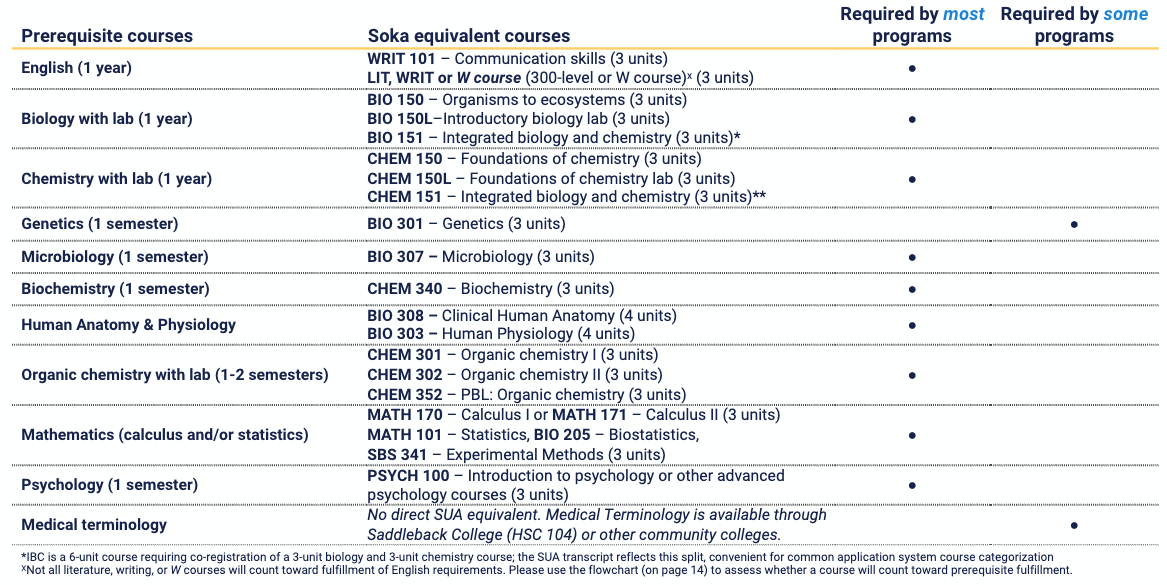
| Prerequisite courses | Soka equivalent courses | Required by most programs | Required by some programs |
| English (1 year) | WRIT 101 – Communication skills (3 units) LIT, WRIT or W course (300-level or W course)x (3 units) | ● | |
| Biology with lab (1 year) | BIO 150 – Organisms to ecosystems (3 units) BIO 150L–Introductory biology lab (3 units) BIO 151 – Integrated biology and chemistry (3 units)* | ● | |
| Chemistry with lab (1 year) | CHEM 150 – Foundations of chemistry (3 units) CHEM 150L – Foundations of chemistry lab (3 units) CHEM 151 – Integrated biology and chemistry (3 units)* | ● | |
| Genetics (1 semester) | BIO 301 – Genetics (3 units) | ● | |
| Microbiology (1 semester) | BIO 307 – Microbiology (3 units) | ● | |
| Biochemistry (1 semester) | CHEM 340 – Biochemistry (3 units) | ● | |
| Human Anatomy & Physiology | BIO 308 – Clinical Human Anatomy (4 units) BIO 303 – Human Physiology (4 units) | ● | |
| Organic chemistry with lab (1-2 semesters) | CHEM 301 – Organic chemistry I (4 units) CHEM 302 – Organic chemistry II (3 units) CHEM 352 – PBL: Organic chemistry (3 units) | ● | |
| Mathematics (calculus and/or statistics) | MATH 170 – Calculus I or MATH 171 – Calculus II (3 units) MATH 101 – Statistics, BIO 205 – Biostatistics, SBS 341 – Experimental Methods (3 units) | ● | |
| Psychology (1 semester) | PSYCH 100 – Introduction to psychology or other advanced psychology courses (3 units) | ● | |
| Medical terminology | No direct SUA equivalent. Medical Terminology is available through Saddleback College (HSC 104) or other community colleges. | ● |
* IBC is a 6-unit course requiring co-registration of a 3-unit biology and 3-unit chemistry course; the SUA transcript reflects this split, convenient for common application system course categorization
x Not all literature, writing, or W courses will count toward fulfillment of English requirements. Please use the flowchart (on HPA handbook page 14) to assess whether a course will count toward prerequisite fulfillment.
Competitive applicants typically demonstrate:
Unlike many other health professions, physician assistant programs expect applicants to have substantial hands-on patient care experience before applying. Students should begin planning for these experiences early in college and recognize that taking one or more gap years is common and often expected.
Physician assistants are among the fastest-growing healthcare professions in the United States. Demand continues to increase due to population growth, an aging population, expanded access to healthcare, and growing utilization of team-based models of care.
The profession offers considerable flexibility, allowing PAs to move between specialties throughout their careers while enjoying opportunities in clinical practice, education, administration, research, and global health.
Physician assistants may practice in nearly every medical specialty, including:
Students interested in becoming a physician assistant/associate may also wish to explore: