Is This Career Right for Me?
| This career may be a good fit if you… | You may prefer another health profession if you… |
|---|---|
|
|


Pharmacists are medication experts who help patients use medications safely and effectively to prevent and treat disease. They dispense prescription medications, evaluate drug therapies, identify potential drug interactions, counsel patients, administer immunizations, and collaborate with physicians and other healthcare professionals to optimize patient care. Increasingly, pharmacists also provide clinical services such as chronic disease management, medication therapy management, point-of-care testing, and preventive care.
Pharmacists work in a wide variety of settings, including community pharmacies, hospitals, ambulatory care clinics, long-term care facilities, specialty pharmacies, public health agencies, the pharmaceutical industry, managed care organizations, government agencies, and academic institutions. The profession combines biomedical science, pharmacology, clinical decision-making, patient education, and interprofessional collaboration to improve health outcomes.
| This career may be a good fit if you… | You may prefer another health profession if you… |
|---|---|
|
|
A pharmacist's day varies depending on the practice setting. Community pharmacists review prescriptions, counsel patients, administer immunizations, answer medication questions, and work closely with physicians to resolve medication-related issues. Hospital pharmacists verify medication orders, monitor drug therapies, participate in healthcare rounds, prepare specialized medications, and collaborate with physicians and nurses to optimize patient care.

Pharmacists in ambulatory care clinics may help patients manage chronic conditions such as diabetes, hypertension, or asthma, while those working in industry contribute to drug development, regulatory affairs, medical affairs, or clinical research.
Professional Degree
Doctor of Pharmacy (PharmD)
Length of Professional School
Typically 4 years after completing prerequisite coursework or a bachelor’s degree.
Admissions Exam
Most programs no longer require the Pharmacy College Admission Test (PCAT), although admissions requirements vary by school.
Application Process
Most programs participate in PharmCAS.
Licensure
Graduates must pass the North American Pharmacist Licensure Examination (NAPLEX) and meet state licensure requirements. Many states also require the Multistate Pharmacy Jurisprudence Examination (MPJE) or a state-specific law examination.
Optional Residency
Graduates interested in clinical practice may complete one- or two-year postgraduate residencies (PGY1 and PGY2) in specialties such as oncology, critical care, infectious diseases, ambulatory care, pediatrics, or emergency medicine.
Bachelor’s Degree
Complete prerequisite coursework, explore pharmacy through shadowing or employment, and gain healthcare, research, or volunteer experience.
Apply to Professional School
Complete prerequisite courses, obtain letters of recommendation, and apply through PharmCAS.
Professional School (4 years)
Complete coursework in pharmacology, medicinal chemistry, pharmacotherapy, physiology, patient care, ethics, and healthcare systems while participating in extensive clinical rotations in a variety of practice settings.
Licensure
Pass the NAPLEX and any required state law examinations to obtain pharmacist licensure.
Practice
Begin practicing in community pharmacies, hospitals, ambulatory care clinics, specialty pharmacies, industry, government, academia, or other healthcare settings.
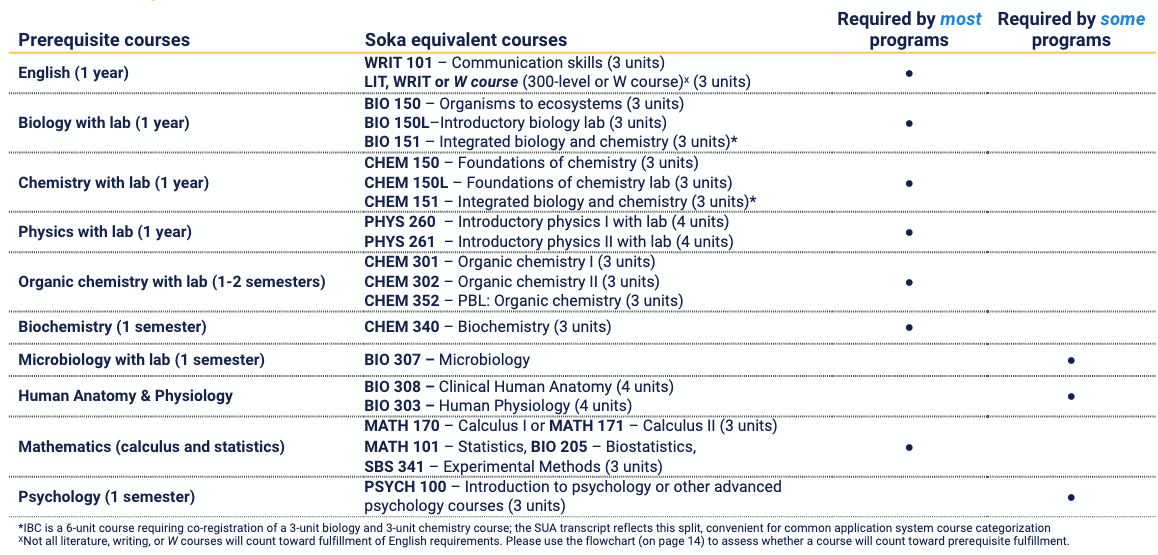
| Prerequisite courses | Soka equivalent courses | Required by most programs | Required by some programs |
| English (1 year) | WRIT 101 – Communication skills (3 units) LIT, WRIT or W course (300-level or W course)x (3 units) | ● | |
| Biology with lab (1 year) | BIO 150 – Organisms to ecosystems (3 units) BIO 150L–Introductory biology lab (3 units) BIO 151 – Integrated biology and chemistry (3 units)* | ● | |
| Chemistry with lab (1 year) | CHEM 150 – Foundations of chemistry (3 units) CHEM 150L – Foundations of chemistry lab (3 units) CHEM 151 – Integrated biology and chemistry (3 units)* | ● | |
| Physics with lab (1 year) | PHYS 260 – Introductory physics I with lab (4 units) PHYS 261 – Introductory physics II with lab (4 units) | ● | |
| Organic chemistry with lab (1-2 semesters) | CHEM 301 – Organic chemistry I (4 units) CHEM 302 – Organic chemistry II (3 units) CHEM 352 – PBL: Organic chemistry (3 units) | ● | |
| Biochemistry (1 semester) | CHEM 340 – Biochemistry (3 units) | ● | |
| Microbiology with lab (1 semester) | BIO 307 – Microbiology (3 units) | ● | |
| Human Anatomy & Physiology | BIO 308 – Clinical Human Anatomy (4 units) BIO 303 – Human Physiology (4 units) | ● | |
| Mathematics (calculus and statistics) | MATH 170 – Calculus I or MATH 171 – Calculus II (3 units) MATH 101 – Statistics, BIO 205 – Biostatistics, SBS 341 – Experimental Methods (3 units) | ● | |
| Psychology (1 semester) | PSYCH 100 – Introduction to psychology or other advanced psychology courses (3 units) | ● |
* IBC is a 6-unit course requiring co-registration of a 3-unit biology and 3-unit chemistry course; the SUA transcript reflects this split, convenient for common application system course categorization
x Not all literature, writing, or W courses will count toward fulfillment of English requirements. Please use the flowchart (on HPA handbook page 14) to assess whether a course will count toward prerequisite fulfillment.
Competitive applicants typically demonstrate:
Most pharmacy schools do not require extensive direct patient care experience before admission, although experience in a pharmacy or other healthcare setting is highly recommended.
Pharmacists enjoy diverse career opportunities across healthcare, industry, research, government, and education. While traditional community pharmacy positions remain common, the role of pharmacists continues to expand into direct patient care, chronic disease management, population health, and collaborative practice within healthcare teams.
Graduates who complete postgraduate residency training often pursue advanced clinical positions in hospitals and specialty practice, while others build careers in pharmaceutical research, regulatory affairs, medical affairs, health policy, informatics, or academia.
Pharmacists may specialize in:
Students interested in pharmacy may also wish to explore: