Is This Career Right for Me?
| This career may be a good fit if you… | You may prefer another health profession if you… |
|---|---|
|
|


Naturopathic physicians (NDs) are primary care healthcare professionals trained to prevent, diagnose, and manage acute and chronic health conditions using evidence-informed natural therapies alongside conventional medical knowledge. Their approach emphasizes identifying the underlying causes of illness, supporting the body’s capacity to heal, promoting disease prevention, and partnering with patients to improve long-term health.
Depending on state laws and scope of practice, naturopathic physicians may perform physical examinations, order and interpret laboratory tests and imaging, prescribe certain medications, perform minor procedures, and recommend treatments such as clinical nutrition, lifestyle modification, botanical medicine, physical medicine, nutritional supplementation, and counseling. Some also receive training in acupuncture and other complementary therapies.
Naturopathic physicians work in private practices, integrative medicine clinics, community health centers, multidisciplinary healthcare practices, and wellness centers. Scope of practice varies considerably by state, and students should understand how licensure laws may influence future career opportunities.
| This career may be a good fit if you… | You may prefer another health profession if you… |
|---|---|
|
|
Naturopathic physicians spend much of their day evaluating patients, performing physical examinations, reviewing laboratory results, diagnosing health conditions, and developing individualized treatment plans. Visits often include discussions about nutrition, exercise, sleep, stress management, and other lifestyle factors in addition to medical management.

Appointments are generally longer than many conventional primary care visits, allowing physicians to provide education, counseling, and preventive care. Depending on state scope of practice and clinical setting, naturopathic physicians may prescribe medications, perform minor office procedures, administer injections, or provide therapies such as botanical medicine, nutritional counseling, and physical medicine.

Professional Degree
Doctor of Naturopathic Medicine (ND) or Doctor of Naturopathy (ND)
Length of Professional School
Typically 4 years after completing a bachelor’s degree.
Admissions Exam
Most programs do not require a standardized admissions exam, although some may require or recommend the MCAT or GRE.
Application Process
Most schools accept applications directly through the institution, although some participate in centralized application services.
Licensure
Graduates must meet state licensure requirements where the profession is licensed. Scope of practice varies by state.
Board Examination
Graduates seeking licensure generally complete the Naturopathic Physicians Licensing Examinations (NPLEX).
Bachelor’s Degree
Complete prerequisite coursework, explore naturopathic medicine through shadowing and informational interviews, and gain healthcare, volunteer, or research experience.
Apply to Professional School
Complete prerequisite courses, obtain letters of recommendation, and apply to accredited naturopathic medical schools.
Professional School (4 years)
Complete coursework in biomedical sciences, clinical medicine, pharmacology, nutrition, botanical medicine, physical medicine, counseling, and public health while participating in extensive supervised clinical training.
Licensure
Pass the Naturopathic Physicians Licensing Examinations (NPLEX) and obtain state licensure where available.
Practice
Begin practicing in private practice, integrative medicine clinics, community health centers, or multidisciplinary healthcare settings.
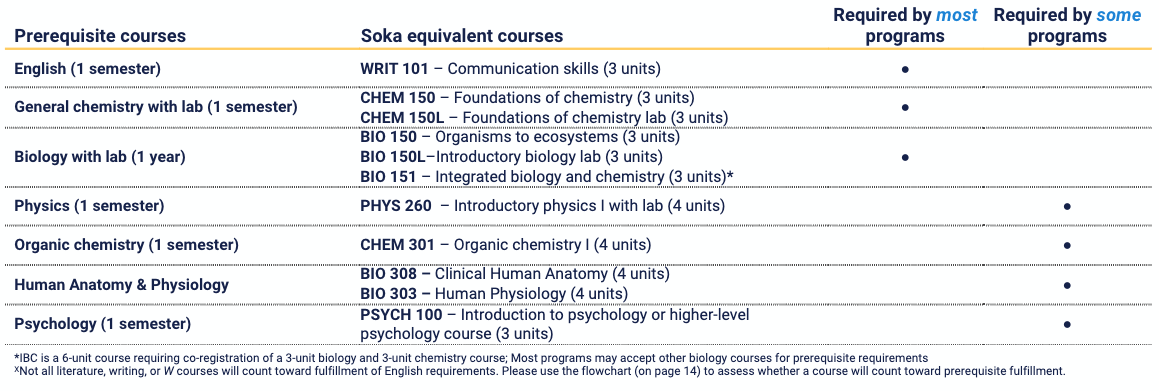
| Prerequisite courses | Soka equivalent courses | Required by most programs | Required by some programs |
| English (1 semester) | WRIT 101 – Communication skills (3 units) | ● | |
| General chemistry with lab (1 year) | CHEM 150 – Foundations of chemistry (3 units) CHEM 150L – Foundations of chemistry lab (3 units) | ● | |
| Biology with lab (1 year) | BIO 150 – Organisms to ecosystems (3 units) BIO 150L–Introductory biology lab (3 units) BIO 151 – Integrated biology and chemistry (3 units)* | ● | |
| Physics (1 semester) | PHYS 260 – Introductory physics I with lab (4 units) | ● | |
| Organic chemistry (1 semester) | CHEM 301 – Organic chemistry I (4 units) |
| ● |
| Human Anatomy & Physiology | BIO 308 – Clinical Human Anatomy (4 units) BIO 303 – Human Physiology (4 units) | ● | |
| Psychology (1 semester) | PSYCH 100 – Introduction to psychology or higher-level psychology course (3 units) | ● |
* IBC is a 6-unit course requiring co-registration of a 3-unit biology and 3-unit chemistry course; the SUA transcript reflects this split, convenient for common application system course categorization
x Not all literature, writing, or W courses will count toward fulfillment of English requirements. Please use the flowchart (on HPA handbook page 14) to assess whether a course will count toward prerequisite fulfillment.
Competitive applicants typically demonstrate:
Most naturopathic medical schools do not require extensive direct patient care experience before admission, although meaningful healthcare exposure strengthens an application.
Interest in integrative and lifestyle medicine continues to grow as patients increasingly seek preventive, patient-centered approaches to healthcare. Naturopathic physicians practice in a variety of outpatient settings, particularly in states where the profession is licensed and regulated.
Career opportunities vary considerably based on state licensure laws and scope of practice. Students considering naturopathic medicine should familiarize themselves with the regulations governing practice in the states where they hope to live and work.
Naturopathic physicians may focus their practice in:
Students interested in naturopathic medicine may also wish to explore: